A Report
by Sheree Renee Thomas
|
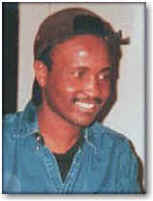
I would like to thank everyone who joined us on Saturday, March 25 at the Lafayette Avenue Presbyterian Church for the "Litany for Survival" Amadou Diallo poetry reading (covered in the New York Times, March 27). The reading was very moving, and I was greatly touched by the community's support, as well as that of friends, old and new.
The afternoon began with an introduction by Rev. David Dyson. He spoke about the church's origins as a strong haven for abolitionists. The church began initially as a "Temple for Abolition," and it was one of the Underground Railroad stops. Later, after having had abolitionists such as Frederick Douglass speak in its halls, the church became the place where the Emancipation Proclamation was signed. Rev. Dyson also discussed the congregation's current activism. In keeping with their long history of community work, they have written over 100 letters asking Janet Reno to initiate a federal investigation of the NYPD, in relation to the Diallo case and its history of police brutality in general. He encouraged members of the audience to participate.
Rev. Dyson's inspiring words, along with the church's distinguished history and its beautiful mural of the diverse Ft. Greene community all helped to set the tone for the program. Poet and educator Patricia Spears Jones (The Weather that Kills) began the scheduled reading with "Power" from Audre Lorde's The Black Unicorn Poems and two poems of her own, the "Halloween Suite." Poet, curator, and educator Tony Medina (No Noose is Good Noose, In Defense of Mumia, Catch the Fire!!!) followed with "Diallo," an original epic poem. Unlike the Albany trial, this work-in-progress humanized Diallo and gave him a voice. Taking the litany to yet another level, poet and journalist Suheir Hammad (Born Palestinian, Born Black and Drops of this Story) read the first half of her "41 Shots" poem, a work that, among other things, evoked Diallo's given name and explained the significance of the 41 shots, versus 40--a number that is considered to be holy in some cultures. The audience barely had a moment to recover from Suheir's insights before Carl Hancock Rux (Pagan Operetta and the cd Rux Revue) approached the mike with his powerful but subtle work-in-progress, "Lead in My Eye," an original poem written in response to the Diallo verdict. Poet Willie Perdomo (Where a Nickel Costs a Dime) introduced some humor by beginning his reading with a personal anecdote about an incident with the police. He then read three pieces from his collection, including "Take Out," "Revolution," and "Catch-22." He finished up with "41 Shots on Broadway," an original Diallo and Dorismond poem that he sang in a clear voice parodying George Benson's classic. Poet and educator Jacqueline Johnson (A Gathering of Mother Tongues) joined us with two untitled works-in-progress that she began writing over a decade ago, when a Bronx Honor Student was killed under similar circumstances. Poet and educator Tracie Morris (Chap-T-Her Won and Intermission) read an untitled sound poem and a somber untitled piece that represented a marked departure from her signature work. Patricia ended the scheduled readings with "I Must be a Menace to My Enemies" from June Jordan's Things That I Do in the Dark and Audre Lorde's "A Litany for Survival," the title of the program.
We had a short break for announcements, then the open mike session began. For the most part, it went smoothly, including a 72-year old grandmother/artist/poet who presented a collage she had created for the reading. Noel Morgan, aka, "The Drum Voice of Force" offered an interesting performance piece that was a dirge for Diallo. Poet David Mills read an original poem castigating the four acquitted policeman and the four black female jurors. It was a work that, in my opinion, became increasingly offensive, homophobic, and mysogynistic. Fortunately, Poet Andrew McCarthy delivered a thoughtful poem evoking Matthew Shepard and James Byrd, Jr., reminding us that all of our communities are touched by brutality. Jenga, a member of the audience, said that she was so moved by the program that she wanted to sing a song. She offered us a beautiful rendition of a song by Sweet Honey in the Rock. Her lyrical voice echoed in the halls of the church, reminding us why we had all gathered that afternoon. It was a fitting ending to the litany.
Peace,

ANANSI: Fiction of the African Diaspora
http://aalbc.com/anansi.htm
