The 10 Best Black Non-fiction of 2005
By Kam Williams
2006 turned out to be an explosive, coming-of-age year for African-American writers of non-fiction. Proof for me was that there were so many phenomenal texts to choose from when compiling this list that I found it quite a challenge to settle on the final 10. What's probably most interesting about the authors who did win is that half of them are relative unknowns, either self-published or associated with modest-sized book companies.
Displaying a variety of unique voices and covering a wide spectrum of subject-matter, the only thing that these gifted craftsmen have in common is an unbridled passion and a soul still intact. For they are able to express themselves on paper in a recognizably black, and larger-than-life fashion, doing with words what Aretha can do with her voice, and what Coltrane could do with his horn.
Since nothing I say in this limited space could possibly do justice to these welcome additions to the field of black literature, I strongly suggest that you consider reading any whose descriptions pique your curiosity.
10 Best Black Non-Fiction Books of 2006
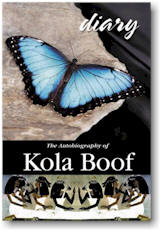 1. Diary of a
Lost Girl 1. Diary of a
Lost Girl
by Kola Boof Diary of a Lost Girl is a welcome addition to the genre of African-American memoir for it represents the unalloyed emotions of an intelligent, defiant, controversial, frequently profane and proud black woman, a survivor who somehow overcame one of the worst childhoods imaginable to share an abundance of intriguing, if debatable insights about her adopted homeland. Read Kam Williams' Full Review Editor's Note: Diary is also a #4 Non-Fiction book sold on AALBC.com in 2006 |
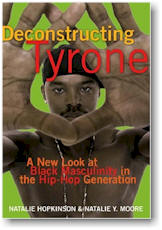 2. Deconstructing
Tyrone: A New Look at Black Masculinity in the Hip-Hop Generation 2. Deconstructing
Tyrone: A New Look at Black Masculinity in the Hip-Hop Generation
by Natalie Hopkinson & Natalie Y. Moore The fundamental question the book raises repeatedly, but in a myriad of ways, is 'How can you love your culture, hip-hop, but love yourself, too?' Can a self-respecting black woman embrace the typical black male in spite of the gender frictions without capitulating and accepting the 'video ho' label? An excellent, urgent study designed to initiate a healthy, long-overdue debate about the prospects and direction of the Hip-Hop Generation by exposing its prevailing male imagery as unacceptably misogynistic, and as more emasculated than macho. |
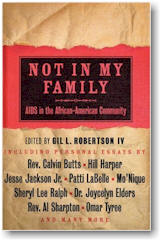 3. Not in My
Family: AIDS in the African-American Family 3. Not in My
Family: AIDS in the African-American Family
Edited by Gil L. Robertson, IV James Benton and Dr. Joycelyn Elders; AIDS activists Phill Wilson and Christopher Cathcart; ministers, like Reverend Al Sharpton and Calvin Butts; best-selling authors, such as Randall Robinson and Omar Tyree; and Congressmen Barbara Lee, Jesse Jackson, Jr. and Gregory Meeks. But just as moving as the clarion call sounded by any of these celebs, are the heartfelt stories related by ordinary folks without any pedigree. Filled to overflowing with almost sacred moments, Not in My Family is a must read, but not merely as a heart-wrenching collection of moving AIDS memoirs. For perhaps more significantly, this seminal work simultaneously serves as the means of kickstarting candid dialogue about an array of pressing, collateral topics, ranging from homophobia to incarceration to brothers on the down low to low self-esteem to the use of condoms to the role of the Church in combating this virtually-invisible genocide quietly claiming African-Americana. |
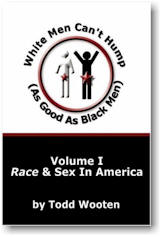 4. White Men
Can't Hump (As Good As Black Men) Race & Sex in America, Volumes I & II 4. White Men
Can't Hump (As Good As Black Men) Race & Sex in America, Volumes I & II
by Todd Wooten Taking no prisoners, the author is an equal-opportunity offender, and an admirable in his effort to close the human divide by addressing a litany of uncomfortable issues with the goal of eradicating both intolerance and underachievement. Overall, the book happens to be quite an entertaining page-turner which rests on the basic premise that the legacy of slavery has left black males both devalued and blamed for their collective lower station in life. Read Kam Williams Full Review |
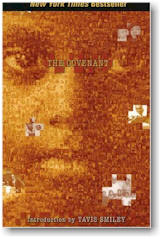 5. The Covenant
with Black America 5. The Covenant
with Black America
Edited
by Tavis Smiley The Covenant with Black America amounts to an exhaustive, encyclopedic assault on the litany of woes presently plaguing African-Americans. What makes this treatise unique is the plethora of practical guidance it provides in terms of the undoing the persisting inequalities. In advocating evolutionary as opposed to revolutionary solutions, this inclusive, optimistic opus ought to inspire anyone who reads it to get involved personally, and to lend their talents to the eradication of the seemingly intractable impediments to black progress. |
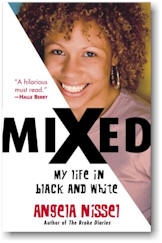 6. Mixed: My Life
in Black and White 6. Mixed: My Life
in Black and WhiteBy Angela Nissel Halle Berry's blurb on the front cover of this poignant memoir
misleadingly describes it as, 'Hilarious!' A must read, yes. Halle was
ostensibly quoted not as a literary critic because she has a black
parent and a white parent, just like the book's author. Nevertheless,
while Angela Nissel's autobiography has more than its share of humorous
moments, its prevailing tone is stone cold sober. |
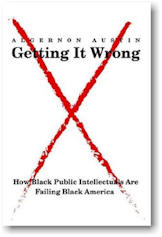 7. Getting It Wrong How Black Public Intellectuals Are Failing
Black America 7. Getting It Wrong How Black Public Intellectuals Are Failing
Black America
by Algernon Austin The author's primary contention, here, is that ivory tower blacks, who have lost touch with the community, now feel comfortable indicting less fortunate black folks they left behind for exhibiting symptoms simply long-associated with poverty. Such blaming of the victims is destructive, Austin suggests, because it relies on a stereotyping which makes it convenient for Middle America to see skin color rather than a racist, exploitative economy as the explanation for the plight of the least of their brethren. He goes on to indict the legal system as 'the most anti-black institution' in the country arguing that it defines 'criminality as an inherent characteristic, as a trait, of blackness.' Consistently separating myth from fact in this fashion, Getting It Wrong is an excellent opus in that it deliberately deconstructs the unfair and color-coded stereotypes which the both the black bourgeoisie and the white mainstream culture have come to resort to when referring to African-American ghetto-dwellers. |
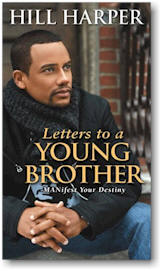 8. Letters to a Young Brother: Manifest Your Destiny 8. Letters to a Young Brother: Manifest Your Destinyby Hill Harper y, it seems that everyday another study is announced sharing some sobering statistics about the dire straits of the African-American male. Whether it has to do with employment, parenting, education, incarceration, or any other factors correlated with success in this society, all indications are that the black male is currently in crisis. For this reason, Hill Harper, star of CBS-TV's CSI: NY, was inspired to publish Letters to a Young Brother, a priceless, no-nonsense, step-by-step guide out of the ghetto, provided it reaches a pair of receptive ears with a support team prepared to help him achieve his dream. The salient message being delivered by this how-to primer is that education is power, that material possessions do not ensure happiness, and that it's important to be the architect of your own life. |
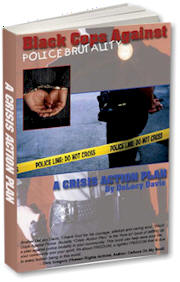 9. Black Cops Against Brutality: A Crisis Action Plan 9. Black Cops Against Brutality: A Crisis Action Plan
by DeLacy Davis He also lets you know how to handle the situation when the authorities arrive at your door, whether with or without a warrant, or if they simply begin questioning you right on the street. Of equal import is how Delacy addresses what to do when you've become the victim of a profile stop, an unlawful arrest or an unfair search and seizure. Here, he delineates each step of the subsequent civilian complaint process, from keeping a log sheet, to finding an attorney, filing charges, and contacting the press and your political representatives. Finally, because the author sees the issue as a nationwide crisis, he stresses the need to develop strategies for eradicating police brutality once and for all. Overall, this arrives readily recommended as a legally-sound, morally-upright and most practical guide by a brother who breaks the blue wall of silence to help hip the people about how to deal with the criminal justice system most effectively. |
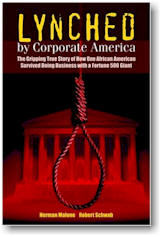 10. Lynched by Corporate America: The Gripping True Story of How
One African-American Survived Doing Business with a Fortune 500 Giant 10. Lynched by Corporate America: The Gripping True Story of How
One African-American Survived Doing Business with a Fortune 500 Giant
by Herman Malone and Robert Schwab That's how he ended up in Denver where he started a company called RMES Communications, Inc. By 1990, RMES was flourishing, generating about $10 million in annual sales as an approved vendor for US West, one of the seven Baby Bells. At this juncture, it looked like happily-ever-after for Herman and his family. But unfortunately, their version of the American Dream soon turned into a neverending nightmare when a new CEO took control of US West a couple of years later. For, according to Malone, the new chairman systematically began backing out of its established agreements with black-owned businesses. So, the suddenly-disenfranchised African-Americans filed a class action suit alleging racial discrimination against the Fortune 500 mega-corp. And it is that frustrating, drawn-out legal battle which is oh so painstakingly recounted in Lynched by Corporate America. As an attorney, I found this cautionary tale about the justice system rather riveting. Filled with copious quotes ostensibly recounted from court transcripts, Mr. Malone makes a very convincing argument that a combination of racism and a judicial kowtowing to corporate interests played a significant role in the resolution of the case. While discouraging, this should come as no surprise to anyone familiar with the age-old legal maxim well-known to lawyers, 'In the halls of justice, the only justice is in the halls.' |
| Honorable Mention |

5 Worst Black Books of 2006
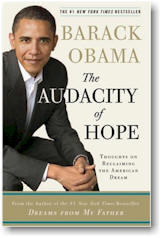 1. The Audacity
of Hope: Thoughts on Reclaiming the American Dream 1. The Audacity
of Hope: Thoughts on Reclaiming the American Dream
by Barack Obama Obama goes on to conclude that 'the single biggest thing' we could do to reduce inner-city poverty 'is to encourage teenage girls to finish high school and avoid having children out of wedlock.' If these sort of simplistic 'blaming the victim' pronouncements are truly Barack's best ideas on how to reclaim the American Dream, I suggest he keep dreaming. Read Kam Williams' Full Review Editor's Note: The Audacity of Hope has been one of the best selling books on Amazon.com since its release in October 2006 |
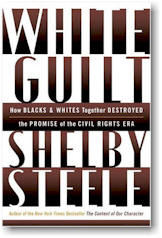 2. White Guilt: How Blacks & Whites Together Destroyed the
Promise of the Civil Rights Era 2. White Guilt: How Blacks & Whites Together Destroyed the
Promise of the Civil Rights Era
by Shelby Steele Euphoric in his having achieved the American Dream which has
proven to be so elusive for most blacks, Steele repeatedly proclaims
himself to be cured of the schizophrenia he says has a destructive hold
on most other African-American intellectuals. 'Tired of living a lie' in
order to be black, he has found bliss in a Negro Nirvana free of the
'corrupting falseness' of the pressure to identify with folks who look
like him and with prevailing black points-of-view. |
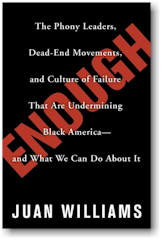 3. Enough: The Phony Leaders, Dead-End Movements, and Culture of
Failure That Are Undermining Black America and What We Can Do About It 3. Enough: The Phony Leaders, Dead-End Movements, and Culture of
Failure That Are Undermining Black America and What We Can Do About It
by Juan Williams When not indulging in character assassination, the author devotes his attention to topical issues such as the handling of Hurricane to Katrina. Enough's most mind-boggling passages are those covering the tragedy, especially since the book is dedicated to 'the people rising above Katrina's storm.' Yet, rather than question how the city, state and federal authorities could have all abandoned thousands upon thousands of poor black folk for days on end, Williams conveniently concludes that, 'The government response was the result of ineptitude, not racism.' Meanwhile, he has issues with black 'paranoia' about New Orleans and sees the black church, strong families, and a tradition of 'self-help' as a viable solution to rebuilding the devastated Lower Ninth Ward. Reads more like a series of Republican talking points than an honest assessment of the state of African-Americana. Enough is enough! |
 4. Hokum: An Anthology of African-American Humor 4. Hokum: An Anthology of African-American HumorEdited by Paul Beatty When I cracked open this collection of black jokes with a watermelon on the cover, I frankly expected to find material far funnier than a pathetic mix of goofball commentaries which devotes entire chapters to losers like Mike Tyson, a functional illiterate who probably wasn't even trying to make people laugh when he went on the diatribes recounted here. To the press, Iron Mike once said this about Lennox Lewis: 'I want to eat his children. Praise be to Allah!' The ex-champ is later showcased at his best when simply rambling like a cross between a punch-drunk boxer and a mental patient with diarrhea of the mouth: 'At times, I come across as crude or crass. That irritates you when I come across like a Neanderthal or a babbling idiot, but I like to be that person. I like to show you all that person, because that's who you come to see.' Where are the examples of the acerbic wit of Richard Pryor, Paul Mooney, Godfrey Cambridge, Dick Gregory and other brilliant African-American comedians known for their biting social satire? Not here. Maybe I missed something, but Hokum strikes this critic as a ho-hum hoax perpetrated on the public, since it's ostensibly designed more for those interested in laughing at black folks than in laughing with them. Buy this book and the only joke's on you. |
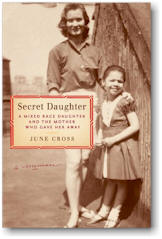 5. Secret Daughter: A Mixed-Race Daughter and the Mother Who Gave
Her Away 5. Secret Daughter: A Mixed-Race Daughter and the Mother Who Gave
Her Awayby June Cross Ten years ago, PBS aired a documentary entitled Secret Daughter, a gut- wrenching bio-pic about the life of little orphan June, abandoned by both of her parents at an early age to be raised by strangers in Atlantic City. What made Ms. Cross' story so compelling was not the fact that her father was black and her mother was white, but that her mother was such an ice princess when her long-lost daughter tracked her down with a camera crew to ask her why she had dumped her on the doorstep of people she barely knew so many years ago. June came off as oh so
masochistic trying to kiss-up to her cold-hearted mom who did little to
hide her annoyance that this sepia skeleton would come jumping out of
her closet at a time when she was happily-married and had a white
daughter. After hitting an emotional dead end retracing her roots, one
would think that Cross would drop the 'Love me, Mommy!' act and move on
with her life. June just doesn't understand that there's no excuse for the way that racist witch denied and mistreated her till the day she died. Before she tries to convince the world that her mother was misunderstood and actually really loved her, June needs to convince herself of it, and then figure a way to erase the monster we witnessed on that damning PBS broadcast from our collective memory. |
Related Links
AALBC.com's Best Selling Books for 2006
http://books.aalbc.com/2006_by_month.htm
Best Black Nonfiction
Books for 2010
http://books.aalbc.com/10_best_black_books_of_2010_non.html
Best and Worst Black Nonfiction
Books for 2009
http://books.aalbc.com/10_best_black_books_of_2009_non.html
Best and Worst Black Nonfiction Books for 2005
http://books.aalbc.com/2005_best_nonfiction.htm
