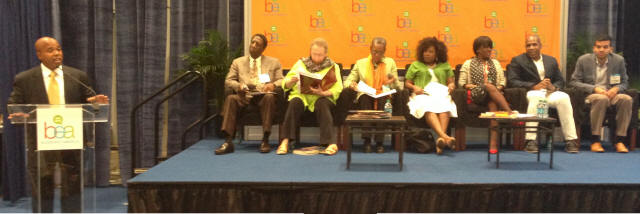
Panelists


Harlyn Pacheco
Panel Discussion Held:
Saturday, May 31, 2014, During Book Expo America
Wade Hudson …of this same discussion we are having today, the lack of books for
children that reflect our nation’s diversity. We had already self published two
titles, The Afro-Bets A B C Book and The Afro-Bets 1 2 3 Book, both written by
Cheryl, so in 1988, inspired by the sale of the two titles, we decided to
incorporate and publish other writers as well as our own works.
We started Just Us Books, we joined a campaign — movement really — to change
book publishing and make it more inclusive. It was a movement filled with
people, with folks who were passionate, determined, who were willing to step up
and they represented our country’s diversity.
We hit the ground running at Just Us Books taking books to our potential market.
We knew it wouldn’t be easy to get them into traditional sources such as
bookstore chains, so we went to festivals, national conferences, gave
presentations in churches and schools and libraries and had programs organized
by sororities, fraternities and other organizations. We utilized direct mail
campaign and courted the media.
Just Us Books is featured in a number of national magazines such as Essence,
Black Enterprise, and Income Opportunities. We set up tours for authors which
wasn’t a common practice for children’s authors at that time. In fact, Harper
Collins hired me to set up a mini tour for Walter Dean Myers which included an
interview on the Cathy Hughes Radio One Program in D. C.
Chris, Walter’s son, then a student at Brown University, came with us and later
he shared with me this was one of Walter’s first tours that he had done and
Walter was already a well-established author. What Just Us Books was doing in
the children’s book arena, others were doing in the adult market.
In 1992, Terry McMillan’s Waiting to Exhale, Toni Morrison’s Jazz and Alice
Walker’s Possessing the Secret of Joy all appeared on the New York Times
Bestsellers List at the same time for several weeks in a row. Other adult
authors were doing well, too.
At publishing conferences and gatherings Cheryl and I attended, the number of
Black and people of color steadily increased. There were many viable and
innovative Black bookstores around the country selling the growing number of
books written by Black writers and writers of color such as Hue-Man Experience
in Denver, Black Books Plus in New York City, Savannah Books in Cambridge and so
on.
And then there were a number of Black distributors like Lushena Books and A & B
Books who distributed to the more than 300 Black bookstores that were around the
country. Many of them were barber shops and hair salons where they sold books.
It was during this period that Charles Taylor of the Multicultural Publishers
Exchange and I and others convinced the NAACP Image Awards to include literature
for children among its awards categories. We pushed then to get them to add
children’s books to the category, which they did do.
When Just Us Books exhibited at ABA in 1989, Johnson Publishing Company was the
only other Black owned publisher we saw that year, but in just a few years,
Clara Villarosa, Emma Rogers, Gail Willett and Gwendolyn Johnson and other Black
booksellers had become major players at ABA, organizing many programs and
affairs that spotlighted authors of color and Black and multicultural book
publishing in general.
In 1993, Black Classic Press, Third World Press, Africa World Press, Kitchen
Table Press, Writers and Readers Press and Just Us Books, all owned by Black
people, formed the National Association of Black Book Publishers and joined
together to have a united presence at ABA. There was the Essence/Blackboard
Bestsellers List and the ever present literary agent Marie Brown who did as much
as anybody to advance the cause of Black book publishing.
Charles Harris, a pioneer in Black book publishing founded Amistad Press in
1986. Cheryl Woodruff established the One World imprint at Random House in 1991.
There was Black Expressions Book Club and the African American Literature Book
Club (AALBC) started by Troy Johnson in 1998. Max Rodriguez started the Harlem
Book Fair in 1999 and there were public publications like Black Issues Book
Reviews and the advocacy organizations like Black Women in Publishing.
Meanwhile, there was much going on in children’s book publishing, too. The
Multicultural Publishers Exchange headquartered in Madison, Wisconsin was an
association that brought together publishers, writers and artists of color.
There was Bernette Ford who brought African American authors and illustrators to
Scholastic.
Lee and Lowe Books came on board in 1993 as did Essence Books for Children. In
1998 Andrea Pinkney helped to launch the Jump at the Sun imprint in that period.
Toni Trent Parker, Black Books Galore organized children’s book fairs in cities
around the country providing community people opportunity to see African
American book creators and purchase their books.
Vanesse Lloyd-Sgambati began in Philadelphia African-American Children’s Book
Fair in 1990 and it remains one of the most successful book fairs around today.
All of us added to the pioneering work of Walter Dean Myers, Tom Feelings
Virginia Hamilton, Patty and Fred McKissack, Leo and Diane Dillon, George Ford,
Eloise Greenfield, Jerry Pinkney and others. That movement—and that’s what I
call it—was grassroots in its involvement and it did make a difference, but
unfortunately it did not continue and so we find ourselves here again, still
addressing many of the same challenges.
Dr. Martin Luther King, Jr. said, “Human progress is neither automatic nor
inevitable. Every step toward the goal of justice requires sacrifice, suffering
and struggle, the tireless exertion and passionate concern of dedicated
individuals.”
I would like to close by saying it’s time now for a new movement, one that’s
sensitive to the age in which we live but infused with the same sense of
mission, dedication and passion that characterized the previous movement. Thank
you.
Troy Johnson Thanks you, Wade. Next up we have Bernette Ford who founded
Color-Bridge Books, a packaging and consulting firm in January 2003 and has
packaged a wide range of children’s books all written and illustrated by people
of color.
Ford’s career began in 1972 and covered a wide variety of roles including her
position as VP Associate Publisher at Grosset & Dunlap of which she was the
first African American editor to hold that position at a major house. Bernette
has also written many picture books for toddlers and books for children. Let’s
have a round of applause for Bernette Ford.
Bernette Ford Thank you, Wade. That was really great history and we appreciate
it. At the time I started in the publishing business in 1972, you could count on
one hand the number of African Americans in children’s book publishing. There
was very little place for Black children’s books in that world, but
consciousness was starting to be raised.
Many of us owe a debt of gratitude to the late illustrator, Tom Feelings who was
responsible for spearheading a workshop in Harlem for people of color in
publishing. Artists and authors as well as editors and designers. Several of our
members became well-known authors and illustrators, and I formed friendships
there that continue today.
I met my husband, illustrator George Ford, at the Black Creators for Children
which was what we eventually called ourselves. George had been a past president
of the Council on Interracial Books for Children which had started a contest to
bring authors and illustrators of color to the attention of editors and art
directors in the all-white world of children’s books.
There I became friends with Cheryl Hudson and through the Black Creators for
Children’s Workshop. When, years later, the Hudsons were starting up their
company, Cheryl asked me to approach George to illustrate a poem she had written
for her young daughter, Katora . I thought the poem was short to be a picture
book so she challenged me to expand upon it and that is how we ended up
collaborating on Bright Eyes, Brown Skin.
All of the books I’ve ever written or published have come about because there
was a need. Within weeks of leaving Scholastic Books, their School Division
approached me about packaging a series of 24 African American Easy Readers
similar to the Hello Reader Series I had spearheaded at Cartwheel Books.
We did many Black books on the Hello Reader List, but the educational division
needed more. The Just for You Books were exactly the kind of books I wanted to
be working on as a packager, and while it seems to be a difficult concept for
booksellers to grasp, these books are just as much for white children as they
are for Black children.
All children need to see themselves reflected in books at home, at school, in
the library. If all children see in their books is pictures of white kids, they
will begin to feel that white kids are the only ones who are important in the
world. Period.
This goes for white children and Black children. How many times do we need to
hear about Dr. Kenneth Clark’s experiment with children choosing between Black
dolls and white dolls to learn this lesson? Children of color in this country
need validation of the importance of their existence to help them develop
feelings of self worth and to aspire to great accomplishments.
I have been operating Color-Bridge Books since 2003 after working in corporate
publishing for more than 30 years. I wake up every day feeling overjoyed that I
report to no one but myself and overwhelmed by fears that the most recent
assignment just might be the last.
I have done packaging, book production, teaching and mentoring, freelance
editing and consulting and I’ve worked on some projects I wish that I could have
turned down (I won’t tell you what those were) but the mortgage had to be paid
and there is no other work I would rather be doing.
Troy Johnson Thank you Bernette and I’d also like to take this opportunity to
make sure everyone recognizes Bernette’s husband and business partner,
illustrator George Ford who is sitting in the front.
Next we have Regina Brooks who is the Founder and CEO of Serendipity Literary
Agency and represents a diverse base of award winning authors in children’s and
young adult fiction. Her authors have received numerous accolades and honors
including Coretta Scott King Awards, a National Book Award finalist and a Lambda
Award winner.
She is the author of the children’s book Never Finished, Never Done and the
award-winning go-to book for MFA programs “Writing Great Books for Children”—
Regina Brooks.
Regina Brooks Before I started in the publishing industry, I worked as an
aerospace engineer at NASA and 2015 will mark my 15th year anniversary in
agenting and my 22nd year in publishing.
When I first started agenting I was excited by the idea that I had the
opportunity to work on books outside the engineering discipline. I first worked
at John Wiley & Sons and McGraw-Hill and I was working in the engineering
disciplines.
I was energized by the fact that I would be able to work on fiction, work with
illustrators and with children’s books. I was drawn by the idea that I’d get a
chance to exercise both the left and the right sides of my brain.
But my first meeting with an editor revealed to me that I would be called for a
greater cause. The editor said to me, “Regina, it’s so good to see you agenting.
We need you. I look forward to seeing more African American submissions.” I was
a little confused by that because when I first came into the industry, like I
said, I was interested in doing fiction. I never thought of this as a business
that was centered around color, or culture for that matter.
After 15 years of agenting and authors who have won Coretta Scott King Awards,
Michael L. Printz Award, Lambda Award, the Stone Wall Award, I know now how
great that need was and still is.
My author, the late Toni Trent Parker — I started my agency in 2000 and she
started an organization that had book fairs — and she and I would sit down and
talk for hours about what was needed in the marketplace, what books were
missing, what were some of the ideas that were not being represented.
When she first started her organization it was born out of the fact that she and
a couple of her friends in Stamford, Connecticut, were not able to find books in
the bookstore about African American women except for on Harriet Tubman. That
was the impetus for the organization.
And she started the Multicultural Book Fair and then she worked on a book, a
reference guide called Black Books Galore that featured over 500 African
American children’s books. If we think about that, 500 African American
children’s books, and you think about where we are today, it makes me wonder.
So I think about why it is that I’m still agenting and why I need to be there
and that’s why I started agenting. I started to champion those who have been
forgotten, for those who need a seat at the table, for those who have been
marginalized. I want to walk into publishing houses and translate and to
motivate and to champion, and that is why I built the largest African American
agency in the country because we need soldiers out there who understand how to
sell books to major publishers.
Troy Johnson Next is Tonya Bolden who has authored and co-authored or edited
more than two dozen books for children and young adults. They include The Champ,
the story of Mohammad Ali, Marisa: A Nineteenth-Century American Girl and her
latest, Searching for Sarah Rector: the Richest Black Girl in America. Tonya has
a great passion for African American history and aims to make it come alive for
a nation’s young people. It is wonderful the way she expresses her hope for the
future. Tonya Bolden.
Tonya Bolden Thank you guys. Good morning. I am one of the Children of the
Dream. I grew up in the 1960s, a decade of great shake up and change on so many
fronts and it was the time of— we had the best music ever I think in the 60s.
Right? Fantastic harmonies, lyrics that uplifted me, so my mind could soar and
dream. And back then I know— I don’t think, as a child, I don’t think I ever
heard the term “the Beloved Community” but I believed in it. I longed for it and
I still do.
So in this situation, my credo is “All the children need all the books.” We who
truly care about the future of this nation, we who truly want all children and
‘tweens and teens to be their best selves. Basically being your best self means
not being ignorant. We must become more engaged with what Wade was talking
about, the movement for all the children to have mirrors—and what are the
mirrors? Books in which they see themselves and all the children need windows,
what are the windows? Books through which they can learn about people who do not
look like them, people who do not speak as they do, eat as they do, or share the
same cultural norms.
A few years ago at a book signing in Connecticut, I was seated near a white
colleague who does terrific books, and at one point I just looked up and my eyes
met the eyes of a white woman. She had just had my colleague sign two of her
books. One was on Eleanor Roosevelt. And the woman hugging these books smiled
and said to me, “Oh, these are for my children. I’m going to buy your books for
my school because your books are perfect for those children.”
My books included a biography of George Washington Carver. So here was an
educator who apparently felt that her children could not benefit from a book
about a Black scientist and environmentalist and visual artist. Here was an
educator who apparently felt that those children couldn’t benefit from a book on
the life and mind of Eleanor Roosevelt. All the children need all the books!
All the children need to know everything. All the children need to know about
the Trail of Tears; all the children need to know the racial and ethnic makeup
of the men who exhausted themselves and made that name that had grown up
building the Continental Railroad. All the children need all the books.
As MLK said in his 1963 book, Strength to Love, “we are made by history, all the
history, everyone’s history.” It’s all our history and if our children don’t
know it, they don’t know who they are, they don’t have a context for their time
and their lives. This tribalism must stop. It has no place in education and it
does not make for a strong nation, especially a nation whose motto is what? E
pluribus Unum.
And so while I’m really frustrated about this situation, I have hope because I’m
a child of the ‘60s but also because—and that’s what we did in the ‘60s, we had
hope — but I have hope also because there are enlightened souls out there like
Dr. Jane Gangi, a white Professor of Education and Literacy at Mount Saint Mary,
Newburgh. She has recently worked on an Alternative Appendix B, a list of books
recommended for classroom use and Common Core Standards. She did this in her
battle against what she called “the unbearable whiteness of literacy
instruction.”
And there’s Dr. Rudine Sims Bishop, Professor Emerita of Education, Ohio State
University, a Black woman who for years has been writing about, speaking about
the need for diversity in books for children and young adults. In the 1990
article, “Mirrors, Windows and Sliding Glass Doors,” Dr. Bishop acknowledged
that a book won’t shelter the homeless, a book won’t feed the hungry, a book
won’t stamp out drug abuse, but it could, she said, “help us to understand each
other better by helping to change our attitudes towards difference. When there
are enough books available that can act as mirrors and windows for all our
children, they will see that we can celebrate both our differences and our
similarities because together they are what makes us all human.”
When Dr. Bishop’s dream is a reality, then our children, all our children, will
be better citizens and then they can advance to being citizens of the world.
Thank you.
Troy Johnson Listening to these powerful statements, I want to make sure that
you do remember to write down the questions that you might have. You can pass
them up to me or pass them forward and I’ll grab them. We have about three more
speakers so I want to make sure I have questions in the hand once the third of
the last speakers finishes.
Next we have Vanesse Lloyd-Sgambati. She— actually before I read into her bio,
she is a woman, the lady who has made all this possible and I’d like to give her
a round of applause. She gather together this group of professionals and really
historical icons in many ways. And if it wasn’t for her efforts, I’d be hard
pressed to think what else would be going on.
But at any rate, Vanesse the CEO of The Literary Media and Publishing
Consultants. The Literary is a PR firm that specializes in publishing. They are
consultants of authors, publishers and corporate entities interested in
literacy.
She’s also the Founder of the African American Children’s Book Project which
produces the largest and oldest single-day event of its kind, the 22- year-old
African American Children’s Book Fair.
In addition, Vanesse is the cultural correspondent for WUR-AM Radio in
Philadelphia and a frequent contributor to the syndicated “Beth Smith Show” that
broadcasts in 30 major markets across the country. A round of applause for
Vanesse Lloyd-Sgambati.
Vanesse Lloyd-Sgambati Thank you so much. If you saw the official program, I
was supposed to be the moderator, but Regina informed me, “You can’t be a
panelist/moderator,” so I’m taking my seat because I have a lot to share.
On paper when I read all the things I do in publishing, it’s like, “Really? She
does all of that?” And really, I do all of that. I got into the publishing
industry in the front door-back door as I call it. I was a producer and
publicists used to call me to pitch story ideas and I was that producer who
would say, “I’ll call you back” or “I’ll get back to you.”
So there are a number of people who are now directors, presidents, of various
publishing houses that say "I remember you". Well the show got canceled. It was
a nationally syndicated program. It was called— it was part of EB Magazine, it
was part of that whole franchise.
And so publishers were still calling me saying, “Hey, I need to place some
author in the Philadelphia market,” and I said, “Well, if you hire me I’ll help
you,” and that began my career.
I didn’t really know what I was doing and I called Literary Agent Marie Brown up
and Marie always tells this story because I love high heeled shoes and it was
snowing and I was going to New York and I’m from Philadelphia and I want to make
an impression. So in the snow I had on my high heeled shoes and I walked into
her office and she looked at me—she’s a Philly girl like me—and she said, “Are
you really serious?”
And needless to say, agent Victoria Sanders had called her the previous week and
said she needed a publicist for Connie Briscoe and this was the beginning of
that whole literary renaissance when people were getting mega deals. It was not
unusual for somebody to get $300,000 for a two- or three-book deal.
Victoria Sanders said, “I need you to help promote Connie Briscoe.” Connie
Briscoe was hearing impaired and Connie had an interpreter — I believe that’s
what she’s called — and I said “No problem.” I had not any clue. The only thing
that I had to my advantage was that most of my friends were journalists so I
started calling people and saying, “I need to put this author on your program.”
I didn’t give them all the particulars but I said, “This is hot!”
Back then, if you were an African American fiction author is was a novelty, so
everyone wanted to talk to you because there was this aura about writing these
sister-friendly books. Needless to say that book went on to get on the New York
Times Bestsellers list. I’ve worked with so many wonderful authors during that
era.
That was also at the time when I founded the African American Children’s Book
Project. There was a department store in Philadelphia and they were looking for
an activity during Black History Month because they wanted to get that post
Christmas holiday traffic. Again, I didn’t know what I was doing and again I
called Marie Brown up.
I said, “Marie, do you know any children’s authors?” and she said yes. It was
snowing. This is a story between me, Marie Brown, and the snow and needless to
say, 250 people showed up at that first event. It was so amazing because people
said “Why don’t you do this on a regular basis because we really need it. We
can’t find children’s books in the stores.” So I was on to something and that
was we celebrated our 22nd Anniversary this past February.
My experience in publishing is really unique because everything I’ve been
involved with has been filled with success. We sell more books in two hours than
any other African American retailer in the country. We do about $25,000 worth of
books and if anyone comes to that book fair at 10am in the morning, no matter
how cold it is because I don’t open up the doors till 1pm, people stand in line
because they want to buy books for their children.
And I asked the person who works with me what were the types of books, and what
was the average sale? The average sale was about $75 and most of the books are
picture books but nonfiction. The audience is really in really interested in
teaching their children through books about their history. But we create a hype.
I call it the Macy’s Hype. You know Macy’s has this commercials that run on TV
that says it’s a one day sale, you’ve got to come. And you get there and there’s
really nothing to see but you’re there so you buy something.
So we had promotional giveaways and many of the publishers here know that I am
begging on bended knees “Could you send me some posters, some catalogs because
all the educators in the region come to our book fair to find out what’s new
going on it the industry so that they can make their book selections throughout
the year.
We have corporate sponsors. People came to me and said I want to be a part of
this. I said “You’ve got to give money. Give money and what we’ll do is buy
books to give away either to the children or to the educators.” You can put your
bookplate in there and that will be your signature as a donation to this book
fair. They embraced it and we have corporate sponsors like McDonalds, the
utility company, NBC 10 which is an affiliate of the Corporate Headquarters of
NBC donates $5,000 but we have to buy books to give to the children and on
average we give away 1,000 books on that day.
These are sales; we’re not asking the publishers to give us books to give away
to children. We’re buying these books because at the end of the day, the sales
determine what happens in the future to all the authors and illustrators who
attend our event.
Our mantra is “A book opens opportunities” because it does. It does transform a
child’s life when they know something about their history. And I’m honored to be
on this panel with this esteemed group of people who are so knowledgeable about
the industry.
But I mention that I work with the publishing media consultants and I’ve worked
with everyone from Al Green, Isaac Hayes, Tavis Smiley—who has a new book coming
out now—I may be working on it, just put a plug in case—as well as a host of
Harlequin authors. So I’m pretty well known in the industry and know something
about what people are interested in and what they want to buy.
One of the things that I realize just from the children’s book world is that a
bookstore can be intimidating, very intimidating, and when I don’t have on my
makeup and I walk in the store and they follow me around—I’m like “Hold up! You
know I don’t need to get dressed up to come into your bookstore.” But a lot of
people find that situation intimidating.
When we have our book fair, we also lay out the books the way you lay out
merchandise in the store. Putting books on a bookshelf becomes difficult. In
Philadelphia our big box store right now, today, probably only has about 20
African American books. Philadelphia is a city of 53% African Americans, which
is a disgrace and I keep harping on it and I keep saying to people, “You’ve got
to go in and you’ve got to demand to have books that reflect your image.”
And finally, I just wanted to acknowledge a couple of people. Andrea Davis
Pinkney who’s in the room who is an icon in the industry. You mentioned George
Ford, Cheryl Woodruff, Irene Small, two children’s authors sitting front row,
and Jerry Pinkney— I’m sorry. Jerry Craft, I have married you off to somebody
else—Andrea—just because a man is sitting next to you, okay? Jerry Craft who has
been a favorite at the Children’s Book Fair. He comes every year, he had his two
kids with him and now he’s got Patrik Bass, his side kick for the next year with
their new book.
But I want to thank everybody that’s here and also acknowledge a couple of
people, Sally Dedector, Steve Rosato, who are the Book Expo people.
And I also want to make a quick statement. Someone said to me yesterday that
this panel was hastily put together in response to the #WeNeedDiverse Books.”
This panel was put together by Vanesse Lloyd-Sgambati in December in response to
the need to have this discussion. So this did not “just happen.” This is on my
radar as 24/7. Needless to say I will take my seat. Bam!
Troy Johnson Patrik Henry Bass is an award winning writer and editor with an
extensive background in publishing, covering books, history, lifestyle and
popular culture. Bass currently serves as Editorial Projects Director at Essence
Magazine. He’s played a significant role in the development of such recognizable
editorial franchises including The Essence Book Club and the Essence Literary
Awards. The Zero-Degree Zombie Zone, which Vanesse just mentioned with its
illustrator, Jerry Craft, is his first children’s book and will be released on
August 26th, 2014 from Scholastic Press. A round of applause for Patrik Bass.
Patrik Henry Bass Thank you so much. I think Vanesse and I were about three
minutes over but all worth it. I’m going to wear two hats. I’m going to wear my
hat as Editorial Projects Director at Essence and because of that title, my
parents who are in Marlboro, North Carolina, they think I work for Housing
because I have Projects in my name. So every time I get to talking about… you
know. But I still do books, so I’m still the Books Review Editor and I’m also
going to talk a bit about the Zero Degrees Zombie Zone and how that came to be.
But just a little bit of history of Essence, especially in light of the passing
of Dr. Maya Angelou. When Essence was born in 1970, it was created by four
African American men. Something extraordinary happened in publishing. I want to
say second renaissance with African American women writers.
Dr. Angelou had published Why the Caged Bird Sings, Louise Meriwether did Daddy
Was a Numbers Runner. Toni Cade Bambara edited The Black Woman: An Anthology.
Alice Walker had written a collection of poems called Once. Toni Morrison wrote
a book called The Bluest Eye and where her own publisher rejected it so she sold
it to Owl at Holt, Rinehart and Winston. And for the most part these books were
widely dismissed. They were labeled protest fiction and with the exception of
Dr. Angelou who opened up the doors especially with the relationship she had
with her editor at Random House was highly influential, plus the fact that she
had been such a presence in culture as a dancer, activist, she blazed trails —
but other books were widely dismissed.
So this magazine, Essence, comes along and with us being available every month,
a book section was created and along the way some of the editors of that book
section include women like Paula Giddings, who had been Toni Morrison’s
assistant at Random House, dear departed Elsie Washington, Benilde Little and
the highly revered Martha Southgate. So when I inherited that post, I understood
the weight of that history and that legacy but also the desire of millions of
African American women every month not only to see themselves reflected in the
pages of Essence Magazine for us to give them solutions, but for us to really
give them information that will change their lives or help them to escape.
So the book section that began in the very beginning of the pages of the
magazine — what we try to do is to find books that will excite, exhilarate,
empower our audience. The question that I’ve been asked the most in the 14 years
that I’ve been there is, “Where are the children’s books?” Which is now that I
am a children’s book author I can say, well you got me at least.
The relationship between children’s books and media is very complicated. I’m
learning, more than anything else, it’s about scheduling. And so now that I’ve
been through this process I’m making it a mission to make sure that we reflect
children’s books every month in the pages of Essence Magazine. That’s one of my
goals. I may not reach it but I’m certainly making that my goal to make sure
that we have children’s books every month.
So I’m challenging the publishing industry. Let’s work together, publish the
children’s books on a regular basis. Thank God for Scholastic Books. They’re my
publisher. They do a fantastic job, but often I get a barrage of books during
Black History Month and I get all the galleys in January although we put that
issue to bed in December and then I’ll get a whole lot of books in November for
our holiday roundup but we close that issue in October. We have to be current,
we have to be relevant, but that’s what I’ll say to the publishing industry.
And I just want to echo what Tonya Bolden was saying, the beautiful mission
statement that she gave. My parents, who still don’t quite get what I do for a
living, were and are passionate about books. My parents are very working class,
retired people.
My love of reading came from watching and growing up with my parents reading—my
father with his blue uniform, with his Black lunch pail. After work he would
read Ian Fleming. And in fact, I didn’t read a lot of children’s books growing
up because I didn’t see myself in children’s books.
So at eleven I was reading Sidney Sheldon because that’s what my mama you know…
And I thought Sidney Sheldon was a genius, like wow, this is amazing.
So here we are in 2014 where a Pew Study revealed that “Black women read more
books than any other group,” so we know that this audience is reading books. I
want to make sure that their children have some of it to read echoing their
moms’ and their dads’ reading. Thank you.
Troy Johnson Thank you, Patrik. Finally we have Harlan Pacheco. Harlan is the
CEO and Co-Founder of QLOVI. QLOVI creates digital reading experiences that
accelerate literacy achievement for diverse kids. Using their interactive
program, QLOVI distributes e-books to K through 12 channels for 20 publishers
including Harper Collins.
In 2013, QLOVI was named a Winner in the Gates Foundation Literacy Courseware
Challenge, the Echoing Green Fellowship and the Harper Collins Book Match
Challenge. Harlan Pacheco.
Harlan Pacheco I’m very humbled to be here because I don’t have nearly the
amount of experience in this space as you do but you inspire me. I want to say a
couple of things. I got into this work because I was in education for many
years.
After attending school at the University of Michigan, I ran a couple of literacy
programs across mediums in schools in New York City and I noticed quite clearly
that there is a staggering literacy crisis that we are confronting and one of
the ways that I at that point in time in my life respond to this crisis was to
put more books in kids’ hands. And the more relevant that that book was, the
more that kids’ experience, the more likely that they would pick it up.
So eventually I went to graduate school at night and I teamed up with some
psychologists and designers and created this neat little platform that helps us
put more e-books into kids’ hands. When we first started out, because we hadn’t
licensed any e-content, we were using public domain titles and we were able to
tract lots and lots of analytics about what kids were reading.
We were working in schools ultimately serving Black and brown kids, African
American kids or Latino kids and the reading rates for the analytics and the
engagement rates for those books was very low. When we brought it online,
actually we brought in rate books about a year and a few months ago. Those
reading rates began to increase and so we began to ask ourselves, “What can we
do to put more books, more of these kinds of books, into kids’ hands?”
And so we improved our platform, partnered with additional publishers who now
have books not only like Wade’s books but we also have books like Arte Publico
Press, and Junto [ph] Press, and we’re now beginning to think about how we can
work with authors directly.
In fact, Andrea Pinkney, was one of our readers for this virtual author reading
series that we had back in December that reached 60,000 kids in one day. And I
think it’s an enormous opportunity for us to think about how we leverage the
fact that kids of color are over indexing on technology and how do we put very
relevant, engaging literacy experiences in front of them.
Look I know everyone here has their work and so I feel like my role here and the
role that my team plays is making sure that that pipeline is very smooth and in
that we help facilitate and accelerate access to the kinds of very impactful
titles that changed my life, that have impactful authors that are changing the
lives of others, and we just want to be an ally and a friend in that movement
and that is our primary objective.
I won’t try to say too much. It’s much more interesting to sit here and hear
from the panel, but right now the things that we are prioritizing are rolling
out a summer reading program for kids. The entire program is free and it’s going
to be run on QLOVI.com and they’re going to be a lot of diverse titles.
One of the recent results of the Handbook for Early Literacy Research is that it
identified the staggering gap not only in access to “first books” but access to
books in general. So in the middle class household, there are about 13
age-appropriate books for every kid in the household. In low income communities
there is one age appropriate book for every 300 kids. That’s 4,000 times more
access to books in middle-class households than in low- income households.
Obviously this disproportionately affects African American communities.
So we are rolling out this free summer reading program, we’ll release additional
information about it and we want to do more of this kind of stuff.
Troy Johnson Thank you. We have approximately eleven minutes and there are a
lot of good questions out there and I actually want to make sure that we get to
them so I’m going to change the format slightly. I’d like each of you to mention
how they can connect with your websites, your businesses or reach out to you.
We’ll start with you Harlan and work our way back and then we’ll open up to the
floor for questions and we’ll continue as long as we can. Harlan.
Harlan Pacheco Two quick ways. One is you can follow us at QLOVI on Twitter,
Q-L-O-V-I, or on Facebook, QLOVIedu. — Q-L-O-V-I-E-D-U. And you can go to our
website and create an account. It’s entirely free to create an account. Tell
educators to create an account and we’ll send you more information.
Patrik Henry Bass You can follow me at Twitter at PatriksPics,
P-A-T-R-I-K-S-P-I-C-K-S at essence.om and the pages of Essence every month
mostly. But “Patrik’sPicks,” my review column.
Vanesse Lloyd-Sgambati You can find me at the African American Children’s Book
Project. We are launching August 1st a website and a whole movement called
"Preserve a Legacy: Buy A Book" because at the end of the day we have to
reorient consumers about the importance of buying books and putting them in the
home.
So we’re connecting all these organizations, every one that’s here on this
panel, they will be connected and working with us. And I’m also speaking with a
number of civic and social African American organizations who are going to jump
on board to get people to buy more books.
Regina Brooks You can find me at— the Twitter account is @serendipitylit. My
website is www.serendipitylit.com. If you want to reach me directly you can just
do info@serendipitylit.com and I do about 20 to 30 conferences a year where I go
out and teach people how to write for this audience so I encourage you to come
to my website and you can participate in some of those workshops.
Tonya Bolden Hi. You can reach me at Tonyaboldenbooks.com and if you forget
that, I live in the Bronx and I’m listed.
Bernette Ford You can reach me at Colorbridgebooks.com and we’re in the process
of updating our website so if you see things about the 2004s and 2005s, you will
know that we’ve been really busy, but now we’re working on the website.
Wade Hudson The Just Us Books website address is www.justusbook.com and we also
have an online store. It’s www.justusbooksonlinestore.com.
Troy Johnson Terrific. And again, my name is Troy Johnson at AALBC.com, African
American Literature Book Club and we have a bunch of questions and it’s
unfortunate, I know we’re not going to make it to all of them but I’ll try. I’ll
let you decide who wants to answer it. Perhaps one response per question and
maybe we’ll get through most of these.
Q: Troy Johnson Are there any books that you’re excited about coming out in
2014/2015? Any talented debut authors/illustrators that we should be on the
lookout for?
A: PATRIK BASS: Patrik Bass is a debut author with my illustrator Jerry Craft.
I’m excited about him. He’ll be in the August issue of Essence Magazine with Mr.
Craft. Jerry, why don’t you stand up and show everybody— or just raise your hand
so people know who you are.
A: Regina Brooks I want to just say one thing real quick. I have one great book
coming out. It’s Great Books for Young Adults. There is a new edition coming out
in November 2015.
A: Troy Johnson Well I didn’t know about that one.
A: Tonya Bolden In a few months, Beautiful Moon: A Child’s Prayer written by me
and illustrated by Eric Velasquez.
Q: Troy Johnson Okay, those are all terrific recommendations. What advice would
you give to white authors who write fiction and want to create and incorporate
authentic characters of color in their work?
A: Tonya Bolden You should know the people you want to write about. You
know…hang out with them, talk to them, you know be in their world. Immerse
yourself in their world. Once I did have a white writer friend. She just sent me
a passage because she had a Black girl in it and she wanted me to look at it to
say you know is this okay. But I think what’s wonderful about it is this person
thinks to ask questions.
A: Patrik Henry Bass And also think about a character not a race. Dilsey and Quinten
in William Faulkner’s The Sound and the Fury, I mean the woman of color in Henry
James work is what makes it knew they were urgent and critical to the plot but
it was less about their race and more about who they were as full
multidimensional characters.
Q: Troy Johnson What steps need to be taken to get more children’s books of
color published? Why still so few?
A: Vanesse Lloyd-Sgambati You know there are not enough African American
children’s books, but there are African American children’s books in the market
place. And I was in Europe touring, going to book fairs and I kept hearing about
there weren’t enough African American multicultural books and then I had just
done my book fair in February where there were rows and rows of African American
children’s books. So we need more but there are books there.
And when you start talking about there are not books out there and people begin
to think “I can’t find a book,” and they don’t go into the market place. Books
do exist! You have got to begin to do your research. You who work in the
industry, you’ve got to start promoting your books in the African American
medium.
There are newspapers, you can hire publicists like me, the radio stations.
They’re always looking for content. We don’t do enough in the industry to
promote our books. We think people will find them. We have to find unique ways
of doing that. For example, the African American Church is a wonderful place to
send information about your books.
There is a company in Chicago. They service 7,000 African American churches.
Send some catalog copy to them to say “Hey, this is a book that I have.” We need
more but they do exist and we have to begin to get that message out into the
community.
A: Regina Brooks As a literary agent, I’m the one who goes in and pitches
projects to the publishers and one of the things that I have been aggressively
trying to do with the projects that are African American-specific is coming to
the table with marketing ideas and marketing campaigns and I’m encouraging
publishers to be open to those campaigns and to put some of the money behind
those campaigns because it’s not necessarily that the ideas don’t exist and that
the models don’t exist; it’s the support of the publishers and the authors to
really get out there and market it.
So I’m encouraging publishers, publicists, marketing professionals inside the
publishing houses to be open to doing nontraditional type of marketing in our
communities.
A: Tonya Bolden Just to follow up on what Vanesse says about people being made
away, in advance of her last book fair in February, as she usually does she had
me do media, do radio in advance of it. And on the day of the fair, half a dozen
people came up to me and said, “I heard you on the radio talking about Sarah
Rector, so I came to buy the book.” It’s that simple.
A: Wade Hudson Yeah, I think you have to really look for alternative ways to
get your books in the marketplace. Just Us Books really became successful
utilizing alternative ways, going to churches, going to libraries doing book
fairs or just taking out books to the marketplace and I think that is one way to
do it. You can’t depend on bookstores.
A: Bernette Ford No, I think it’s important to say that with the major
publishers now cutting back on budgets and a lot of the money to promote their
books to the big books, the big bestsellers. We need to come up with ways to
promote our own books and that is really important to the success of your book.
Q: Troy Johnson The bookseller who asked the question, raise your hand to
identify yourself. But there’s three questions I’ll ask and one that was asked
and it has to do with the…
"I found that many new and independent authors do not understand the mechanics
of getting their books into bookstores and in front of people. There are over
2200 indie bookstores across the country that may have a desire to cater to
African American communities. How can they do a better job of getting their
books into the stores?"
A: Vanesse Lloyd-Sgambati You have to cultivate relationships with
distributors. African World Books which is based in Maryland, they distribute to
a lot of bookstores and vendors who sell on the street because that’s a really
serious means of selling books in the African American community. I would not
try to sell to them individually; I would go to Africa World Books and let them
worry about collecting the money, but you definitely, definitely need to start
looking at Baker Taylor and at Ingram. Cultivate those kinds of relationships
because if you do a campaign and you have authors doing publicity, if they go
into a bookstore and the bookstore doesn’t have it, the bookstore can call up a
Baker & Taylor or an Ingram or African World Books to get the titles in their
stores. Does that help you?
Q: ELLIS: Yes. I guess part of my question is a lot of independent authors do
not know what a BISC code is and as a result their book is in the wrong category
so we can’t find them.
Troy Johnson Repeat the question.
How to educate new authors even about that whole process. Self published
authors. Yes.
A: Bernette Ford I think it’s hard for us to answer that question. We’re not in
that area. However, I think it was Vanesse who said it’s really important that
the independent bookstores go to the distributors and ask for more and ask them
to carry more. If you’ve heard from a self published author whose book you want
in your bookstore, you might have to go to Baker & Taylor or Ingram or one of
the distributors, African World Press and say, “You know this book? I want you
to find it.”
A: Wade Hudson Or reach out to the self published author that you have
identified.
Q: Ellis: That’s the problem; I can’t find them.
A: Troy Johnson We are at 11 a.m. and we want to end on time and respect the
next panel that’s coming up. But I want to again extend everyone, give everyone
a round of applause who participated.
One last time, everyone I hope you all will provide me with your statements.
I’ll publish them on the website and make them available to a much wider
audience. Vanesse do you have something to say?
A: Vanesse Lloyd-Sgambati Yes. If you would like to know more information about
the launch of "Preserve a Legacy, Buy a Book", please get out a piece of paper
and put your email address on it. I want to just acknowledge Marva Allen from
Hue-Man Books who is still coming up with creative things to do.
And all of you. I didn’t know if we would have an audience and I am so thankful
and blessed that everyone showed up because it shows me that there is a passion
to know something about books, especially African American books.
And at 12:45 at Book Con, Cheryl Hudson and John Berg will be hosting a panel —
I’ll be moderating — on conversation with multicultural publishers because here
again, we do have some multicultural books in the marketplace and I’m banging
that drum. Ding!
A: Wade Hudson Just finally, we at Just Us Books put together a list of things
that each of us can do to advance diverse books in the marketplace, so I have a
handout here. You can see me at the end of the PR discussion.
Q: Troy Johnson Patrik, what are you reading?
A: Patrik Henry Bass We’re doing a signing today, Jerry Craft and I will be at the
Scholastic Booth, Table Number 3 from 1 to 2 p.m. In the autographing area.
Thank you.
Troy Johnson All right thank you everyone for coming.