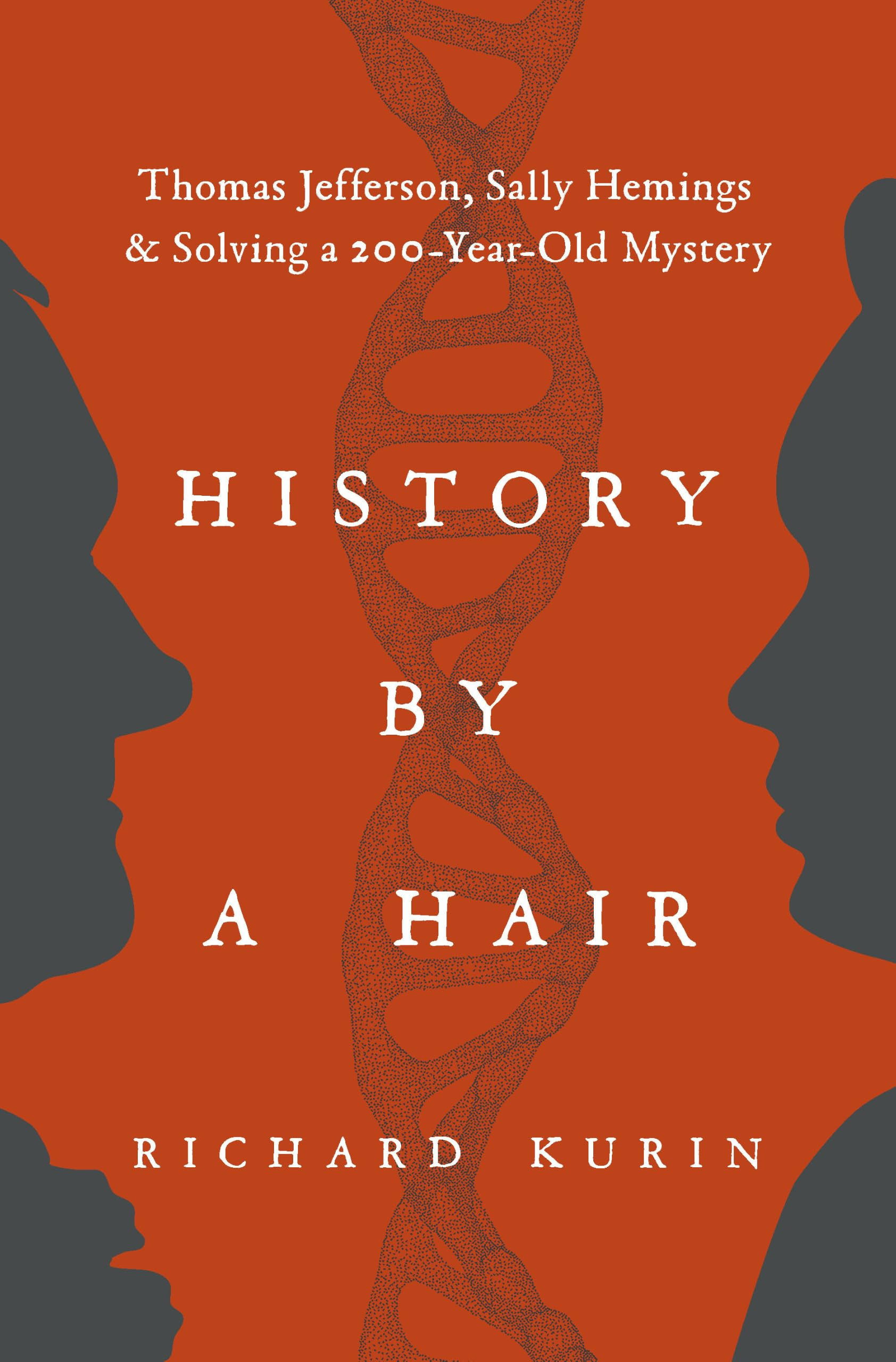
History by a Hair: Thomas Jefferson, Sally Hemings & Solving a 200-Year-Old Mystery
Buy from AALBC
Add to Cart — $35.00More Book Details
Fiction, Hardcover, 432 pages
Publisher: Penguin Random House
ISBN: 9798217088508
 Bookshop
Excerpt
One
An Unexpected Discovery
It was a dreary November afternoon in 2011 when I turned to my computer to watch a preliminary version of Jefferson’s Secret Bible, a documentary being readied for production on the Smithsonian cable television channel. One of my responsibilities as the Smithsonian’s then-undersecretary for history, art, and culture was to review potentially controversial programs before they aired to make sure that they were factually correct and aligned with the institution’s reputation for good scholarship and science.
The film’s focus was on the conservation of a precious artifact of American history, a book known as the “Jefferson Bible” that Thomas Jefferson had composed after he’d retired to his home at Monticello following his two terms as the third president of the United States, from 1801 to 1809. This meticulous work was an original “cut and paste” job, as Jefferson carefully cut out selected passages from Greek-, Latin-, French-, and English-language Bibles that he then pasted down in four parallel vertical columns on loose sheets of paper. Jefferson had learned these foreign languages as a young man and matched the verses horizontally across the pages, Greek in the first column, Latin in the second, then French and English.
Henry Randall, Jefferson’s biographer, believed the retired president had carried out the project during the winter of 1816–17. Now, nearly two centuries after it was first assembled, the Jefferson Bible was the object of extensive restoration treatment.
The National Museum of American History had recently conserved the Star-Spangled Banner—the garrison flag that originally flew over Baltimore’s Fort McHenry and inspired Francis Scott Key to pen a poem, in the dawn’s early light of September 14, 1814, that would later, when set to the music of an old English drinking song, become our national anthem. The flag was displayed in an inspiring new setting as part of the museum’s overall renovation. Following two years of exacting, careful, and thorough conservation—which was documented in the film—the Jefferson Bible would soon go on display as the centerpiece of another new gallery in the museum: the Albert H. Small Documents Gallery, devoted to rare and historical works.
As I watched the rough cut of the film, I was fascinated by actor Jerry Whiddon, who played Thomas Jefferson, working, sometimes by candlelight, and using a small razor-sharp penknife to cleanly cut out the biblical passages that would ultimately fill the volume’s eighty-four numbered double pages. It was tedious and precise work, and as I imagined trying to accomplish the task myself, I thought, “I’d probably cut myself over and over again.”
That was when another, much bigger thought dawned on me: Could Jefferson have cut himself? Could there be any specks of his blood on the pages of his book? My mind was now racing: Great strides had been made in DNA research, biotechnology, and bioinformatics over the past decade. The Human Genome Project had succeeded in identifying and mapping the DNA template for humanity; researchers were using DNA sequences to identify inheritable diseases; law enforcement was identifying suspects from traces of DNA evidence left at crime scenes; DNA was being recovered from ancient fossils, allowing scientists to piece together the genomes of extinct species. If scientists could find a way to sequence Jefferson’s DNA, we might then be able to compare his genomic profile to the living descendants of Thomas Jefferson and his wife, Martha Wayles Jefferson, as well as to the living descendants of the enslaved Sally Hemings, who claimed that they, too, were Jefferson descendants.
Recovering Jefferson’s DNA would mean solving, once and for all, and in an objective and scientific way, one of the thorniest, most enduring controversies in American history: Was Thomas Jefferson the father of Sally Hemings’s children?
The first person I contacted was Harry Rubenstein. A curator at the American history museum, Harry worked closely with Janice Stagnitto Ellis, the museum’s senior paper conservator, on the restoration of the Jefferson Bible. I had great respect for both of them and knew Harry well. For several years, I’d strongly supported his pulling together a major exhibition on Abraham Lincoln’s extraordinary life, including the display of the president’s iconic top hat. I considered Harry to be one of the Smithsonian’s typically fine curators, equipped with abundant knowledge and great expertise, but also temperamentally reserved and possessed of a healthy, professional dose of skepticism.
I sent him an email: “Harry, just watching some of the Smithsonian Channel video clips. Given all of that cutting and pasting Jefferson did on the Bible—have we ever looked for any possible transfer of biological material from which we could extract DNA?”
His response was swift.
“We found a couple of hairs in the book.”
Then in Harry’s somewhat characteristic deadpan style, he continued, “Do you want to make a Jefferson?”
No, but Harry, when the heck were you going to tell someone about it? I thought.
Instead, I wrote, “If those hairs have a follicle and if the DNA has not degenerated, they can be tested.”
My thoughts at that moment were rapid, and I conveyed them to Harry. If the hairs could be tested, we could look at the DNA of Jefferson descendants to see if it might be Thomas Jefferson’s and if so could then compare it to the DNA of Hemings’s descendants.
“The upshot,” I noted, “and there are a lot of ‘ifs’ along the way, it could be a decisive piece of historical evidence.”
Initially, I had watched the Jefferson’s Secret Bible film to make sure the content aligned with the scholarship on Jefferson’s religious views. His views about the place of religion in our national life were well known. In 1786 Jefferson had authored the Virginia Statute for Religious Freedom, which articulated freedom of religious belief and practice and inspired the First Amendment to the Constitution; he subsequently described that amendment as “building a wall of separation between Church and State.” He embraced the idea of an Almighty God who “hath created the mind free” and took that to heart in creating the volume for his own personal use. In substance, Jefferson was not one to shy away from controversial views: He thought, for instance, that Jesus was a profound exemplar of moral principles and an inspirational teacher but not a divine being. During his time, such a belief inspired preachers to call Jefferson an “infidel.” But Jefferson steadfastly pronounced himself a Christian. When challenged about his denomination, he clarified that he belonged to no congregation and constituted “a sect by myself.”
That summed up Jefferson’s perspective as he unabashedly began a task few others would take on—editing the Bible! He eliminated passages referring to miracles and other sections of the Bible that he found “contrary to reason.” Jefferson also penned a guide for the texts he’d selected—an annotated table of contents, marked reference numbers throughout, and an added footnote about Roman law. In 1820, he sent the pages to Richmond bookbinder Frederick Mayo to be stitched and bound into a Moroccan red leather-covered volume. Though Jefferson hand-titled the book The Life and Morals of Jesus of Nazareth Extracted Textually from the Gospels in Greek, Latin, French & English, the cover spine is adorned with the short title Morals of Jesus in gold lettering. Jefferson never called it a “Bible.”
The bound volume was returned to Monticello, and Jefferson apparently read his edited work for inspiration before going to bed. It was later revealed that most of Monticello’s resident family members knew nothing of its existence, but both his composing and reading of the book were probably private matters for him rather than something secretive.
Thomas Jefferson died on July 4, 1826, fifty years to the day after the publication of the Declaration of Independence. As lead author he had drafted, with Benjamin Franklin’s judicious editing, the stirring and inspirational words that struck the chord of freedom for a new nation: “We hold these truths to be self-evident, that all men are created equal, that they are endowed by their Creator with certain unalienable Rights, that among these are Life, Liberty and the pursuit of Happiness.”
At the time of his death, Jefferson’s doctor, a friend, a servant, his grandson Thomas Jefferson Randolph, and the husband of his granddaughter Virginia, Nicholas P. Trist, were present. The latter two were also coexecutors of the former president’s estate on behalf of his surviving daughter and main heir, Martha Jefferson Randolph. Jefferson’s debts were many; Monticello, his beloved estate, was a bust financially and his possessions had to be sold off. That included 130 slaves, land, house, and holdings. But not the book. That stayed within the family. Henry Randall interviewed family members for his three-volume biography of Jefferson and included some information about the Bible in his 1858 account, but it remained essentially a private document.
Read Crown’s description of History by a Hair: Thomas Jefferson, Sally Hemings & Solving a 200-Year-Old Mystery .
Copyright © 2026 Penguin Random House/Richard Kurin. No part of this excerpt may be reproduced or reprinted without permission from the publisher or author.
Reader Comments (0)
Log In to Join the Conversation
Commenting is reserved for registered AALBC members to maintain high-quality discussions.
No comments yet. Be the first to share your thoughts!
Advertisement