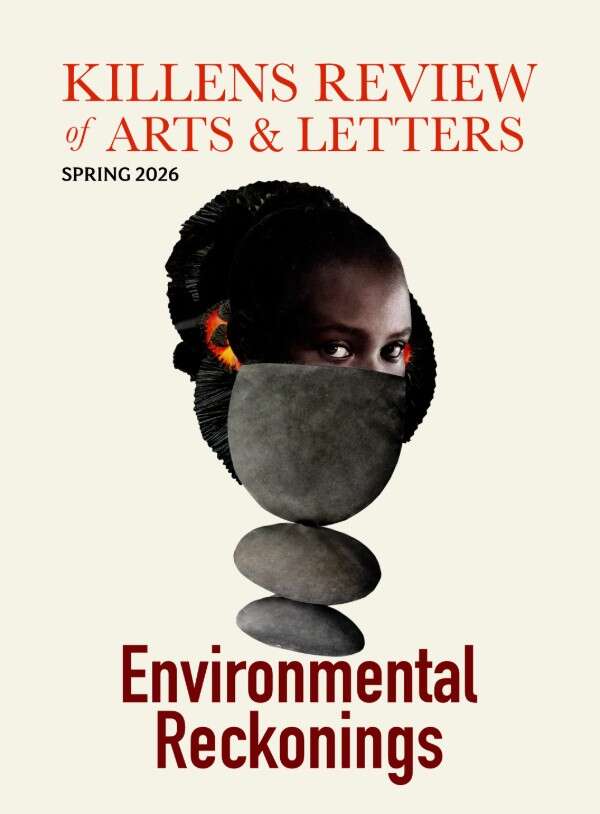
Killens Review of Arts & Letters (Spring 2026): Environmental Reckonings
Buy from AALBC
Add to Cart — $15.00More Magazine Details
Fiction, Magazine, 76 pages
Publisher: Medgar Evers College
Description of Killens Review of Arts & Letters (Spring 2026): Environmental Reckonings
Editor-in-Chief’s Note
Environmental Reckonings is the theme of this issue of the Killens Review of Arts & Letters. In the forthcoming pages, writers and artists from around the world critically elucidate Black peoples’ relationship with their natural, social, and built environments. In this spirit, K. Ibura’s collage, “Balance,” makes a fitting cover image. The precarious equilibrium depicted in the piece evokes the fragility of Black people’s symbiosis with nature, a precarity explored beautifully in the transnational tour of Black ecorealities led by our contributors.
The plantation serves as one tour stop. In “Far Afield,” Malik Isasis imagines a world in which the descendants of Haiti’s self-emancipated peoples have everything they need due to the arrival of an extraterrestrial life force. In “Sisters of the Good Death,” Charlotte Watson Sherman takes us to “Cancer Alley,” where Black communities are subjected to higher rates of disease due to capitalist ecoterrorism. Nzinga LeJeune and Bruce Morrow transport us to the waterways of Flint, Michigan and Makoko, Nigeria, respectively. Tony Medina writes of sites of ceasefire. Several contributors take us to various permutations of “home.”
Despite the honor I feel in shepherding these pieces and the rest of the issue’s work to publication, I struggled to compose this editor’s note. Reflecting deeply on all that is rushing our world into environmental ruin is a staggering task. Instead of fighting against my inarticulateness to reach a self-imposed word count, I will rely on an excerpt from Frashia Muthoni Karanja’s “The Body is a Rented Room” to serve as my introduction’s conclusion and to clear the way for the powerful work that is to come: “Because the truth is this: The environment remembers what we try to forget. The body keeps records no archive can erase. And one day, the land will speak again, not as story but as reckoning.”
Sincerely,
Mudiwa Pettus, Ph.D.
Editor-in-Chief