Juan Williams - The "Muzzled: The Assault on Honest Debate" Interview [August 2011]
Juan Williams Un-Muzzled
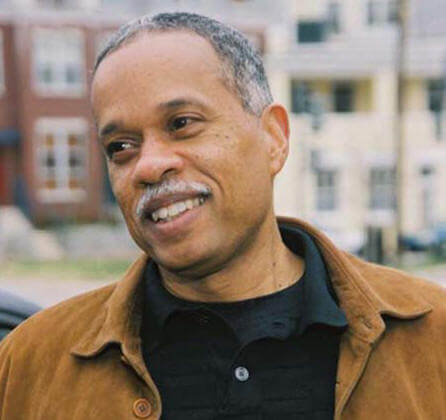
Juan Williams was born in Panama on April 10, 1954, but
raised in Bed-Stuy, Brooklyn by his mother Alma, a seamstress, and his
father, Roger, a boxing trainer. After graduating from Haverford College,
Juan went on to become one of America's leading journalists.
He is presently a political analyst for Fox News, a regular panelist on
Fox's public-affairs program Fox News Sunday, and a columnist for both
FoxNews.com and for The Hill. He has also hosted National Public Radio's
Talk of the Nation and anchored Fox News Channel's weekend news coverage.
His articles have appeared in the New York Times Sunday Magazine, Time, Newsweek, Fortune, The Atlantic Monthly, Ebony, Gentlemen's Quarterly, and The New Republic. Here, he talks about his new book, Muzzled, a memoir generally bemoaning the pressure nowadays to speak in sanitized, politically-correct sound bites and specifically reflecting upon his being fired by NPR for honestly expressing his feelings about getting on a plane with Muslims.
Words that Got Juan WIlliams Fired from NPR
Juan Williams - The ?Muzzled? Interview
with Kam Williams
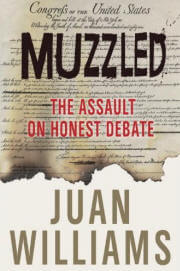 Muzzled:
The Assault on Honest Debate
Muzzled:
The Assault on Honest Debate
Click to order via Amazon
by Juan Williams
Hardcover: 304 pages
Publisher: Crown (July 26, 2011)
Language: English
ISBN-10: 0307952010
ISBN-13: 978-0307952011
Product Dimensions: 8.1 x 5.8 x 1.2 inches
Kam Williams: Hi Juan, thanks for the interview.
Juan Williams: Hey, Kam, you're very welcome. If you don't mind, I'm eating
a salad. Let me know, if you find it obnoxious.
KW: Not a problem. I've often talked to folks in real-life situations, such
as to Soledad O'Brien while she was cooking in the kitchen surrounded by
four kids. I like it because this sort of stuff tends to humanize the
interview. Anyway, I have a lot of questions from my readers and my editors,
just let you know that I'll be mixing them in with some of my own.
JW: That's cool, man.
KW: I went to high school in your neck of the woods. Do you remember
Brooklyn Prep at the corner of Nostrand Avenue and Carroll Street in
Bed-Stuy?
JW: Sure!
KW: Legist/Editor Patricia Turnier asks: What is the biggest lesson you
learned from the experience of being fired by NPR?
JW: I think the bottom-line takeaway lesson for me was that there's
intolerance on the left that I had not fully appreciated. Growing up in the
Sixties and Seventies, I had come to think that it was the Archie Bunker
crowd on the right that was rigid and inflexible, which they certainly were
guilty of back then in terms of the Civil Rights Era. In this instance, I
discovered that people on the left react out of anger if you vary at all
from their orthodoxy. And it resulted in my firing. But in general, they
might ostracize you and say you're not a good Democrat. It's unbelievable!
Or if the conversation is about race, they'll say you're not a good brother
or even call you a bigot or an Uncle Tom.
KW: Or your boss might suggest you need to see a shrink. How did you take
that?
JW: Being fired was bad enough, but then having the president of the company
say publicly that my comments should be kept between me and my psychiatrist,
and that all you get out of me were words from publicists, was further
upsetting because it suggested that I was infantile and incapable of
speaking for myself. I found it incredible. I realized that they will lower
the hammer on you, if they feel you are not following their path.
KW: Patricia also asks: what message do you want people to take away from
Muzzled?
JW: To resist the temptation in the current media landscape to listen only
to people you agree with. In order to have a good sense of what's really
going on in this country you also need to read those publications and to
watch those TV programs and to listen to those radio shows featuring
opposing views. You have to talk to people who disagree with you while
showing mutual respect, all in service of better ideas and better solutions
for the country's problems.
KW: Harriet Pakula Teweles asks: If we all go around un-muzzled, how soon
before we're approaching a hate speech walkabout?
JW: Oh, cool question! Being un-muzzled is not about engaging in hate
speech. That's not the point of the book at all. Its aim is to encourage
?honest debate? which is why that's in the subtitle. The extremists saying
the rudest and sometimes the stupidest things aren't being muzzled. In fact,
some of them are making a lot of money doing that. The problem is that those
of us who are trying to engage in honest debate are being muzzled and
discouraged from listening to and associating with people with different
ideas as a warning to everybody else in the club that independent thinkers
will be shunned and ostracized.
KW: What did you think about MSNBC's suspension of Mark Halperin for
referring to President Obama as an [expletive]?
JW: I thought it was appropriate.
KW: Did you see any similarities between what happened to you and what
happened to Shirley Sherrod whose speech was edited to make her look like a
racist?
JW: Yes, I think my words were intentionally taken out of context by people
who were trying to harm me.
KW: Would you say you've moved to the right over the years?
JW: It's hard for me to have that level of self-awareness. But that does
seem to be the perception others have of me. I'm still very much in favor of
gun control, a woman's right to choose, and affirmative action which would
make me a liberal. So, I haven't changed in terms of my own inner GPS
system, if you will, I don't see any radical changes except perhaps like
Bill Cosby I'm commenting as a journalist about what I see as critical
issues for our society, such as the high out-of-wedlock birth rate, the
breakdown of the family, and so forth.
KW: Tony Noel says: Mr. Williams I am a Muslim who does not think that you
should have been fired for your statements about your fear of being on an
airplane with Muslims in tradition Muslim dress. My question is: Based on
the information regarding terrorists since the 9/11 attacks, up to now I
don't recall any wearing traditional Muslim clothes. So why are you afraid?
JW: Because there's a clear link in my mind between radical Islam extremism
and terrorism. I wouldn't be able to identify most Muslims based on their
dress. But when I can, I have this instinctive fear. Believe me, it's not a
fully thought out opinion, but just a reaction. I still have that feeling,
and that's the reality.
KW: Tony was also wondering whether some fellow guests on news talk shows
have a real personal dislike for you. He says it certainly appears that way
to him.
JW: I will say that there have been moments when people were outraged by my
point of view, or when they roll their eyes as if it's not worthy of their
response. Look, I work at Fox, and there are people there who strongly
disagree with me.
KW: Larry Greenberg observes that there has been a lot of debate recently
about the federal funding for NPR. He asks: Where do you come down on this
issue today?
JW: I initially stayed away from commenting on it, because I felt that
anything I said could be misinterpreted as sour grapes. Upon my firing, the
issue instantly became politicized, with Republicans calling for the
withdrawal of all public funding of NPR. So, I stayed away from the issue
until the man who runs the Democratic Congressional Caucus sent out a letter
saying, ?We have to protect NPR's funding because it's the answer to Rush
Limbaugh.? I said to myself, ?Wait a minute!? because that sounds like NPR
is indebted to the Democrats for its funding. That is not a good working
situation for honest journalism. So, I think it's now time to end the
charade and just have NPR rely on its listeners and on advertisers who ought
to be eager to have access to its affluent, highly-educated audience.
KW: Will Cooper says: Given that NPR's listenership is mostly liberal
upper-income urban and suburban whites, aren't continued government
subsidies unnecessary at this point? Surely such a devoted and wealthy
listener base or the advertisers looking to target them will be able to fill
the 5% gap in NPR's budget that it claims comes from the federal government,
yes?
JW: Yes.
KW: Kevin Williams, director of the documentary ?The Fear of a Black
Republican,? asks: Do you think that the Republican Party will completely
forego the African-American vote in the 2012 Presidential Election?
JW: I do, and I think it's a mistake. I wrote a column about Newt Gingrich's
recent speech in Baltimore where he stated that Republicans need to reach
out to the black community and make the case that Barack Obama hasn't done
all that is possible about the high poverty and unemployment rates and the
declining quality of the public schools. I thought the speech was a
revelation because, whether you think Gingrich is right or wrong, you never
hear Republicans say they could do a better job of appealing to
African-Americans. As we see the dominoes get lined up for the 2012 race, I
believe most Republicans will try to activate their base in the white
community while making some small inroads in the Hispanic community.
KW: Kevin has a follow-up: Do you think that African-Americans will
basically vote as a bloc for
President Obama or is there an opening for the
Republican Party's challenger to win a significant percentage of their
votes?
JW: I don't think there's an opening. The polls that I see still indicate
the existence of overwhelming support for the President in the black
community, despite a few loud critics like
Cornel West. But there's no
evidence that those complaints have diminished the level of support for
Obama.
KW: Victoria Plummer, an impassioned, starry-eyed, 2011 Spelman graduate is
seriously contemplating a career in journalism. She wants to know what
advice you have to share which might help her enter and navigate the
profession at a time when journalists appear to live continually stressful
lives, choked by the forces of market volatility, bottom-line pressures,
political biases of media ownership and management while simultaneously
aspiring to live up to the canons of professional and ethical journalism?
 Eyes on the Prize Official PBS DVD Click to order via Amazon Eyes on the Prize is an award winning 14-hour documentary series on the civil rights movement that brilliantly illuminates the struggle for racial equality and social justice. |
KW: Has Fox ever asked you to hack into somebody's cell phone to get a scoop?
JW: [LOL] Is that a serious question?
KW: No, I was asking it tongue-in-cheek. What do you think of the debt ceiling debate?
JW: I think it's a great illustration of what I'm talking about in my book. Democrats and Republicans can't even have an honest discussion about the depth of the debt problem in this country. Democrats were willing to make cuts yet Republicans refused to raise taxes on even the most-wealthy Americans. It's crazy!
KW: Is there any question no one ever asks you, that you wish someone would?
JW: I wish I had a cute retort, but nothing comes to mind.
KW: The Tasha Smith question: Are you ever afraid?
JW: I was afraid my career was over, when they fired me.
KW: The Columbus Short question: Are you happy?
JW: I live a very stressful life with lots of assignments and deadlines.
KW: The Teri Emerson question: When was the last time you had a good laugh?
JW: I laugh all the time.
KW: What is your guiltiest pleasure?
JW: I spend a lot of time watching sports. I go to see the Wizards. The NBA is my passion.
KW: The bookworm Troy Johnson question: What was the last book you read?
 Mark Twain's Adventures of Tom Sawyer and Huckleberry Finn Click to order via Amazon Publisher: NewSouth Books; Original edition (February 1, 2011) "Both novels can be enjoyed deeply and authentically without those continual encounters with the hundreds of now-indefensible racial slurs," Gribben explains. |
KW: What is your favorite dish to cook?
JW: I used to make some great bread, but right now I'm so busy, I don't have the time. My favorite dish to eat is curried chicken, or ribs.
KW: When you look in the mirror, what do you see?
JW: An aging man. [Chuckles] I'm often surprised enough to say, ?What happened to you?? I became a grandfather about a year ago yet I still think of myself as the 4 year-old in a picture I have of myself with my parents. It's amazing!
KW: The Ling-Ju Yen question: What is your earliest childhood memory?
JW: One of my deeper memories is sitting on the front stoop in Brooklyn, waiting for my mom to come home from Manhattan everyday. She worked as a seamstress in the Garment District and wouldn't come out of the subway until around 6 PM.
KW: If you could have one wish instantly granted, what would that be for?
JW: Well, besides peace and happiness throughout the world, I pray for my family. I pray for their safety, their well-being, that they find God's purpose for them, and that they are willing to fulfill it.
KW: Dante Lee, author of "Black Business Secrets," asks: What was the worst business decision you ever made?
JW: Listening to a friend who told me to invest in a stock. I ended up losing every dime.
KW: The Judyth Piazza question: What key qualities do you believe all successful people share?
JW: Perseverance, optimism, and a good spirit about them.
KW: The Tavis Smiley question: How do you want to be remembered?
JW: As a journalist who made a difference telling the story of his time and of his generation.
KW: Thanks again for the time, Juan. I really appreciate it.
JW: Nice to make your acquaintance, Kam, and thanks for taking the time to talk to me.
Reader Comments (0)
Log In to Join the Conversation
Commenting is reserved for registered AALBC members to maintain high-quality discussions.
No comments yet. Be the first to share your thoughts!
Advertisement