|
Morgan on
Mandela, Mirrors, Mississippi and More
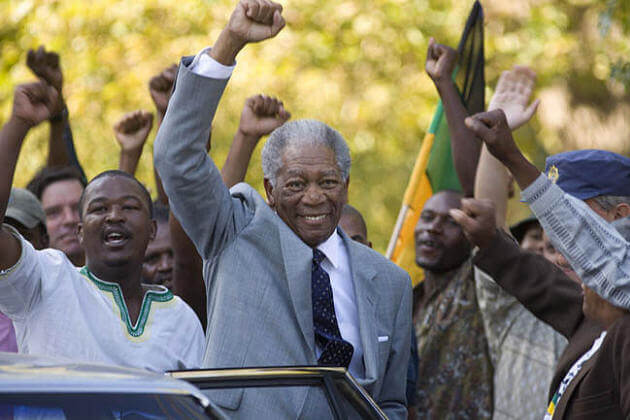
Morgan Freeman was born in Memphis, Tennessee on June 1, 1937
but raised from infancy in Charleston, Mississippi by his
paternal grandmother. Every summer as a young child, he would
visit his parents who had moved to Chicago, which is where he
developed his love of the cinema.
He started acting at the age of 9, exhibiting promise as a lead
character in a school play. Although he had won a statewide
drama competition, upon graduating from high school, he opted to
enlist in the Air Force rather than accept a college scholarship
to pursue his true passion.
After being honorably discharged from the military in the late
Fifties, Freeman decided it was time to take his shot at
showbiz. But he struggled for years, first finding work as a
dancer, then on the stage in a variety of modest company
productions. Eventually, he made his way to Broadway where he
debuted in Hello Dolly in 1968, which led to his landing a
steady gig as Easy Reader on the children’s TV series ’The
Electric Company.’
He subsequently appeared on such soap operas as ’Another World’
and ’Ryan’s Hope’ before finally landing his breakout role
opposite Robert Redford in Brubaker in 1980. Hollywood soon took
note, enabling the capable thespian to blossom into the
universally-admired, consummate actor we’ve all enjoyed over the
years.
A cursory glance at Mr. Freeman’s resume’ reveals a plethora of
memorable hit movies, including Lean on Me, Glory, Unforgiven,
Amistad, Deep Impact, Bruce Almighty, Batman Begins, Gone Baby
Gone, The Bucket List and The Dark Knight, to name a few. He
delivered Oscar-nominated performances, in Street Smart, Driving
Miss Daisy and The Shawshank Redemption before finally winning
that elusive Academy Award in 2005 for Million Dollar Baby,
which also earned Best Picture and Best Director honors for
Clint Eastwood.
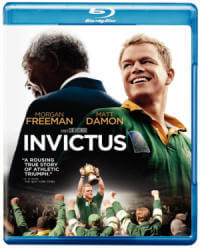
He reunited with Eastwood to make his latest picture, Invictus,
an uplifting, historical saga based on actual events which
unfolded in South Africa shortly after the fall of the apartheid
regime. Freeman, who still makes his home in Mississippi, spoke
with me recently about his life, career and the challenge of
portraying Nelson Mandela.
Morgan Freeman -
The "Invictus" Interview
with Kam Williams
Kam Williams: Mr. Freeman, thanks so much for the time. I’m
honored to be speaking with you.
Morgan Freeman: Well, thank you.
KW: First, let me say congratulations on winning the National
Board of Review’s Best Actor Award for Invictus.
MF:
Thank you very much.
KW: Was making this movie a labor of love? I heard that it was
something that you'd wanted to do for a long time.
MF:
Well, it wasn't necessarily this project, but I felt
destined to do something about Mandela. I don't know whether you
know that in 1992, when he published his autobiography, he was
asked who he would want to play him, if the book ever became a
movie. And he named me. So, I was sort of the chosen one, as it
were. Therefore, I expected that eventually I would play him,
but we always thought it would be in a movie version of "Long
Walk to Freedom." It didn't turn out that way, however.
KW: But you obviously also liked Invictus.
MF:
My partner and I thought that this story was ideal. This
one, we felt was perfect to go with.
KW: Are you referring to your partner in Madidi restaurants and
Ground Zero blues club?
MF:
No, to my producing partner, Lori McCreary.
KW: Jim Cryan, a reader with in-laws in Mississippi, says he’s
enjoyed eating at Madidi down in Clarksdale. He says it’s very
upscale, so he was wondering whether when you cook for yourself
you make any down home Southern dishes like barbecued bologna
sandwiches.
MF:
I don't cook. I’m a partner in the restaurant, but it isn't
because I like to cook.
KW: Attorney Bernadette Beekman wanted to know whether you ever
met Mandela.
MF:
Yes, I’ve met him on a number of occasions, and have even
been able to spend some time with him.
KW: Children’s book author
Irene Smalls asks, how would you
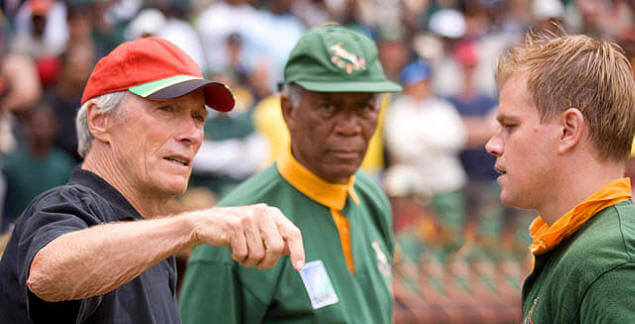
characterize your relationship with Clint Eastwood, as a friend,
mentor or fellow artist?
MF:
I think it’s as friend and fellow artist. Yeah, fellow
artist, first.
KW: Reverend Florine Thompson asks, who or what has been your
greatest source of encouragement and inspiration?
MF:
Sidney Poitier, his whole life and career.
KW: She also wants to know, how important is spirituality in
your life?
MF:
Very important. Very important, indeed, although I’m not
what you would call ’officially’ spiritual.
KW: Aspiring actor Tommy Russell asks, did you ever want to give
up as an actor?
MF:
Oh, yeah. Many times’ many times’
KW: Is there any question no one ever asks you, that you wish
someone would?
MF:
[Laughs] No, I’ve been asked everything that you can
imagine.
KW: The Tasha Smith question: Are you ever afraid?
MF:
Afraid? Yes, I get afraid, because I’m an adventurer. I like
to live on the edge. Afraid means you have an adrenaline rush.
KW: The Columbus Short question: Are you happy?
MF:
Happiness is relative. I’m content.
KW: The Teri Emerson question: When was the last time you had a
good laugh?
MF:
Well, I’ve been with Clint and [co-star] Matt Damon the last
couple of days, and we’ve laughed a lot.
KW: The bookworm
Troy Johnson question: What was the last book
you read?
MF:
Oh, gosh’ I’m sorry. I can't remember what the last book was
offhand.
KW: Maybe it’ll pop into your head before we finish.
MF:
Yeah.
KW: The music maven
Heather Covington question: What are you
listening to?
MF:
An eclectic mix of people. Right now, I have a mix on my
disc player of Norah Jones, Ray Charles, Frank Sinatra and Al
Green.
KW: The Ling-Ju Yen question: What is your earliest childhood
memory?
MF:
My earliest childhood memory’ I think my earliest childhood
memory is of getting up one morning and putting my own shoes on.
I put ’em on the wrong feet.
KW: That’s funny, because my earliest childhood memory is being
taught by my mother to tie my shoes while we sat under a tree in
a park.
MF:
Do you remember how old you were?
KW: Either 3 or 4.
MF:
That seems to be about the same age that I was.
KW: The Mike Pittman question: Who was your best friend as a
child?
MF:
I had a lot of best friends as a child. My first one’s name
was Sonny Man. [Chuckles] Then there was Bobo and Walter, up
until I was a teenager.
KW: When you look in the mirror, what do you see?
MF:
When I look in the mirror, what do I see? I see me. What
does that mean? Do you have any idea?
KW: No, because I don't know how to interpret the answers to
that question.
MF:
I meant, can you interpret the question? What
did you have in mind there?
KW: It’s a question I use often, and I leave it to each person
to interpret the meaning.
MF:
Do you ever get any interesting answers to that?
KW: Yeah.
MF:
Really?
KW: Sure, they can be very revealing!
Ludacris said, ’an
entrepre-Negro,’ Gladys Knight said, ’A child of God,’ Faizon
Love responded, ’The light! The reflection of the light,’
Mo’Nique said, ’I see somebody that’s full of life,’ and
LeBron
James answered, ’A great father, a great friend, a loyal person
and someone who’s always trying to make a difference.’ I like
offbeat questions that people aren’t always asked which cause
them to pause and become a little more introspective, like: Are
you happy?
MF:
I see happiness and sadness as two sides of the same coin.
And if you're somewhere in the middle of that, you're going to
float both ways from time to time, but you never know what your
ambient temperature might be.
KW: The Flex Alexander question: How do you get through the
tough times?
MF:
I have this amazing belief in myself, and the idea proven to
me time and time again that if you just keep going, stay on your
feet, and keep moving, things will work out.
KW: Wesley Derbyshire asks, how is it that you always manage to
evoke power, deep emotion, and true conviction onscreen, and in
such a serene fashion?
MF:
In my mind, acting is believing. That’s the way I learned
it, and how I still think of it. So, in order to be true to any
character, you have to believe that you are that character, and
that you have his belief system working for you. That way, when
you're reciting your lines, you’ll be saying them from a place
of conviction.
KW: Laz Lyles asks, did you have to sacrifice a modicum of
reverence for Mandela as an actor to bring out the full palette
of complexity and humanity of a person as universally esteemed
as Mandela? She says she heard Clint Eastwood mention some of
the ways in which Mandela was flawed. So she’d like to know what
it was like for you as an actor to get into the psyche of a
person who is viewed as so selfless and spiritual, and to
discover that he’s also flawed.
MF:
Well, I had already read so much about Mandela that I knew a
long time ago that not only is he a human who is flawed, but
that there are certain personal failings as a man for which he
cannot forgive himself. For despite all of his political
triumphs, he feels unfulfilled in terms of his family.
KW: Carmela Reimers asks, how hard was it to get Mandela’s
accent down?
MF:
Very hard. In fact, that was the most challenging part of
the whole role. It wasn't impossible, but if I were to say any
part of the role was hard, it would have to be that.
KW: Uduak Oduok asks, how did you like shooting on location in
South Africa, and how do you think Africa will be influence
America, culturally, in the coming years?
MF:
I really enjoyed being in South Africa. It is really an
amazing place. We spent about 6 weeks in Cape Town and 2 weeks
in Joburg [Johannesburg]. I still find it a very exciting
country. As old as it really is, right now it seems on the verge
of leaping into the 21st Century. Culturally, I don't think
Africa is going to have any more effect on America than it
already has, which has been considerable. But I believe South
Africa will have an enormous influence on the rest of that
continent. I certainly hope so.
KW: Larry Greenberg was wondering whether, despite your many
accolades and accomplishments, there are any projects you still
feel you must take on?
MF:
Yes, I must get a few more historical dramas made about the
black experience in America.
KW: The Boris Kodjoe question: What do you consider your biggest
accomplishment?
MF:
Working as an actor’ Yep.
KW: What advice do you have for anyone who wants to follow in
your footsteps?
MF:
For anyone who wants to follow in my footsteps? I’ve laid
down a lot of footsteps and tracks in different directions, so
it would depend on which way they want to go. In general, I
would say, ’Gird your loins, and go where you want to go! Do
what you want to do.’
KW: The Laz Alonso question: How can your fans help you?
MF:
By just remaining fans, and by letting me know if I mess up.
KW: Have you remembered the last book you read yet?
MF:
No, I’ve been concentrating on what you’ve been asking. Let me
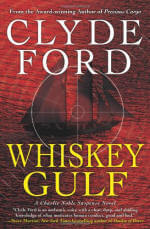
think’ One of the last ones was Whiskey Gulf by Clyde Ford, a
friend of mine up in the Washington area.
KW: Have you been doing a lot more voiceover work lately? It
seems like I’m always hearing you on TV and radio ads.
MF:
No, sometimes I think I hear my voice, too, but it’s not my
voice. So, you have to be a little careful there.
KW: Yeah, Richie Havens said the same thing. That there’s a guy
impersonating him who has done a bunch of commercials.
MF:
Right. If a good model sounds alike, some people go for it.
KW: Thanks again, Mr. Freeman. I really appreciate the time, and
I’ve admired your career and enjoyed all your work.
MF:
Thanks so much, that’s very kind of you.
Related Links
Morgan Freeman - The Evan Almighty Interview
http://aalbc.com/reviews/morgan_freeman.htm
|