Deesha Philyaw: Writing Black Women Toward Freedom
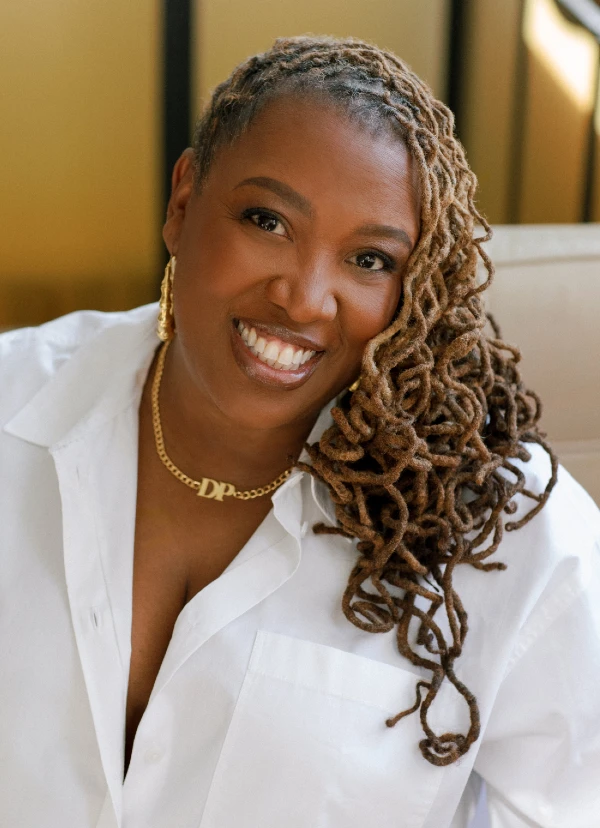 When I caught up with Deesha Philyaw, she was enjoying something increasingly rare in the life of a bestselling author with a new book on the way: a little bit of ease.
Before the tour for The True Confessions of First Lady Freeman begins, Philyaw is spending six mostly travel-free weeks at home—sleeping in, organizing her closet, preparing for the road, working on her next novel, and, of course, reading. Lots of reading.
There are books by the bed and in the bathroom, a book in her purse, and stacks of advance copies waiting for her attention. When she still had a car, she tells me, there was a designated car book, too. “I’m always reading more than one book at a time,” she says.
It feels like a fitting place to meet Philyaw: in a brief season of rest, surrounded by stories, just before the world gets busy again.
Before Philyaw knew she would become a writer, she was a reader, a teacher to an imaginary classroom, and a careful listener. An only child in her mother’s home, she lined up stuffed animals and made them her students. She was always the teacher. She even created homemade books on tape, reading stories into a tape recorder and saying “beep” when it was time for her stuffed-animal students to turn the page. But some of her most important lessons in storytelling came from listening.
Her grandmother was a master storyteller who told family stories and terrible jokes. Her mother and grandmother were also what Philyaw affectionately calls “yappers,” women who could spend hours talking with friends on the phone. Philyaw learned that if a child stayed quiet enough, adults sometimes forgot she was listening.
“I knew everybody’s business,” she says with a laugh.
Today, she often hears her characters’ voices before she knows their stories. “My mom and my grandmother, I guess, were the first real storytellers in my life.”
That inheritance—what women say openly, what they whisper among themselves, and what they are told never to say at all—runs through Philyaw’s work, from The Secret Lives of Church Ladies to her new novel, The True Confessions of First Lady Freeman.
The Women Inside the Church—and Outside It
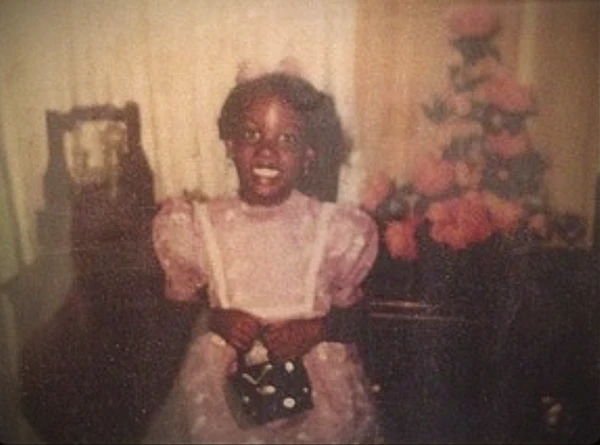
Church was foundational to Philyaw’s childhood. So, too, was the absence from church of the two women raising her. Her mother and grandmother sent her to church but did not attend themselves. Around age eight, Philyaw finally asked her grandmother why.
“I’ll go to church when I get myself together,” her grandmother told her.
The answer confused a child who understood church as precisely where people went to get themselves together. Years later, Philyaw began to wonder whether her mother and grandmother, both single mothers, had felt judged and unwelcome.
The contradiction was particularly striking because the church Philyaw attended belonged to her paternal grandfather’s family. The men in his family had helped build it and held leadership positions there. Her grandmother was absent. “She didn’t make babies by herself,” Philyaw says.
Long before she had words like patriarchy or misogyny, Philyaw understood that the rules were different for women. Inside church, she saw women who appeared joyful, grateful, saved, and certain. Outside, she saw women who seemed freer. They dressed differently. They played cards. They drank. They smoked. To young Philyaw, they appeared to be having considerably more fun.
“I don’t want to go to hell,” she remembers thinking. “But I like how these women are living.” She noticed the double standards, too. When teenage girls became involved with older men in the church, people seemed to have plenty to say about girls being “fast” and far less to say about the grown men involved.
“The Lord never gave you a word about her being sexually assaulted,” Philyaw says. “Or about that deacon.” Still, she tried to follow the rules.
“I married before I had children. I married a man. I married heterosexually. I did everything that good girls are supposed to do.” Then, around 30, she found herself married, living in the suburbs, raising a two-year-old daughter, staying home—and deeply unhappy.
“I did everything right,” she remembers thinking. “Why am I not filled with that joy?” That question became part of a much larger unlearning. Eventually, it became fertile ground for fiction.
Loving Something Enough to Tell the Truth
Philyaw’s work critiques the church without flattening it.
She knows its history and significance in Black life. She also knows church people who lead with generosity, mercy, curiosity, and love. “I have no beef with Jesus,” she says.
Her concern is the distance between those ideals and the harm religious institutions can perpetuate. “There’s a lot of people in churches who are nothing like Jesus,” she says, “and a lot of people outside of churches who are more like Jesus than people in church.”
That tension is essential to her satire.
Philyaw points to George Saunders’ idea that effective satire requires some affection for and intimate knowledge of its subject. She has both. Church was part of her life until she was 35, and some of the people she loves most remain deeply rooted in it. “I know and have experienced the best and the worst of church,” she says. “I’m able to write about it the way I do.”
Learning to Trust Herself
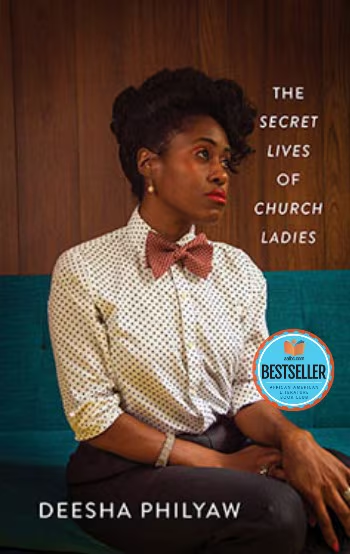 When The Secret Lives of Church Ladies transformed Philyaw’s literary career, success gave her something particularly valuable: confidence. She hadn’t begun those stories knowing they would become a collection. She simply decided to write what she wanted.
The deaths of her mother and grandmother in 2005 sharpened that resolve. Philyaw thought about how much of their lives had been spent doing what they had to do rather than what they wanted to do. She had choices they had not had.
“Here I get to do what I want to do,” she says. “And so why would I squander that by doing anything less than what I absolutely want to do?” Success taught her that she knew how to tell a story, pivot, start over, and revise. It also taught her to trust the process.
That trust became essential while finishing The True Confessions of First Lady Freeman. Her manuscript was much longer than expected, yet her editor initially asked her to expand rather than cut. Philyaw couldn’t understand how the math could possibly work. It did.
By going deeper where the story needed it, Philyaw eventually saw what could disappear. “It worked,” she says. “It actually worked.”
For Philyaw, a great editor helps a writer accomplish what the writer wants rather than imposing another vision. That relationship has given her another kind of freedom.
“I don’t have to worry about nobody trying to whitewash my books,” she says. “No one’s going to try and get me to worry about market trends.”
The First Lady Who Wouldn’t Leave
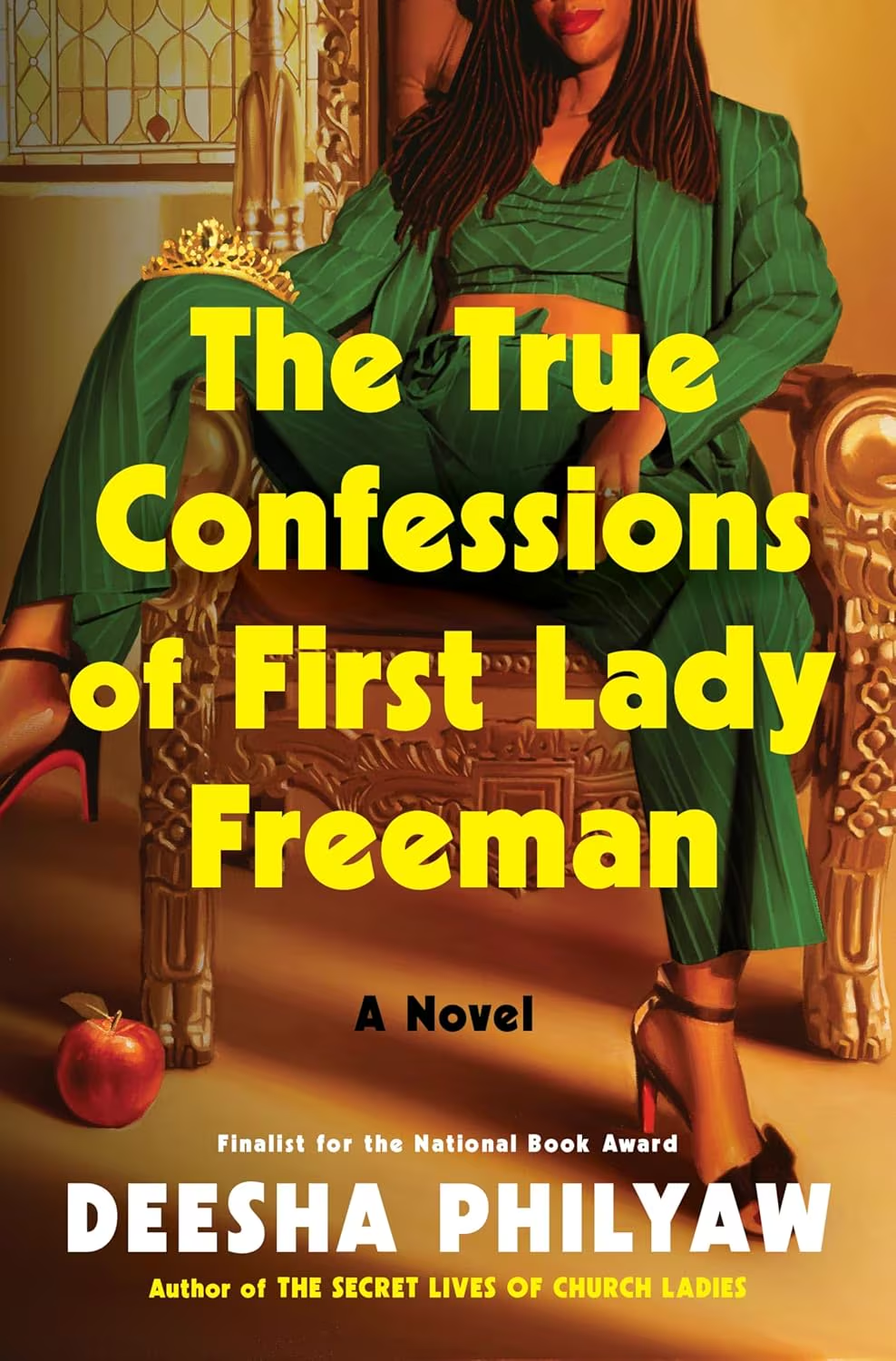 Before there were the church ladies, there was Schar Freeman.
Philyaw began writing the character at the center of The True Confessions of First Lady Freeman roughly 20 years ago—before the stories that became The Secret Lives of Church Ladies. Originally, Schar was already divorced from the pastor, a former First Lady co-parenting, dating, and rebuilding her life. Then the novel stalled.
Part of the problem was craft. Philyaw says she didn’t yet know how to write a novel. The other problem was that Schar was too much like her. So she stepped away. She wrote Church Ladies. She learned. She grew. Eventually, she returned to the woman who had refused to leave her imagination.
The First Lady role remained because pastors’ wives had always fascinated Philyaw. Of all the church women she observed growing up, they seemed the most mysterious. She remembers watching one First Lady as a teenager and wondering what her life must actually be like. “I just remember thinking, gosh, that must be lonely.” Who could she trust? Were people genuinely her friends, or did they want proximity to her position? What happened to her anger, ambition, sexuality, disappointment, and loneliness when an entire congregation was watching?
Those questions helped shape Schar.
Let Black Women Want Things
Desire is everywhere in Philyaw’s work.
Her women want sex and tenderness. Pleasure and recognition. Intimacy and freedom. Sometimes they want people and things they have been taught they should never want. Philyaw lets them.
She grew up in spaces where the message to women was often simply: don’t. But desire does not disappear because a woman has been taught not to name it. Philyaw gives those wants language—and gives Black women room to contradict themselves.
They can love church and question it. Desire marriage and feel constrained by it. Believe in God and reject rules people have attached to God. They can be generous and selfish, faithful and messy, loving and wrong.
They can simply be human.
The Women Who Knew You Before
For all the attention Schar’s marriage and role as First Lady may attract, one of the novel’s most important relationships is with Petra, her estranged childhood best friend. There is something particular about the person who knew you before the title, the marriage, the success, and the image. Before everyone else decided who you were supposed to be.
Through Petra, Philyaw explores a kind of belonging that doesn’t require performance. Schar can be surrounded by people and still be lonely. She can be married and still need someone who remembers who she was before the life she built.
And sometimes the friend who loves you most is also the one willing to hold you accountable.
In Petra, Philyaw gives Schar both history and truth—and offers a vision of female friendship as part of the architecture of a full life.
Coming Back to AALBC
Long before The Secret Lives of Church Ladies brought Philyaw national acclaim, she had found literary community at AALBC.
She was active in AALBC’s forums in the early 2000s, participating in the kind of conversations about Black books that were difficult to find elsewhere online at the time. Those exchanges were more than literary discussion. They created relationships; one woman Philyaw met through the forum became a dear friend.
Her connection to AALBC and founder Troy Johnson endured as her own writing career grew.
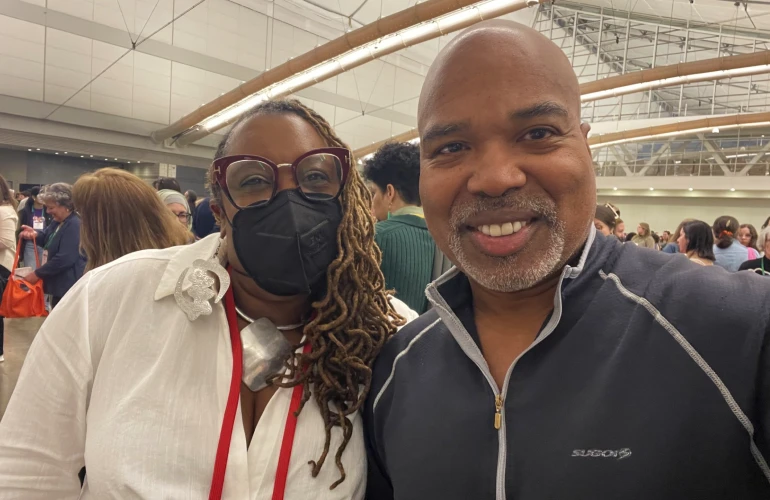
Years later, AALBC supported The Secret Lives of Church Ladies, helping connect the collection with readers. The book would become an AALBC bestseller, part of a relationship between Philyaw and the platform that stretches back well before her literary breakthrough.
For Philyaw, Johnson’s work represents something increasingly valuable: an unapologetic commitment to Black people, Black books, and Black stories. And in 2026, she believes spaces like AALBC still matter.
The internet that introduced Philyaw to AALBC has changed. Social media and algorithms increasingly determine which books readers see and which conversations gain attention. Artificial intelligence is changing how information is created and found.
But visibility is not the same as community. There remains value in a space built intentionally around Black literature—not because Black books are trending, but because they belong at the center.
For Philyaw, returning to AALBC with The True Confessions of First Lady Freeman feels less like an introduction than a continuation of a conversation that began decades ago.
What Does Freedom Look Like?
Twenty years after Schar first appeared on the page, Philyaw is no longer the same woman—or the same writer—who created her. There is more trust now. In her instincts. In revision. In the process. In knowing that getting stuck does not mean a story has failed, and that sometimes a character simply needs time to become who she is supposed to be.
That trust has created its own kind of freedom.
Philyaw is already at work on her next novel, approaching the page with the confidence of someone who knows what she can do without pretending that knowing makes the work easy.
But the freedom running through Philyaw’s work is bigger than creative confidence.
It is the freedom to question what you were taught. To love something without refusing to name the ways it has hurt you. To desire without shame. To change your mind. To outgrow a version of yourself that once kept you safe. To choose friendship, pleasure, faith, solitude, ambition—or something else entirely—without measuring that life against someone else’s definition of what a good woman should be.
For Philyaw’s women, freedom is rarely neat. It comes after doubt, mistakes, desire, grief, and sometimes the realization that doing everything “right” did not produce the life you were promised. Maybe that is precisely the point.
Who gets to decide what makes a woman good?
What do women owe the institutions they love?
What do they owe themselves?
And what might happen if Black women stopped organizing their lives around who they have been told they should be?
For Philyaw, these questions are not arguments to settle. They are invitations. They are the places where stories begin. And perhaps underneath all of them sits an even simpler question—one Schar Freeman must confront, and one Philyaw has spent years answering for herself:
What does freedom look like when you finally give yourself permission to choose it?
Reader Comments (0)
Log In to Join the Conversation
Commenting is reserved for registered AALBC members to maintain high-quality discussions.
No comments yet. Be the first to share your thoughts!
Advertisement