What is SATISFY MY SOUL saying about the American experience?
That the
destruction of African gods has shaped the destiny of this country because
African-American people have been left with no vision of themselves as higher
beings. This affects our ambitions and the assurance with which we move through
this world. It is saying that the sons and daughters of slaves have much to gain
from reopening a conversation with the gods we left behind in Africa in order to
satisfy our souls. It is saying that this satisfaction of our souls is an
important stage in the development of individual African-American people. It is
saying that the emotional trauma of separation from our gods remains with us
today.
Format:
Hardcover, 352pp. |
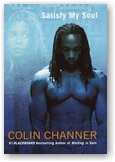 Satisfy
My Soul
Satisfy
My SoulWhat is SATISFY MY SOUL saying about Africa?
That it is a place of great
complexity that will always disappoint people who are searching for simple
answers.
This novel brings together spirituality and eroticism, two ideas that
always seem to be at war. How hard was it to do that?
It wasn’t hard at all.
See, the spirit and the flesh are at war if you as a person are at war with
yourself. When you are at peace with yourself then you experience the bliss
of clarity. When this happens, the erotic flows into the spiritual and the
spiritual flows into the erotic. Carey, the central character, is at war
with himself. So is Frances, the woman with whom he falls in love.
See, the love story is a basic form: two people in love with an obstacle between them. What makes one love story more interesting than another is the originality of the obstacle between them. You can make it something trivial or you can make it something with substance. In this story the obstacle between the lovers is religion. But the lovers are sexually expressive. They are not virginal in any way. They both have a lot of mileage on their clocks. And this makes them deliciously complicated. Because of this the story isn’t morally predictable. There are no clearly right or wrong people here. Just good people working against the impulse to do bad things.
Format: Hardcover, 1st ed., 346pp. |

How did your own religious convictions shape your writing of this story?
The truth is that the story shaped my religious convictions more than the
other way around. I was christened in the Anglican Church. And as a teenager
I became involved in the Evangelical church. Right now I consider myself to
be a secular Rastafarian. My guiding principles are rooted in Rastafarianism
but I don’t believe that Haile Selassie is or was God. But writing in the
first person present tense I was able to occupy Carey’s soul and feel with
him the ways in which it was being pulled by African spirits, by memory, by
destiny. And so I grew. Before I began writing this book I didn’t have the
assurance to look for spiritual sustenance in Africa, was still suspicious
of traditional African spiritual beliefs. But now I am not. And that has
been so liberating to me as a person and as a creative force.
You have written three books with titles taken from songs by Bob Marley.
How has Marley shaped you?
Marley is a great storyteller. And naming my work
after his songs is a way of honoring him. It is also a way to honor the
creative imagination of the Jamaican people. Marley influenced me in that he
answered a lot of questions before I even needed to ask them. Through his
actions he showed me that art that is true to itself and true its subject
will stand the test of time. He showed me that love as a subject is just as
important as politics or revolution. He showed me that an artist from
Jamaica can create work that is relevant to the world. And he showed me
through work like "Redemption Song" how to distill the essence of
monumental moments and great ideas into something that ordinary people can
understand.
Caribbean writers seem to have a fascination with language, with poetry
in language. Why is this?
I think the Caribbean fascination with language
has to do with the fact that most Caribbean writers are effectively
bilingual. Most of us speak patois dialects at home. So we bring the music
of the dialect into standard English. Jamaican dialect for example has a
very limited vocabulary. To create subtlety of meaning we rely on metaphors,
which is in effect a kind of recycling of thought. So we think
metaphorically in the Caribbean, to begin with. And metaphor is the one of
the cornerstones of poetry. Plus the fascination with poetry also reflects
our general exuberance. We are exuberant people. And poetry is language at
its most exuberant. And that exuberance is in many ways a matter of
landscape, the color of flowers, the brightness of the sun. All these things
influence the creative mind. And on top of all this we have great role
models such as Kamau Braithwaite, Lorna Goodison and Derek Walcott.
Format:
Mass Market Paperback, 352pp. |
 Got
to Be Real: Four Original Love Stories
Got
to Be Real: Four Original Love StoriesSpeaking of difference, how do you deal with comparisons to your fellow
contributors to GOT TO BE REAL, E. Lynn Harris, Eric
Jerome Dickey and Marcus Major?
It depends on who is making the
comparison. Sometimes I laugh. Sometimes I scratch my head. Sometimes I
shake it. Each of these writers is different from the other; and I am
different from all of them. Lynn and Eric are writing machines. You can
count on them for a book a year. They are very clear about their ambitions:
they write entertainment. And people turn to them for that. My ambitions are
different. My aim is to do several things at once — entertain, discuss,
inflame, anger, inspire, illuminate, transform, seduce.
This is in many ways a matter of temperament and choice. If I could write the kind of book I could be proud of in a year I would. The truth is that I can’t. But my ambitions also reflect the influence of reggae music. The reggae artist creates music for more than just entertainment. Yes, you must be able to groove to it and have some fun but the work must also be able to take you to a higher place in the mind and in the spirit.
Your narrator Carey McCullough is a fascinating character. Tell us more
about him.
Carey is an African-American man who has a mystical experience
with his spiritual past when he falls in love with Frances, a Ghanaian woman
whose language he has been mysteriously speaking in his dreams since he was
twelve years old. In Carey we have the collective experience of all the sons
and daughters of slaves. Africa for us is a place that we simultaneously
yearn for and fear. So in Carey and Frances we have the love affair of two
people. But we also have the love affair of tens of millions of people and
the continent of their origin.
So in Carey then we have a rootless man, who on the surface seems to delight in his rootlessness, but who really wants to set down roots. But when he finally finds his roots, in Africa, he does not want to go because it is a place that deep down inside he fears.
Carey is a complicated man. He is the result of a tumultuous marriage of convenience between a member of the Nation of Islam and a white Jamaican Jew. But unlike his siblings Carey does not look mixed at all. In fact he is extremely dark. And this prevents him from being deeply rooted in his family.
When he is five years old his family flees the U.S. for Cuba. When he is ten they move to Jamaica. At eighteen he goes off to university in England, returning to the States in his twenties. And this prevents him from being deeply rooted in a physical place.
But he is rootless in another more fundamental way, in the religious sense. His paternal grandfather is a Ghanaian doctor who married an African-American woman from Tennessee. Carey’s father was an Anglican priest before he joined the Nation of Islam. Carey’s mother is an atheist who becomes a religious zealot. Out of all this religious confusion Carey becomes a Rastafarian, a religious fusion of Christian and African traditions. And he remains comfortable here until he meets Frances and Africa begins to call him home. This is when he realizes how Christian he really is.
But with all this depth he also very sexy, very compelling to women. He is imaginative and bright with an athletic body. And he is adventurous and expressive in bed. The first time that he has sex with Frances she is on a swing suspended by rope from the branches of a mango tree. She is wearing a white dress. He is wearing jeans. They have the hottest conversations and the most explosive arguments. But their making up is infused with so much sweetness, so much romance, so much genuine truth and vulnerability. Theirs is a love story for all time.
Frances is, easily, one of the most self-assured and clear-headed female characters in your writing. It is she who teaches Carey how to really make love. Do you see her as a progression in your treatment of women in your work? I do. Frances is a woman in complete charge of her sexuality. More so than Sylvia in WAITING IN VAIN or Mia in I’M STILL WAITING. She has no guilt surrounding sex. She sees sex as one of many exuberant expressions. I think that the fact that I have written a character like this reveals my own evolution or progression as a person. But I think she also reflects my evolution as a writer. Frances is in tune with her male energy, and Sylvia and Mia are not. That is a significant distinction. See, we all have a male and female energy in us, for we are just spiritual beings having a human experience.
How is it that you are able to write sex so well from a woman’s point of
view?
I think that my ability to write about sex from a woman’s point of
view has a lot to do with imagination and assurance. Sex in my work is not
just a matter of people getting off. If a scene is being written from a
woman’s point if view it means that I already know this woman as a
character, I already understand her from the inside.
Beyond that it then becomes a matter of imagination and assurance. Without a certain assurance in myself as a man I would not be able to free my imagination to remain inside that woman and experience lovemaking from her point of view then shift outside and observe her. It is that continuous shifting from inside to outside that makes the scenes ring true for female readers. Many male writers find it difficult to enter the mindscape of their female characters. And many female characters find it difficult to enter the mind of their male characters. Without this capacity it is difficult to write convincingly about people doing anything, including sex.
What are the secrets of writing a good sex scene?
First, the scene must
belong in the book. If you’re not sure if it belongs in the book, you should
test it the way you would test any scene: does it move the story along? If
it does not, then cut it.
So let’s say the scene belongs. How do you make it work?
One of the
secrets to writing a good sex scene is the understanding that the hidden is
always sexy. And what is more hidden than the mind? To write a sex scene
with great erotic power, you have to expose the reader to the thoughts and
reflections and associations being tossed around in the characters’ minds.
Let the reader understand the meaning of the moment.
Externally, the same idea prevails: the hidden is always sexy. Write as if you’re looking through a magnifying glass. Let us see the little creases, the hidden moles. This kind of intimacy draws the reader into the moment.
Metaphorical language is also important, for it allows you to create powerful images while allowing you to avoid cliches and pornography.
Why did you make Carey and Kwabena playwrights?
I think theater is a
fascinating world and I wanted to present some fascinating black characters
to the world. It is a simple as that. Some critics might read some deep
things into the choice. The deep reasons are probably there on a
subconscious level, but I am not aware of them. But what I will say though
is that being playwrights makes them interesting. The story also deals with
rivalry between Carey and Kwabena, who are best friends. There is the old
rivalry as playwrights. Then there is the new rivalry surrounding Frances.
Theater lends itself to this kind of rivalry because staging a play requires
so much collaboration, so many things to go the right way at the right time
for a play to be produced. So it is much easier for a good playwright to get
overshadowed than it is say for a good novelist to get overshadowed. Kwabena
is a playwright who is overshadowed. Carey is a playwright who is
successful. The woman who breaks Kwabena’s heart as a teenager falls in love
with Carey. I found this compelling as complicating conflict.
The main characters in WAITING IN VAIN and your novella I’M STILL WAITING
(included in the book GOT TO BE REAL) are artistic men of color. Why is
that?
It might just be an example of a writer writing what he knows. But I
suspect that it is something deeper than that. These characters are creative
men because I think that I am using these characters to work out some
thoughts about manhood. If men, especially black men, begin to apply their
creative imagination to the question of masculinity I think we would be
happier with ourselves, which would make us better fathers and husbands and
boyfriends. But instead of using our imaginations, instead of improvising,
we are following the outmoded ways of earlier generations. But beyond this,
I love being around creative people. And because I write slowly — SATISFY
MY SOUL for example took six years — I create characters with whom I enjoy
spending time.
Fire in WAITING IN VAIN, Michael in I’M STILL WAITING and now Carey in
SATISFY MY SOUL are all black men in conflict with their fathers. Does this
in any way reflect your own relationship with your father?
My father died
when I was twelve and he and my mother separated when I was six. I have no
father conflict because I essentially had no father. If anything not having
a father has freed me to write about men with difficult father issues
because I have no father to offend. It would be much harder for me to write
about men or women in conflict with their mothers because my mother is alive
and she raised me.
Also, Fire, Michael and Carey are all multiracial black men. What is this
saying?
That multi-racial men exist. I think that I am by nature a
contrarian. And America’s fascination with racial purity is too much of an
easy target to ignore. I create multiracial characters to take people out of
their comfort zones. Black people don’t always act like black people. White
people don’t always act like white people. But humans always act like
humans. And I am fascinated by human beings. Plus, Caribbean people accept
the fact of racial mixing. The national motto of Jamaica is, "Out of
many, one people."
You seem to really like this book a lot. Do you have a favorite scene?
It
is hard to say, but there is one scene that really haunts me. It is a scene
of real tenderness between Carey and his father. In the scene Carey’s father
turns up at in the lobby of the Public Theater in New York on the opening
night of Carey’s mounting of Garcia Lorca’s Blood Wedding. Carey’s father is
in bad shape. The way the scene plays out, with these two black men trying
to resolve issues that existed before either of them was born, is very
moving. To understand why this is moving you have to remember that the novel
is written in first-person present tense, which means that I had to write
and re-write that scene from inside Carey’s head. I saw what he saw and felt
what he felt. It is one of my favorite scenes because I was able to bring
out a series of complicated emotions without being sentimental. So this is
my favorite scene as a writer.
My favorite scene as a reader though is the scene on the swing. Every woman will want to be Frances here. In this scene she allows herself the dual pleasures of domination and surrender. The tension between spirituality and eroticism pushes the scene along and pulls the language to perhaps the highest height achieved in the book.
Who are some of your contemporaries?
There are many. Novel-wise there are
Thomas Glave, Patricia Powell, Margaret Cezair-Thompson, Nalo Hopkinson,
Rosemarie Robotham, Leone Ross, Christopher John Farley, Marcia Douglas and
many, many more. In non-fiction prose there are Malcolm Gladwell and Joan
Morgan, and these are just two names. In poetry we can begin with Claudia
Rankine, Kwame Dawes and Geoffrey Philp and go on from there. These are all
young people who are living and publishing in North America.
We are living in a very exciting time for Jamaican literature. In fact Kwame Dawes and I founded the Calabash International Literary Festival to celebrate this success and to give Jamaican writers a way to give back to their community. We had the first one last year and it was great. The next one will be held this coming Memorial Day Weekend - three days of readings and live music. And all events will be free and open to the public. It is a different kind of festival.
Your narratives always involve travel. WAITING IN VAIN is set in New
York, London and Jamaica. I’M STILL WAITING is set in Jamaica and New York.
SATISFY MY SOUL is set in Jamaica, South Carolina, New York and Ghana.
Africa has always been there as a subtext in your writing, but in SATISFY MY
SOUL it comes through to the surface. Why did you physically take us to
Africa this time?
I didn’t set out to do it this way, although I recognized
it as a possibility. The momentum of the story took me there. But it is not
just a matter of the momentum of the story, it is also a matter of my
personal evolution. Writing from inside the head of Carey McCullough brought
me in contact with my own complicated relationship to Africa. I, Colin
Channer, wanted to go there. It wasn’t just Carey alone.
But this is in many ways a story of the middle passage, about the enduring significance of that journey. The other stories were not about this. In the other stories, the relationship to Africa is something textural, shading so to speak.
But the relationship to Africa is at the root of this story. This is about a man who needs to overcome his spiritual complications in order to satisfy his soul. To do that he has to stop warring with his ancestral gods. He has to make peace with history. And to do that he has to make his way to where these gods reside at the risk of offending the god of the Bible, the only god that he has known.
And finally, why do you like writing love stories?
I love the idea of
love. I am a romantic. Again I am by nature a contrarian. There is the
notion in literature that writers with ambition should leave things live
love for amateurs. I am fascinated by the possibilities of the genre. One of
my favorite novels is Love in the Time of Cholera by Gabriel Garcia Marquez.
Now Marquez is Nobel Prize winner. If he doesn’t feel as if he is above
writing love stories then why should I?