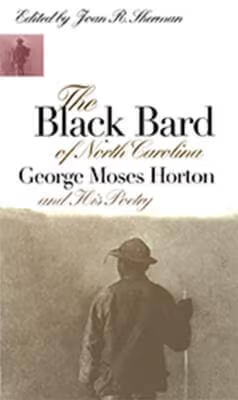
The Black Bard Of North Carolina: George Moses Horton And His Poetry
Buy from AALBC
Add to Cart — $25.00More Book Details
Poetry, Hardcover, 168 pages
Publisher: University of North Carolina Press
ISBN: 9780807846483
 Bookshop
Description of The Black Bard Of North Carolina: George Moses Horton And His Poetry
For his humanistic religious verse, his poignant and deeply personal antislavery poems, and, above all, his lifelong enthusiasm for liberty, nature, and the art of poetry, George Moses Horton merits a place of distinction among nineteenth-century African American poets. Enslaved from birth until the close of the Civil War, the self-taught Horton was the first American slave to protest his bondage in published verse and the first black man to publish a book in the South. As a man and as a poet, his achievements were extraordinary.
In this volume, Joan Sherman collects sixty-two of Horton’s poems. Her comprehensive introduction—combining biography, history, cultural commentary, and critical insight—presents a compelling and detailed picture of this remarkable man’s life and art.
George Moses Horton (ca. 1797-1883) was born in Northampton County, North Carolina. A slave for sixty-eight years, Horton spent much of his life on a farm near Chapel Hill, and in time he fostered a deep connection with the University of North Carolina at Chapel Hill. The author of three books of poetry, Horton was inducted into the North Carolina Literary Hall of Fame in May of 1996.
Inlcudes 62 of Horton Poems from his three books of Poetry
For his humanistic religious verse, his poignant and deeply personal
antislavery poems, his folk verse, and, above all, his lifelong enthusiasm
for liberty, nature, and the art of poetry, George Moses Horton merits a
place of distinction among nineteenth-century African American poets.
Enslaved for sixty-eight years - from his birth until the close of the Civil
War - he was the first American slave to protest his bondage in published
verse, the first black man to publish a book in the South, and the only
slave to earn a significant income through the sale of his poems. As a man
and as a poet, Horton’s achievements were extraordinary. In this volume,
Joan Sherman collects sixty-two of Horton’s poems. Her comprehensive
introduction - which combines biography, history, cultural commentary, and
critical insight - presents a compelling and detailed picture of this
remarkable man’s life and art. Covering a wide range of poetical subjects in
varied verse forms, this collection is an eloquent testament to Horton’s
unique voice.
For his humanistic religious verse, his poignant and deeply personal
antislavery poems, and, above all, his lifelong enthusiasm for liberty,
nature, and the art of poetry, George Moses Horton merits a place of
distinction among nineteenth-century African American poets. Enslaved from
birth until the close of the Civil War, the self-taught Horton was the first
American slave to protest his bondage in published verse and the first black
man to publish a book in the South. As a man and as a poet, his achievements
were extraordinary.
In this volume, Joan Sherman collects sixty-two of Horton’s poems. Her
comprehensive introduction—combining biography, history, cultural
commentary, and critical insight—presents a compelling and detailed picture
of this remarkable man’s life and art.
- Acrostics
- The Art Of A Poet
- The Cheerless Condition Of Bachelorship
- The Close Of Life
- Connubial Felicity
- The Creditor To His Proud Debtor
- Death Of An Old Carriage Horse
- Division Of An Estate
- Early Affection
- Excited From Reading The Obedience Of Nature To Her Lord In Vessel Sea
- Execution Of Private Henry Anderson
- Farewell To Frances
- The Fate Of An Innocent Dog
- The Fearful Traveller In The Haunted Castle
- For The Fair Miss M. M. Mcl(ean)
- Gen. Grant — The Hero Of The War
- George Moses Horton, Myself
- The Graduate Leaving College
- Gratitude
- Heavenly Love
- The Horse Stolen From The Camp
- Imploring To Be Resigned At Death (from Poetical Works)
Let me die and not tremble at death,
But smile at the close of my day,
And then, at the flight of my breath,
Like a bird of the morning in May,
Go chanting away.
Let me die without fear of the dead,
No horrors my soul shall dismay,
And with faith’s pillow under my head,
With defiance to mortal decay,
Go chanting away.
Let me die like a son of the brave,
And martial distinction display,
Nor shrink from a thought of the grave,
No, but with a smile from the clay,
Go chanting away.
Let me die glad, regardless of pain,
No pang to this world to betray;
And the spirit cut loose from its chain,
So loath in the flesh to delay,
Go chanting away.
Let me die, and my worst foe forgive,
When death veils the last vital ray;
- The Intemperance Club
- Jefferson In A Tight Place
- Liberty
- Lincoln Is Dead
- Lines To My —
- Love
- Man, A Torch
- Meditation On A Cold, Dark And Rainy Night
- My Native Home
- New Fashions
- The Obstruction Of Genius
- On An Old Deluded Suitor
- On Hearing Of Intention .. To Purchase The Poet’s Freedom
- On Liberty And Slavery
- On Summer
- On The Evening And Morning
- On The Pleasure Of College Life
- On The Poetic Muse
- On The Truth Of The Saviour
- On Winter
- One Generation Passeth Away And Another Cometh
- The Poet’s Feeble Petition
- Praise Of Creation
- Reflections From The Flash Of A Meteor
- The Retreat From Moscow
- Rosabella — Purity Of Heart
- The Slave
- The Slave’s Complaint
- A Slave’s Reflections The Eve Before His Sale
- Slavery (1)
- Slavery (2)
- Snaps For Dinner, Snaps For Breakfast, And Snaps For Supper
- Song Of Liberty And Parental Advice
- The Southern Refugee
- The Tippler To His Bottle
- To Eliza
- To The Muse
- Troubled With The Itch, And Rubbing With Sulphur
- The Union Of Parties
- The Woodman And Money Hunter
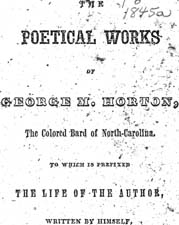 THE
POETICAL WORKS of GEORGE M. HORTON, The Colored Bard
of North-Carolina, to which is prefixed The Life Of The Author, Written by
Himself.
THE
POETICAL WORKS of GEORGE M. HORTON, The Colored Bard
of North-Carolina, to which is prefixed The Life Of The Author, Written by
Himself.
Excerpt from The Poetical Works
From the importunate request of a few individuals, I assume the difficult
task of writing a concise history of my life. But to open a scene of all the
past occurrences of my life I shall not undertake, since I should fail by
more than two-thirds in the matter. But if you will condescend to read it, I
will endeavor to give a slight specimen entirely clear of exaggeration. A
tedious and prolix detail in the matter may not be of any expected, since
there is necessarily so much particularity required in a biographical
narrative.
I was born in Northampton county, N C., near the line of Virginia, and
within four miles of the Roanoke River; the property of William Horton,
senior, who also owned my mother, and the whole stock of her children, which
were five before me, all girls, but not of one father. I am the oldest child
that my mother had by her second husband, and she had four younger than
myself, one boy and three girls. But to account for my age is beyond the
reach of my power. I was early fond of music, with an extraordinary appetite
for singing lively times, for which I was a little remarkable. In the course
of a few years after my birth, from the sterility of his land, my old master
assumed the notion to move into Chatham, a more fertile and fresh part of
country recently settled, and whose waters were far more healthy and
agreeable. I here become a cow-boy, which I followed for perhaps ten years
in succession, or more. In the course of this disagreeable occupation, I
became fond of hearing people read; but being nothing but a poor cow-boy, I
had but little or no thought of ever being able to read or spell one word or
sentence in any book whatever. My mother discovered my anxiety for books,
and strove to encourage my plan; but she, having left her husband behind,
was so hard run to make a little shift for herself, that she could give me
no assistance in that case. At length I took resolution to learn the
alphabet at all events; and lighting by chance at times with some
opportunities of being in the presence of school children, I learnt the
letters by heart; and fortunately afterwards got hold of some old parts of
spelling books abounding with these elements, which I learnt with but little
difficulty. And by this time, my brother was deeply excited by the assiduity
which he discovered in me, to learn himself; and some of his partial friends
strove to put him before me, and I in a stump now, and a sorry instrument to
work with at that. But still my brother never could keep time with me. He
was indeed an ostentatious youth, and of a far more attractive person than
myself, more forward in manly show and early became fond of popularity to an
astonishing degree for one of his age and capacity. He strove hard on the
wing of ambition to soar above me, and could write a respectable fist before
I could form the first letter with a pen, or barely knew the use of a
goose-quill. And I must say that he was quite a remarkable youth, as
studious as a judge, but much too full of vain lounging among the fair sex.
But to return to the earlier spring of my progress. Though blundering, I
became a far better reader than he; but we were indeed both remarkable for
boys of color, and hard raising. On well nigh every Sabbath during the year,
did I retire away in the summer season to some shady and lonely recess, when
I could stammer over the dim and promiscuous syllables in my old black and
tattered spelling book, sometimes a piece of one, and then of another; nor
would I scarcely spare the time to return to my ordinary meals, being so
truly engaged with my book. And by close application to my book at night, my
visage became considerally emaciated by extreme perspiration, having no
lucubratory aparatus, no candle, no lamp, nor even light-wood, being chiefly
raised in oaky woods. Hence I had to sit sweating and smoking over my
incompetent bark or brush light, almost exhausted by the heat of the fire,
and almost suffocated with smoke; consequently from Monday morning I
anticipated with joy the approach of the next Sabbath, that I might again
retire to the pleasant umbrage of the woods, whither I was used to dwell or
spend the most of the day with ceaseless investigation over my book. A
number strove to dissuade me from my plan, and had the presumption to tell
me that I was a vain fool to attempt learning to read with as little chance
as I had. Playboys importunately insisted on my abandoning my foolish
theory, and go with them on streams, desport, and sacrifice the day in
athletic folly, or alibatic levity. Nevertheless did I persevere with an
indefatigable resolution, at the risk of success. But ah! the oppositions
with which I contended are too tedious to relate, but not too formidable to
surmount; and I verily believe that those obstacles had an auspicious
tendency to waft me, as on pacific gales, above the storms of envy and the
calumniating scourge of emulation, from which literary imagination often
sinks beneath its dignity, and instruction languishes at the shrine of
vanity. I reached the threatening heights of literature, and braved in a
manner the clouds of disgust which reared in thunders under my feet. This
brings to mind the verse of an author on the adventurous seaman.
"The wandering sailor ploughs the main,
A competence in life to gain;
The threatening waves around him foam,
’Till flattering fancy wafts him home."
For the overthrow and downfal of my scheme had been repeatedly threatened. But with defiance I accomplished the arduous task of spelling (for thus it was with me,) having no facilitating assistance. From this I entered into reading lessons with triumph. I became very fond of reading parts of the New Testament, such as I could pick up as they lay about at random; but I soon became more fond of reading verses, Wesley’s old hymns, and other peices of poetry from various authors. I became found of it to that degree, that whenever I chanced to light on a piece of paper, so common to be lying about, I would pick it up in order to examine it whether it was written in that curious style or not. If it was not, unless some remarkable prose, I threw it aside; and if it was, I as carefully preserved it as I would a piece of money. At length I began to wonder whether it was possible that I ever could be so fortunate as to compose in that manner. I fell to work in my head, and composed several undigested pieces, which I retained in my mind, for I knew nothing about writing with a pen, also without the least grammatical knowledge, a few lines of which I yet retain. I will give you the following specimen. On one very calm Sabbath morning, a while before the time of preaching, I undertook to compose a divine hymn, being under some serious impression of mind:
Rise up, my soul and let us go
Up to the gospel feast;
Gird on the garment white as snow,
To join and be a guest.
Dost thou not hear the trumpet call
For thee, my soul, for thee?
Not only thee, my soul, but all,
May rise and enter free.
The entire book may be viewed at The University of North Carolina at Chapel Hill Website