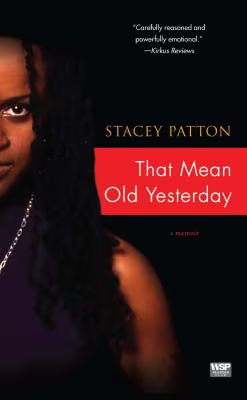
That Mean Old Yesterday: A Memoir
Buy from AALBC
Add to Cart — $20.99More Book Details
Imprint: Washington Square Press
(Sep 16, 2008)
Nonfiction, Paperback, 320 pages
Publisher: Simon & Schuster, Inc.
ISBN: 9780743293112
Nonfiction, Paperback, 320 pages
Publisher: Simon & Schuster, Inc.
ISBN: 9780743293112
 Bookshop
Description of That Mean Old Yesterday: A Memoir
An astonishing coming-of-age memoir by a young woman who survived the foster care system to become an award-winning journalist
On a rainy night in November 1999, a shoeless Stacey Patton, promising student at NYU, approached her adoptive parents’ house with a gun in her hand. She wanted to kill them. Or so she thought.
No one would ever imagine that the vibrant, smart, and attractive Stacey had a childhood from hell. After all, with God-fearing, house-proud, and hardworking adoptive parents, she appeared to beat the odds. But her mother was tyrannical, and her father turned a blind eye to the years of abuse his wife heaped on their love-starved little girl.
Now in her beautiful memoir, Stacey links her experience to the legacy of American slavery and successfully frames her understanding of why her good adoptive parents did terrible things to her by realizing they had terrible things done to them.
On a rainy night in November 1999, a shoeless Stacey Patton, promising student at NYU, approached her adoptive parents’ house with a gun in her hand. She wanted to kill them. Or so she thought.
No one would ever imagine that the vibrant, smart, and attractive Stacey had a childhood from hell. After all, with God-fearing, house-proud, and hardworking adoptive parents, she appeared to beat the odds. But her mother was tyrannical, and her father turned a blind eye to the years of abuse his wife heaped on their love-starved little girl.
Now in her beautiful memoir, Stacey links her experience to the legacy of American slavery and successfully frames her understanding of why her good adoptive parents did terrible things to her by realizing they had terrible things done to them.