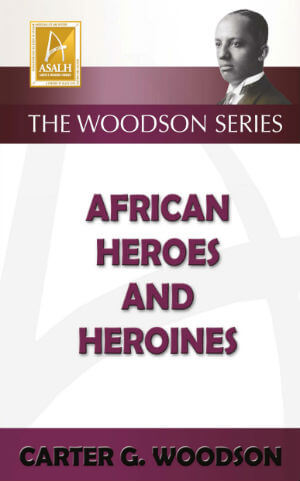
African Heroes and Heroines
Buy from AALBC
Add to Cart — $16.95More Book Details
Nonfiction, Paperback, 272 pages
Publisher: Black Classic Press
ISBN: 9781574781281
 Bookshop
Excerpt
CHAPTER VI
IN STATES TO THE SOUTHWEST
Elsewhere the natives on or near the West Coast had not developed such political organizations as those which have already been noticed. Much has been circulated about the native Congo empire which the Portuguese finally christened as San Salvador under religious influence in the southwest, but even there trade and diplomacy under the pretext of modern enlightenment won the day for the imperialists. While there was imposed the yoke which the other natives wore, it was carried out less hurriedly and more sympathetically than when the early European traders effected their occupation of the western littoral. Natives were made to believe that they were of the same human family as the Portuguese, selected youths were educated in Portugal under Christian influence, and a native prince thus prepared was elevated to the throne of San Salvador as a founder of a new dynasty which runs back with close connection and significant achievement in Christianization for about four centuries.
In the carrying out of this early program, however, the Portuguese with all their profession of Christianity were considered by the Africans as enemies. The Portuguese encountered especially the opposition of the Ngola, from which comes the designation of that territory as Angola. A colony was established there in the name of the king who had no vassals since the chief had made only to the donatory. Troubles of administration arose out of trade in cattle, slaves, and ivory. The Portuguese province of Benguela was set up especially for this traffic, and in order to extend the jurisdiction of it for the purpose of trade, encroached upon natives who protested. Luis Mendes de Vasconcellos, who became governor in 1616, undertook to dethrone the opposing Ngola chief and set on his throne another who would rule in the name of “Christianity” and for the extension of the slave trade. Although the chief’s kraal was destroyed, his subchiefs forced into submission, and a tribute imposed upon them, the Portuguese governor was so hard pressed that he found it necessary to make peace with the chief and his fearless sister, Ginga.
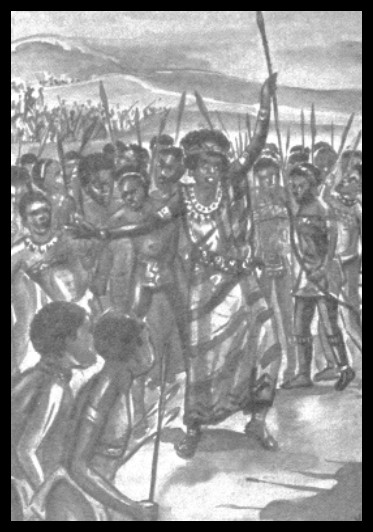
Ginga came as the ambassadress to treat with the Portuguese, and as a stroke of diplomacy accepted Christian baptism. Dissatisfied with the way things had been going under her brother, she had him dethroned in the midst of a rising in which he lost his life in 1623. She next began to stir up against the Portuguese the chiefs who had submitted to the foreigners. A force sent against her seized her camp on Ndangi Island, in the Cuanza, but she escaped to continue as a thorn in the side of the invaders. The Portuguese with alacrity pursued her as far as Quissima, where they captured her two sisters, but Ginga escaped from them again, taking refuge far away in Congo, from which she continued to harass the conquerors. While others yielded, this brave woman chose exile and hardships rather than abandon her rightful claims.
Read The Woodson Series’s description of African Heroes and Heroines .
Copyright © 2016 Black Classic Press/Carter G. Woodson. No part of this excerpt may be reproduced or reprinted without permission from the publisher or author.
Reader Comments (0)
Log In to Join the Conversation
Commenting is reserved for registered AALBC members to maintain high-quality discussions.
No comments yet. Be the first to share your thoughts!
Advertisement