Pulitzer Prize Winning Books by Black Writers (includes Finalists)
← Back to Main Awards Page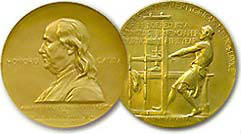
Since 1917 the Pulitzer Prize has honored excellence in journalism and the arts. The first award was presented in 1918. The Prize recognizes American authors in six “Letters and Drama” categories; Biography/Autobiography, Fiction, General Non-Fiction, History, Poetry, and Drama (technically not a book award, but plays are all available as books and have been included here).
The first African-American writer to win a Pulitzer Prize in any of the above categories was Gwendolyn Brooks who received the award for poetry for her collection Annie Allen in 1950.
2 Books were Finalists or Winners of Pulitzer Prizes in 2018
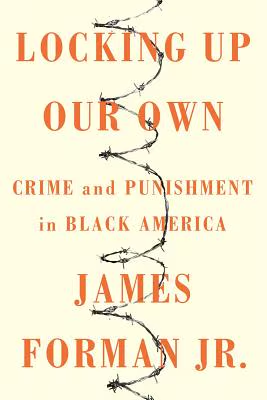
Locking Up Our Own: Crime and Punishment in Black America
Buy from AALBC
Add to Cart — $27.00More Book Details
Nonfiction, Hardcover, 320 pages
Publisher: Macmillan Publishers
ISBN: 9780374189976
 Bookshop
Long-listed for the National Book Award
One of The New York Times Book Review s 10 Best Books of 2017
Short-listed for the Inaugural Goddard Riverside Stephan Russo Book Prize for Social Justice
In recent years, America s criminal justice system has become the subject of an increasingly urgent debate. Critics have assailed the rise of mass incarceration, emphasizing its disproportionate impact on people of color. As James Forman, Jr., points out, however, the war on crime that began in the 1970s was supported by many African American leaders in the nation s urban centers. In Locking Up Our Own, he seeks to understand why. Forman shows us that the first substantial cohort of black mayors, judges, and police chiefs took office amid a surge in crime and drug addiction. Many prominent black officials, including Washington, D.C. mayor Marion Barry and federal prosecutor Eric Holder, feared that the gains of the civil rights movement were being undermined by lawlessness and thus embraced tough-on-crime measures, including longer sentences and aggressive police tactics. In the face of skyrocketing murder rates and the proliferation of open-air drug markets, they believed they had no choice. But the policies they adopted would have devastating consequences for residents of poor black neighborhoods.A former D.C. public defender, Forman tells riveting stories of politicians, community activists, police officers, defendants, and crime victims. He writes with compassion about individuals trapped in terrible dilemmas from the men and women he represented in court to officials struggling to respond to a public safety emergency. Locking Up Our Own enriches our understanding of why our society became so punitive and offers important lessons to anyone concerned about the future of race and the criminal justice system in this country.
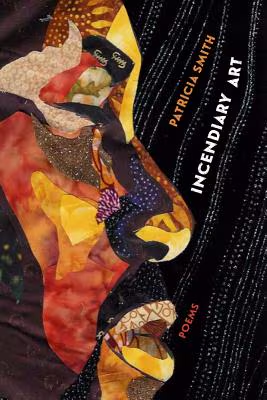
Incendiary Art: Poems
Buy from AALBC
Add to Cart — $18.95More Book Details
Poetry, Paperback, 112 pages
Publisher: Northwestern University Press
ISBN: 9780810134331
One of the most magnetic and esteemed poets in today s literary landscape, Patricia Smith fearlessly confronts the tyranny against the black male body and the tenacious grief of mothers in her compelling new collection, "Incendiary Art." She writes an exhaustive lament for mothers of the "dark magicians," and revisits the devastating murder of Emmett Till. These dynamic sequences serve as a backdrop for present-day racial calamities and calls for resistance. Smith embraces elaborate and eloquent language ""her gorgeous fallen son a horrid hidden / rot. Her tiny hand starts crushing roses one by one / by one she wrecks the casket s spray. It s how she / mourns a mother, still, despite the roar of thorns"" as she sharpens her unerring focus on incidents of national mayhem and mourning. Smith envisions, reenvisions, and ultimately reinvents the role of witness with an incendiary fusion of forms, including prose poems, ghazals, sestinas, and sonnets. With poems impossible to turn away from, one of America s most electrifying writers reveals what is frightening, and what is revelatory, about history. "
Reader Comments (0)
Log In to Join the Conversation
Commenting is reserved for registered AALBC members to maintain high-quality discussions.
No comments yet. Be the first to share your thoughts!
Advertisement