|

W. Frank Fountain is the President of the
DaimlerChrysler Corporation Fund, the automobile company's
philanthropic organization. On January 1, 2004, he was also
named Senior Vice President, External Affairs and Public
Policy (Auburn Hills) of the Chrysler Group. In that
capacity, Mr. Fountain is responsible for maintaining and
coordinating DaimlerChrysler's interface with state and
local governments across the country.
His other areas of responsibility include Community
Relations and National Education Programs. Since joining
Chrysler in 1973 as an Investment Analyst, Fountain has held
numerous positions of increasing responsibility in
Chrysler's Corporate Controller's Office, the Treasurer's
Office and Chrysler's Government Affairs Office in
Washington, D.C.
Born in Brewton, Alabama on July 17, 1944, Frank, Jr. was
the eldest of Willie Frank and Janie Fountain's seven
children. The Fountain family operated a small farm in the
town of Tunnel Springs which is where he learned the value
of what he refers to as 'working hard and working smart.'
Mr. Fountain holds a bachelor's degree in history and
political science from Hampton University, an MBA from the
University of Pennsylvania Wharton School, and an honorary
doctorate of public service degree from Central Michigan
University. Prior to embarking on his illustrious
professional career, he served as a Peace Corps volunteer in
West Bengal, India, applying the lessons he had learned on
his family's farm to aid in the improvement of agricultural
techniques.
Frank Fountain The DaimlerChrysler Interview
with Kam Williams
KW: Hi Frank. Thanks for the time. I don't know
whether you're aware that you're speaking with a fellow
Wharton alumnus.
FF: Great!
KW: Given your being such an important pillar of the
community in Detroit, first off, I have to ask you about
your embattled Mayor, Kwame Kilpatrick. Do you think he
should step down?
FF: Well, Kam, our focus for quite a long time now
has been on the economic revitalization of the city. Mayor
Kilpatrick's administration played a significant role in
that, as did [his predecessor] Mayor Archer's
administration, along with the business community. I expect
that effort to continue. We have good momentum that has been
the result of very hard work by all. And we hope that the
issues surrounding Mayor Kilpatrick will be resolved. In the
meantime, we are focused on continuing the progress that has
been contributing to the revitalization of the city.
KW: What did you think when Senator McCain while campaigning
in Michigan said that things were going to get worse there
before they get better.
FF: Well, Detroit is a tough town. We've been through
many difficult economic cycles before. What we're
experiencing now, with the housing slump, the sub-prime
mortgage crisis and the escalating price of oil, are all
issues beyond our control. But we've survived many downturns
before, and I think the smart money is guessing that we will
survive this one.
KW: Many political pundits are suggesting that if Michigan's
Democratic delegates aren’t seated at the convention, the
state will definitely go for McCain in November. Do you
agree?
FF: No, I think the people of Michigan knew what we
were getting into when we voted to change the primary date.
So, it's only fair if the Democratic National Committee is
going to enforce what it made clear at the outset. I think
we should take our medicine and live with it.
KW: What role did your service in the Peace Corps play in
shaping you?
FF: Kam, it had an immense impact on my life. I grew
up a poor farm boy in Southwest Alabama who had some sense
that the world was bigger and wider than just my little neck
of the woods. Being inspired by Dr. Ralph Bunche, the first
black person to receive the Nobel Peace Prize, I decided to
start a career in the foreign service, and I felt that the
Peace Corps was the way to do it. I think my life has been
richer because of that volunteer effort. It was not well
understood at the time by my family and friends, but I would
recommend that kind of service to anyone today. Whether
international or domestic, there's no greater reward that
one can receive than contributing their blood, sweat and
time to their fellow human beings.
KW: What did you do while over there in India?
FF: I was in West Bengal teaching farmers how to grow
high-yielding varieties of rice.
KW: Have you been back since the Subcontinent's economic
boom of the last ten years or so?
FF: I have not, Kam, but I have remained involved
with the organization and just last week I was informed that
on June 19th I am going to be presented the Director's
Award, the American Peace Corps's highest honor.
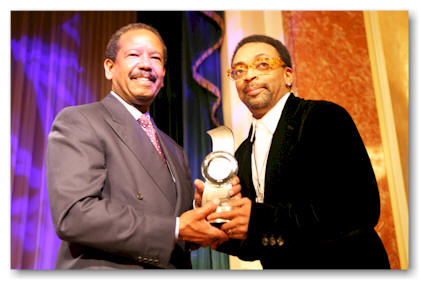
KW: Congratulations! You recently presented Spike Lee with
Chrysler's Sixth Annual Behind the Lens Award for excellence
in the entertainment industry. Why Spike?
FF: He is one of today's most prolific and respected
artists. He has helped launched the careers of many,
including household names like Halle Berry, Samuel L.
Jackson and Denzel Washington. Spike has had a major and
very positive impact on the film industry and for over 20
years he's been willing to address issues and stories others
have shied away from. So, he was a natural selection for
this year's award.
KW: He's not too controversial a character for a
Fortune 500 corporation?
FF: Well, Spike has certainly been synonymous with
thoughtfulness. He's been provocative, and an activist. We
believe that, sometimes, it's important to make change in
society. So, as a good corporate citizen interested in
everyone having an opportunity to display and show their
talents, we felt Spike Lee deserved this award.
KW: What sort of reception did you receive as a black man
upon entering the corporate world after you graduated from
Wharton with an MBA in 1973? That must have been a very
tough time to try to integrate the white-collar business
world.
FF: There certainly weren’t many blacks in corporate
America at the time. But as you know very well, Wharton
prepares you to go into the corporate world and lead, not
just get a job, but to lead. I understood that very well.
I've never been just a follower. And even though there
weren’t any great African-American mentors to hitch my wagon
to, I made my way. Whether or not people are standing at the
door with welcoming arms, what's important is that you get
in and demonstrate your abilities and earn your rightful
recognition and place. That's what I've done at Chrysler,
and it's been a very long and rewarding career.
KW: What was the last book you read?
FF: I must say that I buy books regularly, I have
quite a collection, and I've started many books, but I can't
remember the last one I got all the way through.
KW: Is there a question no one ever asks you, that you wish
someone would?
FF: [Laughs] That's a great question, but no.
KW: You were on Detroit's School Board for a number of
years. What do you see as the remedy for the low
African-American graduation rate we're witnessing all over
the country nowadays?
FF: Kam, I wish I had the answer for that. The answer
isn't just with the kids. It's also with teachers, the
principals, and the parents. And beyond that, it's with the
culture to a certain extent. Most of our young people are
being born to single parents. Those statistics are
absolutely startling. If you can't read by the time you're
six years-old, the chances of being able to complete school
successfully is very small, and the likelihood of ending up
in prison is very great. So, I don't think it's poverty per
se. If you put a kid in a very caring environment with
caring and concerned teachers, he or she is going to learn
and have a great chance of breaking out of the cycle.
Unfortunately, most of our educational system is a
bureaucracy. And the problem isn't just limited to Detroit.
We find it in Baltimore, Chicago, Washington, DC, Los
Angeles and elsewhere. In most of these cities, the
destinies of black kids are in the hands of black folks. We
can no longer point the finger. We may be short of resources
in some of our school districts, but we're not so short as
to be unable to teach. There is nothing more important or
vital to the black community than making sure that all of
our kids get an education. Nothing. I'm sorry, but I'm going
to have to run, Kam.
KW: Thanks, Frank, for a great chat.
FF: Same here, and I'd be happy to talk to you
anytime in the future.
KW: Yeah, we’ll have to do it again.
Named by Detroit Crain's as one of the most connected
business leaders in Detroit, Frank has given back to the
community as a member of many business and professional
organizations and by serving on numerous boards of
directors, including:
 |
Detroit Public Schools Board of Education (4/99 -
2/03) |
|
|
Detroit Regional Chamber of Commerce ’ Vice Chair
|
|
|
Museum of African American History
|
|
|
Hudson - Webber Foundation
|
|
|
Michigan Manufacturers Association
|
|
|
Community Foundation of Southeast Michigan
|
|
|
WTVS ’ Channel 56 (Public Television)
|
|
|
Music Hall
|
|
|
The Wharton School Board of Overseers
|
|
|
Hampton University Board of Trustees - Chair
|
|
|
Metro Detroit Convention & Visitors Bureau
|
|
|
Citizens Research Council of Michigan - Chair
|
|
|
International Visitors Council of Metro Detroit
|
|
|
The Detroit Investment Fund
|
|
|
New Detroit ’ Vice Chair
|
|
|
Dennis W. Archer Foundation
|
|
|
Economic Club of Detroit
|
|
|
Corporate Council on Africa ’ Vice Chair
|
|
|
Detroit Metro Sports Commission
|
|
|
Africare
|
|
|
Focus Hope Advisory Board
|
|
|
Metropolitan Affairs Coalition (MAC) ’ Past Chair
|
|
|
Mackinac Center for Public Policy Advisory Board
|
|
|
Joint Center for Political & Economic Studies ’ Vice
Chair |
|
|
Business Council of Alabama
|
|