|
Making ’Friends' with Lisa
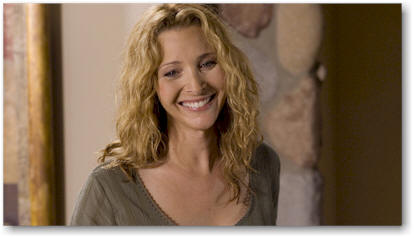
Lisa Marie Diane Kudrow was born in Encino, California on
July 30, 1963 to Nedra, a travel agent, and Lee, a physician
specializing in headaches. Lisa came belatedly to acting, having
focused more on athletics and academics both in high school and
in college. She attended Vassar where she earned a BS in
Psychobiology while playing tennis on the school's varsity team.
After graduating from college, she returned to the West Coast
where she contemplated following in her father's footsteps. In
fact, she was working as a medical researcher when her brother's
best friend, the actor Jon Lovitz, suggested she consider
showbiz and encouraged her to audition for the legendary improv
comedy troupe ’The Groundlings.’
The brainy beauty was accepted into the ensemble and proceeded
to hone her skills until she started landing bit roles on TV
shows like Cheers, Newhart and Coach. Her big break came in 1992
when she was hired to portray Ursula Buffay, a recurring
character on Mad about You.
A couple of years later, she parlayed that success into the role
she will probably forever be associated with, namely, that of
Phoebe Buffay, on Friends. During that landmark series' ten-year
run, Lisa would win an Emmy and more nominations than any of her
talented co-stars. Still, all three Friends' female cast members
would make history by signing contracts paying them a record
million dollars each per episode.
Meanwhile, Lisa's screen career heated up, too, in the wake of
critical acclaim for memorable performances in everything from
Analyze This to Romy and Michele's High Schoool Reunion to
Wonderland. And on top of her acting accolades, she was named
one of the 50 Most Beautiful People in the World by People
Magazine. The following year, she gave birth to a son, Julian,
the focus of her and her husband Michael's life.
Here, she talks about all of the above and more, and about her
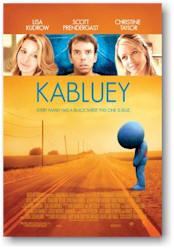
new film, Kabluey, a ’melan-comedy’ co-starring Scott
Prendergast where she plays a frazzled mother raising a couple
of kids alone while her National Guardsman husband is serving in
Iraq.
The Kabluey Interview with
Kam Williams
KW: Hi Lisa, thanks for the time. I'm really honored to be
speaking with you.
LK: Sure.
 KW:
I've got four pages of questions for you, some from fans who I'd
alerted that I'd be interviewing you. KW:
I've got four pages of questions for you, some from fans who I'd
alerted that I'd be interviewing you.
LK: Uh-oh.
KW: What interested you in this film and gave you the confidence
to go with a first-time director like Scott Prendergast?
LK: Well, I've had good experiences with first-time
directors, especially with director-writers, because they wrote
it and know what the story is since they saw it as they were
writing it. In Scott's case, I could tell from the script that
he saw it as he was writing. There was nothing in there that
made think, ’Gee, that would be impossible to shoot.’ And then I
spoke with him on the phone and he wasn't crazy, but just a
smart, funny guy. Also, it turned out by coincidence that we had
mutual friends since he had been in The Groundlings program.
KW: Who else was at The Groundlings when you were there?
LK: Let's see, Julia Sweeney, Kathy Griffin, Heather
Morgan, Tim Bagley, Patrick Bristow, Mindy Sterlling and
Jennifer Coolidge were all there when I was in the company. And
I remember voting on Will Ferrell and Cheri Oteri.
KW: I saw that you were recently at an event in support of the
new G.I. Bill. Is that something you feel passionately about?
LK: I was there because it was just the right thing to
do. It's crazy that there's been any hesitation in signing it.
KW: Kabluey touches on similar themes.
LK: One thing I liked about Scott's movie was that it
wasn't really taking a stand on the war, except in that the
National Guardsmen were the first to go, and they kept getting
extended, and the people at home hadn’t signed up for military
careers, none of them had. Meanwhile the benefits are being cut.
KW: Tell me a little about your character, one of those military
wives left behind to care for two young kids all alone.
LK: Leslie, who I played, is not one of those
extraordinary people who could cope. She's a regular person who
had difficulty coping with something she wasn't prepared for.
The movie doesn't make her a hero, really, but not everybody is
extraordinary.
KW: I was pleasantly surprised by how different the movie was
from Stop-Loss and those other heavy-handed dramas exploring
similar issues.
LK: Right. No, it doesn't take a stand on the war. It's
just that the war is so destructive of these people who aren’t
really equipped to cope. The whole world that Scott created in
Kabluey is a bunch of numb people who aren’t even listening to
each other or even thinking two steps ahead. It's almost like a
science fiction movie to me. They’re like Zombies.
 KW:
Even Scott's character inside the mascot costume somehow served
as a metaphor for a sort of detachment, despite all the
slapstick. KW:
Even Scott's character inside the mascot costume somehow served
as a metaphor for a sort of detachment, despite all the
slapstick.
LK: Yeah, I liked that, too. And when I watched the movie
my reaction was, ’Ooh! I'm like the drama.’ I'm in the drama
portion of the movie.
KW: This is a movie which could have easily fallen apart, but
you had the ability to combine the comedic and dramatic elements
convincingly and seamlessly.
LK: That's really a testament to Scott. He wrote it and
directed it. And it's a tricky movie. It's a comedy and a drama.
KW: Scott calls it a melan-comedy. Despite your being associated
with comedy because of Friends, we can see from this film that
you can do drama, too, and have an extraordinary emotional
range. Which is your preference drama or comedy?
LK: I don't think I have a preference. I like doing both
a lot. I do love comedy, especially these darker comedies. But
when I'm doing anything, I often wonder whether I should turn on
my version of what the comedy switch is, because it's always
either on or off.
KW: It must be hard for you at times to hold back, given not
only your tremendous success but your intelligence. People
shouldn’t be fooled by any of the bimbos you've played. I know
that you have a degree in Psychobiology. In fact I read that
your nickname is ’Smart.’ Is that true?
LK: No, although in college someone did call me Einstein.
But I think he was being sarcastic. [Laughs]
KW: After you graduated from Vassar, you returned to Los
Angeles. Were you planning to follow in your father's footsteps?
LK: Yeah, though not exactly following in his footsteps.
I planned to do graduate work to have a better understanding of
brain chemistry and how it has evolved.
KW: Is it true that Jon Lovitz played a pivotal role in your
altering those career plans?
LK: Yeah, he's my brother's best friend, so I grew up
with Jon, and knew he was always studying acting. And after he
finished college it was always exciting watching when he was a
guest star on a show. Then, when I graduated, he got Saturday
Night Live. That was really inspiring to me because I'd seen him
struggling for so long. Before that, I always thought of the
actors in movies as almost mystical, as if that never happened
to regular people. So, John's success made realize, ’No, no, if
you pursue it, then it's a possibility.’ He suggested that I go
to The Groundlings, because he said that's where he learned the
most useful stuff of all the acting schools he went to. So, I
followed his advice.
KW: Had you studied acting before?
LK: No, not at all. In junior high, I wrote some
sketches, but not in high school or college. I was pre-med.
KW: I read that you went to school with Daniel Pearl, the Wall
Street Journal reporter who was beheaded by Muslim extremists in
Pakistan just for being Jewish.
LK: Yeah, we went to the same junior high school, and a
good friend of mine was very, very close to him.
KW: Did your family lose anyone in the Holocaust?
LK: Yeah.
KW: Were either of your parents survivors?
LK: No, my parents were both born here, but they were
first-generation American. It's funny you should ask because
we're currently producing a genealogy show called ’Who Do You
Think You Are?’ which was a hit in Great Britain. Just
yesterday, in fact, I was giving my family history to the
producers, so they could start their research to see if there
are enough documents to support a whole episode.
KW: Sounds interesting.
LK: But it's so strange that you would ask me that,
because I was just thinking and talking about it again this
morning. I was wondering, what would I do, if I learned that
some of my relatives had been in concentration camps? I know
that a lot of my family died over there, but not in
concentration camps.
KW: How far back can you trace your lineage now?
LK: I don't know much more than my grandparents. It all
stops there. To me it's fascinating when you start putting your
ancestors' lives in historical context, and how that forced some
big decisions that made the difference between surviving and not
surviving. I like the idea of looking at a lot of the little
things that I always took for granted which explain why I'm even
here.
KW: Especially given what eventually happened in Europe. What
will you do if it turns out some of your relatives were in
concentration camps?
LK: As part of the show, I'd go visit the places.
KW: In the last ten years or so, there have been a number of
powerful Holocaust documentaries, like Fighter in which a couple
of 70 year-old survivors return to Europe to return to their
roots while debating what Jews could have done to prevent the
genocide.
LK: It's called Fighter? That sounds very good.
KW: It's excellent. Let me shift gears again and ask you how did
it feel to be named one of the 50 Most Beautiful People in the
World?
LK: Oh’ I guess I should just say, ’That was really
nice!’ Except that’ [hesitates] Oh, never mind.
KW: No, go ahead. What were you going to say?
LK: Honestly, mostly what strikes you is, ’I'm not really
one of the 50 Most Beautiful. It's just that I had a movie that
did well.’ [Chuckles] Still, it's nice, if it brainwashes anyone
into thinking it's true.
KW: I noticed that you're left-handed. They say that lefties are
more creative. Do you think that might have led you to the Arts?
LK: I don't know. Are there a disproportionate number of
left-handed people in the arts?
KW: I don't have any statistics, but that's what I've always
heard.
LK: I think in certain fields, some of the extraordinary
ones are left-handed. It always made me feel that lefties are
special.
KW: You once said, ’You become a celebrity, not because of your
work or what you do, but because you have no privacy. I've been
careful to keep my life separate because it's important to me to
have privacy and for my life not to be a marketing device for a
movie or a TV show. It's worth more than that. I'm worth more
than that.’ How have you managed to stay out of the tabloids?
LK: Oh, I just try to be as uninteresting as possible,
even though in some ways it's not good business, in terms of
show business, because this business does really insist that
people get to see you. So, you need to go out, and you need to
stay interesting. But I made a decision to be a little less
interesting and to let the work I do stand on its own. Do you
know what I mean? That’ll just have to be good enough because I
have a family, and they have to be a priority. Whatever legacy I
can hand over to my son has to be as a good parent more than
anything else.
KW: That's admirable. But can you go to the supermarket or the
mall or a movie theater?
LK: Yeah, I can go. People stop, and they look. And some
might ask for a picture or for you to sign something, but that's
as bad as it gets, in general, especially, L.A. But if you go to
touristy places, then you become one of the attractions, because
what are the odds of seeing Phoebe? But I understand that, so I
do stay away from those places.
KW: After Friends, you created and starred-in a
critically-acclaimed, but short-lived show called The Comeback,
about a sitcom star trying to resuscitate her career. Was that
difficult?
LK: Difficult? No. I thought the whole idea was
hilarious. So, it was effortless. What I was making fun of was
that notion that celebrity is a career, that it doesn't matter
what you actually do, as long as you get your picture somewhere,
that's success. It's worth it, even if you have to allow
yourself to be followed around and humiliated. That was the
joke.
KW: Where do you like to vacation?
LK: Well, we go to the south of France every summer
because my husband's whole family is there. And that's
beautiful.
KW: Do you miss Friends, and your friends from Friends?
LK: Yes I do.
KW: The
Tasha Smith question: Are you ever afraid?
LK: Yeah, of different things.
|

Dreams from My Father: A Story of Race and Inheritance
Click to order via
Amazon
Audio CD
Publisher: Random House Audio; Abridged edition (May 3,
2005)
Language: English
ISBN-10: 0739321005 |
KW: Bookworm
Troy Johnson asks: What was the last book you read?
LK: I listen to books on tape. The last one was
Barack Obama’s Dreams from My Father.
KW: ’Realtor to the Stars' Jimmy Bayan asks where in L.A. you
live?
LK: Where in L.A.? L.A. [Laughs]
KW: Tell me a little about your upcoming films, like Hotel for
Dogs.
LK: My son saw a preview of it, and he's excited. That's
good, because that's kinda who I did it for. That's the only
movie of mine he's old enough to see.
KW: And how about Powder Blue?
LK: It was great, because all my scenes were with
Forest Whitaker, and he loves what he's doing. That always
makes it easier.
KW: Do you want to say anything about Analyze This?
LK: Yeah, wasn't it good?
KW: Absolutely!
LK: I was lucky that I got to do it. That's how I feel
about that movie.
KW: You worked with Damon Wayans on Marci X, and no matter who I
speak to, they always tell me how great the Wayans Brothers are.
Did you have that same experience?
LK: I can say the exact same thing. What a family! The
best part about doing that movie was get to work with and talk
with Damon Wayans, because he's just really smart. My son was
really little at the time. We had just moved to New York and it
was very hard on him. I was in a panic and working 17 hours a
day on the movie, and Damon was very helpful and supportive. He
had life experience from raising four kids, and his priorities
were pretty clear. And he's really grounded about work, too.
KW: How did it feel to be the highest paid actress in the
history of television at a million dollars an episode, along
with your Friends co-stars?
LK: We were? Great!
KW: Will there be a Friends movie?
LK: Not that I know of. That's a rumor that I'm asked
about by reporters only.
KW: Is there a question nobody ever asked you that you wish
somebody would?
LK: Interesting. I've never thought about that’ No.
KW: How do you want to be remembered?
LK: Like I said, in terms of my family, as a good mother,
as a good wife, as a good sister, a good daughter and a good
friend. By the general public, I guess ’Yeah, she was funny.’
[Chuckles]
KW: Lisa, thanks again for the interview, and best of luck with
both your family and career.
LK: Great! Thanks so much.
Related Links Kabluey - Film
Review by Kam Williams
http://reviews.aalbc.com/kabluey.htm
|