Dante James: The “Huey P. Newton Documentary” Interview
Emmy-Winning Director Invites Investors in Black Panther Biopic
Dante James is an Emmy Award-winning independent filmmaker who has produced and directed critically-acclaimed documentary and dramatic films. He is also the assistant director of the African Cultural Center at North Carolina State University (NCSU).
Prior to joining the faculty at NCSU, he was an Artist in Residence and Instructor at Duke University. In 2006, he won a National Emmy for his work as series producer of the well-received PBS series, "Slavery and the Making of America." James’ most recent offering, “Harlem in Montmartre: A Paris Jazz Story,” was awarded Best Documentary at the 2010 Pan African International Film Festival in Cannes, France.
In 2008 he wrote, produced and directed “The Doll,” an adaptation of a classic short story by Charles W. Chesnutt. That picture received the Best Dramatic Short Film Award at that year’s Hollywood Black Film Festival.Earlier in his career, Dante executive produced the PBS series, "This Far by Faith" for Blackside Films in Boston, Massachusetts. He was also honored with the DuPont Columbia Silver Baton for his work at Blackside.
Mr. James has a Bachelor of Arts Degree from Grand Valley State University and a Master of Arts in Liberal Studies from Duke University. In 2008 he was awarded an honorary Ph.D., a Doctorate of Humane Letters by Grand Valley State University.
During the summer of 2010 he served as a guest lecturer at the University
of Cape Town in South Africa. And he plans to return to Cape Town to make a
film with a black South African resident of the Khayelitsha Township. A
member of the Directors Guild of America and the Writers Guild of America,
Dante is currently developing an independent feature-length documentary
about
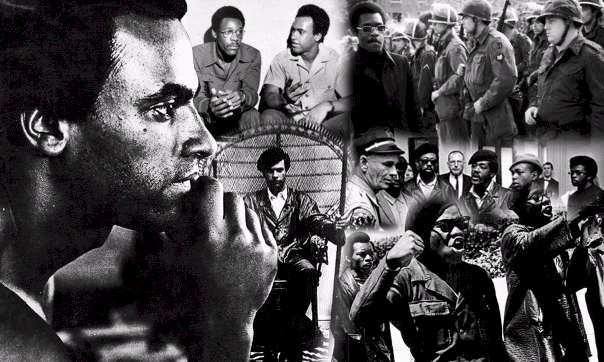
Huey P. Newton and the Black Panther Party.
Kam Williams: Hi, Dante, thanks for the interview. How ya been, bro?
Dante James: Hi Kam, thank you for your continued interest in my work. The
last few months have been really busy. I’m enjoying my responsibilities as
assistant director of NCSU’s African-American Cultural Center and all of my
film projects. The independent feature and, of course, the feature
documentary on Huey P. Newton and the Black Panther Party are moving
forward.
KW: What interested you in doing a documentary about Huey Newton?
DJ: As a young person, I was interested in the Black Panther Party and their
efforts to serve the needs of the community while also having the courage to
confront oppressive exploitative forces in the community. That interest grew
as I got older and, as you are aware, all of my films explore some aspect of
the African American experience. So, a film on Huey P. Newton and the Black
Panther Party is an opportunity to grow intellectually while also exploring
an often misrepresented movement.
KW: Do you think that the Panthers have been slighted by history because J.
Edgar Hoover was so successful at destroying the Party?
DJ: That is a very interesting question. I think the misrepresentations of
the Black Panther Party are certainly connected to J. Edgar Hoover and his
unrelenting efforts to destroy the Party. For about ten years, Hoover
illegally used the power of the federal government along with black
informants to create dissention within the Party and to present a negative
image of the Party to the general public. Additionally, in concert with
local police officials, Hoover used brutal force in his effort to destroy
the Black Panther Party. The images and accounts of these efforts have
misrepresented the Black Panther Party movement. Historically, and even
today, external forces including the government, the mainstream corporate
media and academics have defined the Black Panther Party. This film will be
the first to tell the story of the Black Panthers from inside the Party.
Black Panther Party members will define themselves and their movement.
KW: How did you get David Hilliard to participate in the project?
DJ: Actually David who was Huey P. Newton’s childhood friend, a founding
member of the Party and its Chief of Staff, approached me. David also led
the Party during the time that Huey and
Bobby Seale were incarcerated. David
and I spent several months talking about the film in terms of a conceptual
framework at the same time that I conducted my own research. During these
conversations David would tell me these incredible stories about Huey’s
vision for the party, the inner workings of the party, the mistakes they
made, the successful maneuvers, and the pain and agony of the murder of
Party members. One of the main misconceptions of the party is grounded in
the concept of armed struggle. While there were factions of the party who
pushed an armed struggle agenda, that was not Huey’s vision. This was a
leading source of tension within the Party and it will be a major story
focus of the film.
KW: What about Bobby Seale, who I think of as the only other surviving
founder of the Black Panthers?
DJ: I haven’t had a chance to speak to Bobby Seale yet. I have been working
very closely with David Hilliard and I’m thrilled to have the support of
Fredrika Newton, Huey’s widow and the president of The Dr. Huey P. Newton
Foundation. Of course, we want to and will speak to Bobby Seale but the
story of the Black Panther Party, in essence, is the story of Huey Newton.
Huey had his own personal issues. He was complex, he was brilliant, and he
was a student of history, politics and economic theory. Clearly, Huey P.
Newton was the leader and standard bearer of the Black Panther Party.
KW: What sort of archival footage will you have access to?
DJ: David was very forward thinking in terms of the legacy of the Black
Panther Party. He has every issue of the newspaper, hours of unseen film
footage and unheard audio recordings, documents and correspondence. It’s
these materials that will facilitate our efforts to tell the story of Huey
Newton and the Black Panthers from inside the Party. To that end, we need
support from the public to raise the development funds to catalogue these
materials and to have film footage cleaned and transferred to a digital
format. We are asking that conscious and critical thinking individuals go to
Kickstarter.com and contribute to the project. It is essential that people
contribute today because we only have 21 days left to raise the development
funds at
http://www.kickstarter.com/projects/1649581507/the-story-of-huey-p-newton-and-the-black-panther-p
.
KW: Will you also be looking at documents made available by the Freedom of
Information Act proving the U.S. government’s infiltration of and war on the
Panthers via the FBI’s Cointelpro program?
DJ: Another major story line is the violence and oppression of the Black
Panther Party under the auspices of the Cointelpro program. David Hilliard
actually led the party during the most violent assaults by the FBI because
both Huey Newton and Bobby Seale were incarcerated. David obviously has
first had knowledge of this time period and his knowledge will be
supplemented with Freedom of Information Act documents.
KW: How many original Panthers are still around to interview?
DJ: I’m not certain how many original Panthers are still around but David’s
brother, June Hilliard, and Huey’s older brother, Melvin Newton, will be
essential to the storytelling. Additional contributors include, but are not
limited to, Elaine Brown, who led the BPP during Huey Newton’s exile, and
Fredrika Newton. Other key people are Che Billy Brooks, Minister of
Education of the Chicago Chapter, Larry Little, the leader of the
Wilmington, North Carolina chapter, and Kumasi Simmons the foremost
authority on George Jackson and the prison movement.
KW: Do you know yet what, besides Huey, will be the primary focus of the
film?
DJ: Another major theme will be the efforts of the Black Panther Party to
serve the needs of the community. The philosophy of the Black Panther Party,
as defined in the 10-Point Program, addressed the basic needs and desires of
the community. It was bold and decades ahead of its time. The 10-Point
Program demanded that America serve the needs of the people. If you look at
the status of black and poor Americans, it is obvious that the demands of
the party are still unfilled. Therefore, this history and the story of the
Black Panther Party remain very relevant to contemporary society.
KW: Will you be discussing the New Black Panthers? When I interviewed Bobby Seale, he was furious that they’ve appropriated the name, because he sees
them as having a totally different agenda.
DJ: David Hilliard and the Huey P. Newton Foundation have no connection to
the New Black Panthers.
KW: What do you want people to take away from the movie?
DJ: We want young people to know that Huey P. Newton and the Black Panthers
were very young. They were in their twenties but they had the courage to
confront oppressive forces and struggle to make America live up to its
promise of equality and justice for all its citizens. We want young people
to know that it is now their responsibility to carry the struggle forward.
And, of course, I think it is paramount that the Black Panther Party be
afforded an opportunity to define themselves and their movement outside of
the mainstream, corporate-controlled media.
KW: How long will it take you to complete the project?
DJ: Once we secure production financing, it will take 12-14 months to make
the film. But the most pressing challenge is to secure the development funds
so, again, I ask that people go to Kickstarter.com today and contribute to
the project.
KW: How much more money are you looking to raise?
DJ: The production budget is $700,000 dollars, which is not a big budget for
a feature documentary film. We are exploring possibilities with private
investors because this film and this story cannot be conformed to the
artistic, editorial and content standards of broadcast outlets,
corporations, and foundations. In the context of a business venture, our
research indicates that the film will have strong domestic and international
market appeal. So, I want it to be clear that we are seeking investors not
funders. Investors can fully expect a return on their investment.
KW: Dante Lee, author of "Black Business Secrets,” asks: What was the best
business decision you ever made, and what was the worst?
DJ: My best decision was to starting to put money away for retirement at an
early age. My worst decision was not taking advantage of an opportunity to
invest in the stock market as a teenager.
KW: If you could have one wish instantly granted, what would that be for?
DJ: That everyone who reads this article go to Kickstarter and support the
film. And that people who have the resources will realize how important it
is to define our own history, tell our own stories, and invest in this film.
KW: The Ling-Ju Yen question: What is your earliest childhood memory?
DJ: Trying to keep up with my late older brother Mike, who grew up to be a
brilliant artist and passed away much too soon.
KW: The Kerry Washington question: If you were an animal, what animal would
you be?
DJ: That’s easy, a black panther, because I respect the commitment and
courage of the Black Panther Party. But I could also see being a
thoroughbred racehorse. They are an interesting mix of power, speed, agility
and beauty.
KW: What is your guiltiest pleasure?
DJ: Spoiling my four-year-old granddaughter, Destiny.
KW: The Sanaa Lathan question: What excites you?
DJ: It’s exciting to see Destiny learn and grow. I also teach at North
Carolina State University and it’s exciting to inspire my students.
KW: The Pastor Alex Kendrick question: When do you feel the most content?
DJ: When know that my family is happy and secure and when I’m working on a
film.
KW: The Judyth Piazza question: What key quality do you believe all
successful people share?
DJ: Confidence and determination.
KW: Thanks again for the time, Dante, and best of luck with the film.
DJ: It’s been great talking with you, as always, Kam.
Click to invest in the Huey Newton documentary
Reader Comments (0)
Log In to Join the Conversation
Commenting is reserved for registered AALBC members to maintain high-quality discussions.
No comments yet. Be the first to share your thoughts!
Advertisement