Prophet Shelby Explains Why Black Messiah Obama Won’t Win

Photo Credit: Hoover Institution
Shelby Steele is a controversial public intellectual who often
finds himself at the center of controversy because of his conservative
stances on such issues as Affirmative Action, reparations, welfare and
other government entitlement programs. As an African-American, this
makes him a much in demand media darling who Republicans wheel out
whenever they need a black man to weigh-in on a hot-button issue.
Consequently, he’s been a popular guest on the TV talk show circuit
where he has generally been reduced to speaking in sound bites. For this
reason it was very enlightening to see him recently speak at length in
’What Black Men Think,’ a brilliant documentary by Janks Morton which
afforded Shelby a fair opportunity to air his political philosophy. In
that context, he seemed sincerely concerned about alleviating the plight
of black folks, and not merely a right-wing apologist.
By profession, Steele is a research fellow at the Hoover Institution at
Stanford University. He is the author of the New York Times bestseller
’The Content of Our Character: A New Vision of Race in America,’ which
won the National Book Critics’ Circle Award. He is a contributing editor
at Harper’s Magazine, and his work has also appeared in The New York
Times, The Wall Street Journal, The New Republic, Newsweek, and The
Washington Post.
For his work on the PBS television documentary ’Seven Days in
Bensonhurst,’ he was recognized with both an Emmy Award and a Writers
Guild Award. In 2004, President George W. Bush, citing Steele’s "learned
examinations of race relations and cultural issues," honored him with
the National Humanities Medal.
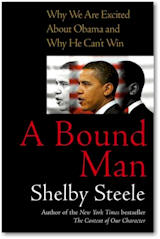
Here, Shelby talks about his provocative new book
A Bound Man: Why We
Are Excited about Obama and Why He can't Win.
Shelby Steele: The Why Obama can't Win Interview
with Kam Williams
KW: Hey, Shelby, how are you?
SS: Pretty good, how are you?
KW: Thanks for the time.
SS: Sure.
KW: Well, I found much of what you had to say in your new book
thought-provoking. But do you have any second thoughts about your Obama
prediction, or about making it the subtitle of your new book?
SS: Well, I don't know if I did that well, here. [Chuckles] You know,
you're sitting there trying to come up with a subtitle. This wasn't the
best one. Nevertheless, I still think it may be difficult for him to go
all the way.
KW: If he gets the nomination, you can be sure that McCain and the
Republicans are going to mount a serious campaign.
SS: Right, there’s a long way to go. But that wasn't the point off my
book, obviously, so I regret that title.
KW: ’Why Obama can't Win’ sounds like an attention-grabber dreamed up by
somebody in the marketing department. But let me ask you about your
first book, ’The Content of Our Character.’ I actually agreed with much
of what you had to say in that book, but it seemed that soon thereafter
you became a media darling among conservatives who were quick to co-opt
some of your words as a rationale for dismantling Affirmative Action.
Did you sense how you might be being used in this fashion?
|
|
SS: I take responsibility for what I write. I came to have really strong
views about Affirmative Action. In the next book I wrote, ’A Dream
Deferred,’ I took on the issue a lot more directly. But it’s always
there, even in ’White Guilt.’ So, here you are, where people are
inviting you to speak about what you really believe. That’s how that
went. Certainly, in the media, there have not been many black voices
that have argued against Affirmative Action with any decent logic.
KW: I reviewed your book ’White Guilt,’ where you said ’I walked right
into stigmatization as an Uncle Tom.’ How did that make you feel to be
seen this way?
SS: Well, this is interesting, and I think it relates to my Obama book
where I talk about ’bargaining’ and ’challenging’ and how we, as blacks,
entering this great American mainstream wearing a mask because, when
you're a minority, you don't have the same power as the majority. That’s
something that has just been a part of our survival mechanism. Well, I
tried not to wear those masks, not to give whites the benefit of the
doubt or to hold them on the hook, but to simply speak as an individual.
I knew that if you're going to do that in a society that has this
history, this past, and this way of relating through masks and so forth,
that you're going to get some blowback. So, I was not surprised, and I
fully accept that you can't write the way I’ve written and not get
blowback. You will. And in fact, you learn from it. It sharpens me and I
hope it makes me a better writer.
KW: To be honest, after loving your first book, I was disillusioned by
the way that you seemed to become a Republican spokesperson for the
anti-Affirmative Action movement. However, I recently came to appreciate
you again when I saw you in
Janks Morton’s documentary ’What Black Men
Think.’ It really showed you in a new light.
SS: Right. Oh yeah, I think it’s a really great film. One of the points
it made for me, both participating in it and then later viewing it, is
that you get a chance to see how these ideas that are often labeled
conservative actually come out of a great concern for black America and
the direction it is headed. And I think Janks’ film established that
context.
KW: I agree, even though I see myself as a progressive liberal,
politically. What was the extent of your involvement with the project?
SS: Janks came out and conducted the interview. Then he left, and I had
no idea what to expect. When I saw it, it blew me away. It was a
powerful piece of work. And he did it in such a way that made it
palatable. It wasn't shrill or preachy.
KW: In your Obama book, you say he won’t win because he has to wear
masks to win. don't the white candidates have to do that, too?
SS: All politicians are going to mask to some degree in order to present
themselves in away they think will get them votes. What’s different in
Obama’s case is that he’s wearing a racial mask, this ’bargainer’s’
mask, and I think very effectively, whereby he gives whites the benefit
of the doubt. He’s essentially saying, ’I am going to presume you are
not racist, if you won’t hold my race against me.’ So, his mask is a
distinctly racial one. This approach is old. It’s been around for a long
time. There have been black bargainers all the way back to Louis
Armstrong, and I’m sure even far back beyond that.
KW: Well, when you compare Obama to Louis Armstrong that makes me think
of Satchmo’s smiling and mugging deferentially with the big
handkerchief. Do you think that’s a fair comparison?
SS: Well, Armstrong came from a whole different world 100 years ago. And
he had to do things that, obviously, no black has to do today, thank
God. Certainly, Obama doesn't have to adopt those sorts of hideous
expressions. Yet, at the same time, he does strike this bargain which
makes white people feel this comfort with him because he is in code
saying to them, ’I’m not going to rub America’s shameful racial history
in your face. You can look at me and you can support me with comfort.’
And whites are so grateful, they come out in great numbers and they are
his basic constituency. My problem with Obama is that he’s not a new
paradigm; he’s an old paradigm. A new paradigm would be somebody like
Harold Ford [former Democratic Congressman from Tennessee] or Michael
Steele [former Republican Lieutenant Governor of Maryland], no relation,
both of whom present themselves as individuals, and don't seem to wear a
mask. They don't ’bargain;’ they don't ’challenge.’ So, I see them as
fresh, and as evidence of what I hope will be a new trend. There’s a
pathos to Obama in that so much of his power and his political support
grows out of this mask as opposed to people responding to him as an
individual.
KW: What I’m curious about Obama is, where did he get his black accent,
if he wasn't raised around black people, but by a white mother from
Kansas? Does his voice sound authentic or adopted to you? I figured you
might have an insight about this since your mother’s white, too.
SS: It sounds a little hollow. Sometimes, he’s Martin Luther King,
sometimes, he a black militant from the Sixties, then he’s a Baptist
minister. He can be so different. There’s not yet an Obama voice. That
troubles me on other levels. It’s hard to know what bag he’s going to
come out of when he takes to the podium. you're making the point that,
given his background, he doesn't have the flava’, that he’s a bit
artificial and struggling to get there. Yeah, sure, that is part of what
I talk about in the first half of the book. I think this need to belong
has trailed him all of his life.
KW: It reminds me of a guy who tried to befriend me in college, saying,
’We mulattoes have to stick together.’ I didn't understand why he was
trying to bond, because, even though I’m light-skinned, both of my
parents were black and I had been raised in a black neighborhood, so I
obviously had a different set of life experiences. What was your
childhood like having one black parent and one white parent?
SS: I grew during segregation in an all-black segregated neighborhood
with segregated schools, etcetera. I was raised by a great father, my
hero, who I much admired. So, I never really had anxiety in the way that
someone like Obama would have. When he walks down the street alone,
since no one knows who his mother is, they’re just going to see him as a
black guy. That’s the fact of it. He has to be a black, yet he has an
insecurity about it, and maybe overcompensates. I talk about that in the
book. Part of it comes from a desire to establish your bona fides as a
black.
KW: Did you feel that you had to deny half of who you are, because the
world only saw you as black?
SS: I think my situation was probably different from somebody younger
than I who came up after segregation and maybe grew up in an integrated
or mostly white suburb. I was raised in a completely black world. In
those days, if a white woman married a black man, she lived as a black
woman, and that was just the end of it. So, I don't have a feeling of
being bi-racial. I don't have a connection to it. People often come up
to me thinking I do have a connection to it, and I kind of let them down
because I really don't. My mother was deeply involved in a black
community and when she died, these are the people who came to her
funeral. Still, I do empathize with the younger people who may feel
torn. I just myself have not had that feeling.
KW: Do you think it’s possible for a black male born in America to
transcend the bind of having to choose between being a ’negotiator’ and
a ’challenger,’ like Jack Johnson did in his day.
SS: Good question. Jack Johnson was famous for not wearing any mask.
Yes, I do think it’s possible today, but you will probably pay the kind
of price that Shelby Steele has paid. You’ll get some blowback for it,
because your own group is going to have some expectations of you. Take
me, for example. I decided to live as an individual and as I grew older,
and thought more, and read more and experienced more, my views became
more conservative. But my group is liberal. Not only that, they say, ’If
you're not liberal and not a Democrat, you're not black. If you're
conservative, you're a sellout.’ Here, then, I’m living with that kind
of a pressure against my individuality. I have to throw it off, because
my experience in life tells me that the values that are now being
labeled ’conservative’ are the only way that blacks can get ahead. So,
my individuality is my gift to my people. I’m sure that, in the long
run, it will be taken that way.
KW: Is there, then, a third type of black person, different from the
’negotiator’ and the ’challenger.’
SS: Yes, the individual who doesn't bargain with whites, but deals with
them as an individual. In other words, I’m not going to play a racial
game. With me, you're going to meet a guy named Shelby Steele, and you
will have to get to know me as an individual. The color of my skin won’t
tell you anything. I think there’s more and more of that in America.
KW: I think Obama started his campaign trying to be neutral in terms of
color, but the Clintons have been trying to bait him by playing the race
card ever since they lost the Iowa.
SS: Right, they are. But it’s probably redounded against them. I would
love to see us, as blacks, get to the place where we say, ’I’m not going
to play race games with you. Here I am. This is who I am. Take it or
leave it.’
KW: I'd go along with your approach in a world where racism and
discrimination didn't still exist.
SS: I don't let that stop me from being an individual. My honest opinion
is that blacks have to fight much harder for their individuality than
whites do. That’s still the case, because of this history of masking
that’s been with us for so long that the idea of a black individual is
still new. So, we have to fight harder for it.
KW: Interesting. In your book you relate an anecdote about a black man
who you felt obviously exaggerated the amount of racism he had faced,
saying he’d been profile-stopped by the same cops 20 times.
SS: I just wanted to make the point that there’s a poetic truth as well
as the literal truth. Part of our identity is the idea that racism is
still there and that we are vulnerable to it. So, the question is, ’How
vulnerable?’ In other words, is it really a problem for us, or is it
just a small thing. How do you evaluate racism in America on a scale of
1 to 10? My suspicion is that most blacks overrate it a bit. Not to say
it’s not there, but we overrate it because this masking is part of our
relationship to the larger society. This is a way we keep whites on the
hook. We keep them obligated, and we keep ourselves entitled. There’s an
incentive, you see, to inflate it a little bit.
KW: I can see what you're saying, but I also know that discrimination
definitely still exists.
SS: Sure, and if you're getting harassed, it’s not helpful to know that
racism has generally declined in America, when you're still experiencing
it. That is a reality that we're still vulnerable to. However, what I’ve
tried to do in my work is point out the underside of it that almost
gives you an investment in racism. Also, it stigmatizes us. That’s my
biggest problem with it. It steals our thunder. No matter how
accomplished we may be, just any little white person can come up and
say, ’Well, you wouldn’t be here, if it weren’t for Affirmative Action.’
You put power in white people’s hands, and then they use it against you.
It’s a trick bag.
KW: I'd go along with eliminating Affirmative Action, if the playing
field were truly leveled.
SS: We have laws on the books. If somebody’s discriminating against you,
I strongly advocate suing them. That’s the most effective thing you can
do in terms of fighting racism. People understand that they’re
vulnerable to lawsuit
KW: I think it would be even more effective if they made discrimination
in housing, employment, or education a criminal offense.
SS: There you go. I’m with you. I wrote a piece in the New York Times
back in the Nineties saying that racial discrimination ought to be a
criminal offense, not just a civil one. I’m all for the criminalization
of discrimination.
KW: Wonders never cease. I never expected to find myself agreeing with
Shelby Steele so much.
SS: If you are a minority, it is important that you have legal ways to
defend yourself in the society in which you live.
KW: Do you think ’negotiators’ like
Oprah would be enjoying their
success, if ’challengers’ like Reverends Al Sharpton and Jesse Jackson
didn't exist?
SS: Probably not. Barack Obama ought to send Al Sharpton a check. It’s
precisely the specter of a really aggressive ’challenger’ such as Al
Sharpton, who constantly tries to keep whites off-balance, that makes
whites like Barack Obama. He’s saying, ’I’m not going to do that. I’m
going to be an anti-Al Sharpton.’ That’s what so excites whites. Yes,
it’s absolutely the presence of these ’challengers’ that helps make
’bargaining’ effective.
KW: Bookworm
Troy Johnson wants to know: What was the last book you
read?

SS: The last book that I read was a novel called ’The Bad Girl’ by Mario
Vargas Llosa.
KW: And
Columbus Short asks: Are you happy?
SS: [Laughs] Yes.
KW: Is there any question you wish somebody would ask you, but nobody
ever asks?
SS: Yes, about the craft of writing, but I think that might bore your
readers.
KW: Not at all. What is your approach to writing?
SS: My background is literature. That’s what my doctorate is in. So, it
remains the love of my life. Whatever I’m doing, I try to write well. I
try to give the reader a nice, clean well-written surface, where the
writing is transparent. It probably takes me longer to write things, but
it’s very important to me that the writing itself be good. I know that
whatever power Shelby Steele has always comes out of the writing. I’m
not the greatest television pundit or the best public speaker, so it’s
my writing that’s most important.
KW: Although I may disagree with your politics, I grant that your
writing style is excellent. However, I have noticed one recurring
grammatical error in your last two books, several split infinitives.
Although William Safire pronounced them acceptable over ten years ago or
so, they’re still like nails on the blackboard to me.
SS: I split more than you know. I do it now only if I feel that it
sounds smoother. I'll also occasionally end a sentence with a
preposition, which is verboten.
KW: You know what? That rule I don't mind breaking.
SS: Grammar does evolve.
KW:
Toni Morrison called Bill Clinton the first black president. Do you
agree?
SS: [Chuckles] Yes, the black identity is grounded in ’challenging,’ not
in ’bargaining.’ What the Clintons have always done is embraced
challenging. They can't have enough photo opportunities with Al Sharpton
or Jesse Jackson. They communicate to blacks that they agree with their
challenging identity. So, in a sense, Hillary is blacker than Barack.
[Laughs] Their alignment with this black identity makes them ’black’ in
a metaphorical sense, I guess,
KW: Do you think Obama lost an opportunity during that debate when he
was asked about Bill being the first black president and he just made a
joke about dancing instead of answering it seriously?
SS: His strategy is to get away from anything having to do with race as
quickly as he can. He might have made a serious comment, but his fear is
that that might open a Pandora’s Box. And then he’d be mired in race
again. My guess is he wanted to make a joke, which I thought was a funny
one, and move on. He doesn't ever want to get close to race.
KW: Have you endorsed anyone yet?
SS: No, I haven't.
KW: What will be the subject of your next book?
SS: I hope it’ll be on foreign affairs. I'd like to look at Islamic
extremism and terrorism a lot more carefully. I'll probably move away
from race for a while.
KW: If you love literature so much, why not write a novel.
SS: I hope to. My rule is, whatever is the most urgent is what I do
next.
KW: Did you read the
interview I did with Stephen Carter?
SS: No, but I know he’s done exactly that, started writing novels.
KW: Yeah, he got a $4 million advance to write his first novel after
first publishing several very successful non-fiction books. And, they’ve
tried to pigeonhole him as a black conservative, like you, but he says
he doesn't mind being seen as religious, but he says he’s not political.
SS: He has every right not to be.
KW: Well, thanks for the time, Shelby, this has been a great
conversation.
SS: I’ve enjoyed it very much.
KW: I think people are going to get a kick out of hearing your ideas
fully fleshed-out.
SS: Find another pretext to call me. We can chat again.
KW: Will do. Absolutely! Now I feel horrible about some of the things
I’ve written about you in the past.
SS: don't worry about.
KW: Well, I did enjoy this Obama book, and I loved your first one, ’The
Content of Our Character.’
SS: Well, thank you. That means a lot to me.
Reader Comments (0)
Log In to Join the Conversation
Commenting is reserved for registered AALBC members to maintain high-quality discussions.
No comments yet. Be the first to share your thoughts!
Advertisement