Spike Lee: The Miracle at St. Anna Interview
Miracle of St. Spike
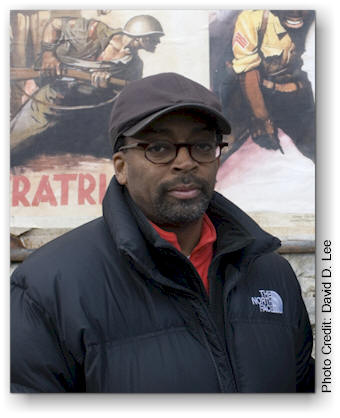
Spike Lee is back with his first full-length feature since Inside Man (2006), the NYC crime caper which netted over $100 million at the box office alone. That picture’s commercial success enabled the Oscar-nominated director to interest Disney in backing Miracle at St. Anna, a big budget WWII saga shot mostly in Europe.
The movie’s script, adapted by James McBride from his own historical novel, is a fact-based adventure revolving around the heroic exploits of four black GIs (Derek Luke, Laz Alonso, Michael Ealy and Omar Benson Miller) who became separated from their unit while fighting behind enemy lines in Italy in 1944.
Spike as two children and is married to novelit and health guru Tonya Lewis Lee. Here, Spike talks not only about his new film, but about the prospect of his beloved Knicks during the upcoming NBA season, and about his feud with Clint Eastwood.
 Spike Lee:
The Miracle at St. Anna Interview
Spike Lee:
The Miracle at St. Anna Interview
with Kam
Williams
KW: What interested you in making Miracle at St. Anna?
SL: Reading the original source, James McBride’s novel. The
man’s a great writer. That’s what drew me to the project.
KW: How was it filming on location in Europe for the first time?
SL: It was a great experience. Practically this whole film was
shot in Italy. I'd love to shoot over there again soon, maybe
not in Italy, but somewhere else.
KW: What was the most challenging aspect of shooting?
SL: Tuscany is one of the most beautiful places on Earth, and
you have to hike that equipment up the mountains and hills to
get those shots. But that’s just part of the job. I would love
to make another movie there. The light there is wonderful. You
can not get that on the back lot in a studio. The small village
the soldiers stumble into is 800 years-old. Where we able to
shoot at a lot of locations where actual incidents took place,
like the massacre. I think it adds something for both the cast
and crew when they know they’re standing on the same exact spots
as the scenes they’re recreating.
KW: How was it collaborating with
James McBride, who also wrote
the script?
SL: It was a great working experience, and I think that he would
say the same thing. We had disagreements, but we respected each
other’s opinion, since we both wanted what was best for the
film.
KW: Mr. McBride says Miracle at St. Anna is fiction inspired by
real events. Can you tell me some of things in the story that
are real?
SL: Well, the 92nd Division, the Buffalo soldiers, they did
fight in Tuscany against the Nazis. The massacre in St. Anna di
Stazzema on August 12, 1944 where the Nazis’ 16th Division of
the SS slaughtered 560 innocent Italian civilians really
happened. The statue head, that’s real, too.
KW: Would you say Miracle at St. Anna is more than a war movie?
SL: This film is definitely more than just a war film. Of all
the movies I’ve done, this one, by far, has more discussions of
religion, faith and hope. That reflects James McBride’s novel
which is all about hope, faith, prayer, belief and God.
KW: What do you expect people to take away from this movie?
SL: I’m not in the business of telling audiences what to think.
I respect their intelligence, and they’ll make up their on minds
about what they think.
KW: During World War II, America’s armed forces were segregated
and the Department of Defense directed embedded cameramen not to
film African-American GI’s in action. And no blacks were
subsequently featured in any of the early war films from the
Forties and Fifties, and none were awarded the Congressional
Medal of Honor for bravery in World War II until Bill Clinton
belatedly corrected the glaring oversight during his presidency.
Was your purpose in making this movie an attempt to rectify the
deliberately whitewashed version of history?
SL: Well, that was part of it, because at the time these black
men were fighting for the United States, the Army was still
segregated. And they not only fought the Fascists and the Nazis
for the Red, White and Blue, but they had to fight Jim Crow down
South once they got home. But the whole movie isn't about the
Buffalo Soldiers. We spent a great deal of time with the
Italians, too, and the story is framed within a murder mystery.
But nonetheless, there’s been a great omission here, and the
surviving Buffalo Soldiers I’ve spoken to are elated that we're
doing this film.
KW: NYU History Professor Yvonne Latty urged Clint Eastwood,
even before he began production on Flags of Our Fathers, to
include black soldiers in the film since somewhere between 700
and 900 African-Americans had fought on Iwo Jima. She even sent
him a copy of her book about these forever unsung heroes, but to
no avail. Is this the basis of your ongoing beef about the movie
with Eastwood?
SL: I’m glad you're saying that, because it needs to be known
that there were people saying stuff to Clint even before he shot
the film. So, this stuff is on record. I was not the first one
to voice those sentiments.
KW: As far as I can tell, you're the only film director who
individually credits every musician who plays on his soundtrack.
Why do you do that?
SL: Because I grew up in a jazz household, my father [Bill Lee]
is a great jazz bassist, and I value the contributions of the
musicians and the composer. My father did the scores for my
movies in film school, and for She’s Gotta Have It, School Daze,
Do the Right Thing and Mo’ Better Blues. And Terence Blanchard
did all the scores for my films since. Musicians are great
artists. In my opinion, I think they’re the greatest artists. If
somebody gets credit for pushing a dolly or holding a boom mike,
why should someone who’s playing the violin, the bass, the
trumpet, the French horn or the oboe not get credit too? They
contributed as much as anybody else. That’s why I give musicians
credit in my films.
KW: I appreciate that, being from St. Albans, which was an
enclave of black musicians when I was growing up in the Fifties
and Sixties.
SL: Yeah, I know it had James Brown’ Count Basie’ and my man
Milt Hinton.
KW: Count Basie lived up the block. We used to swim in his pool
as kids. You know who else lived in St. Albans? Coltrane, Billie
Holiday, Ella Fitzgerald, Oliver Nelson, Lena Horne and Illinois
Jacquet to name a few off the top of my head. But it was first
integrated by Jackie Robinson, along with baseball. Speaking of
sports, how do you think the Knicks will do this season?
SL: Well, I hope we have a winning record. [Laughs] Notice I
said ’hope.’
KW: Where in Brooklyn did you grow up?
SL: We were the first family to move into Cobble Hill, which at
the time was primarily an Italian neighborhood. Cobble Hill is
right by the Brooklyn docks, and almost all the people that
worked the docks were Italian back then when the waterfront was
alive and thriving. Funny thing, we got called ’nigger’ a couple
of times, when we first moved in, until they saw that there
weren’t anymore black families moving in behind us. We never had
any more incidents after that.
KW: The
Columbus Short question: Are you happy?
SL: Yeah, very happy.
|
Click to order via Amazon ISBN: 1400082773 |
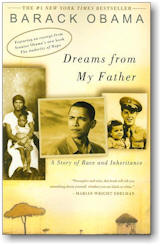
KW: The bookworm
Troy Johnson question: What was the last book
you read?
SL: Dreams from My Father by Barack Obama.
KW: Who are you supporting for president?
SL:
Barack Obama!
KW: The
Tasha Smith question: Are you ever afraid?
SL: Everybody’s afraid.
KW: What has been your biggest disappointment?
SL: My biggest disappoint so far was when I couldn't get that
Jackie Robinson film made. And then, when I couldn't get the Joe
Louis-Max Schmeling film made, or the James Brown bio-pic.
KW: Do you have a bio-pic in the works?
SL: Yes I do. I just optioned the right to the autobiography of
a black physicist and professor at the University of Connecticut
named Ronald Mallett called The Time Traveler. He’s drawn up the
blueprint for a time machine.
KW: Is there a question no one ever asks you, that you wish
someone would
SL: Not really.
KW: The Music Maven
Heather Covington question: What’s music are
you listening to nowadays?
SL: Right now I’m listening to Raphael Saadiq’s new album, The
Way I see It, and to Terence Blanchard’s score to Miracle at St.
Anna.
KW: How do you want to be remembered?
SL: For my body of work.
KW: Thanks for the time, Spike.
SL: Alright man, thanks.
Reader Comments (0)
Log In to Join the Conversation
Commenting is reserved for registered AALBC members to maintain high-quality discussions.
No comments yet. Be the first to share your thoughts!
Advertisement