Assessing the State of the Black Digital Press

Troy Johnson is the President of AALBC.com, LLC, whose main property is the
website AALBC.com, for which Troy is the founder and webmaster. AALBC.com (The
African American Literature Book Club) was officially launched in March of 1998
and has grown to become the largest and most frequently visited site dedicated
to books and film by or about people of African Descent.
In 1984 Troy earned a degree in Electrical Engineering from Syracuse University
and spent the next seven years working for defense contractor like United
Technologies in Florida and General Electric in Pennsylvania. During this
period, he earned a master degree in engineering, while working full time.
In 1991, Troy went back to school on a full scholarship from The Consortium, and
received an MBA from New York University’s Stern School of Business. And over
the next 16 years he was employed in financial services and consulting by such
Wall Street firms as Goldman Sachs, Deutsche Bank and PricewaterhouseCoopers.
However, it was during his tenure on Wall Street that Troy discovered and began
to pursue his passion for sharing the full breadth of black culture through the
words and stories contained in books. As a regular contributor to AALBC, I’ve
not only been lucky enough to work with him for years, but have also enjoyed
just hanging out with him as well.
Married for over 21 years with two daughters currently in college, Troy divides
his time between East Harlem, where he was raised, and Tampa, Florida. Here, he
talks about both the challenges and rewards of running AALBC.com
Troy Johnson - The “AALBC.com” Interview with Kam Williams
Kam Williams: Hi Troy, thanks for the interview.
Troy Johnson: No problem, Kam, it is my pleasure to have this opportunity. Thank you.
KW: What interested you in starting AALBC.com?
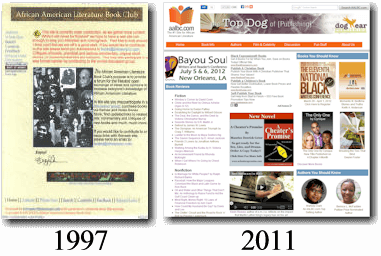
TJ: During the mid to late Nineties, I had a sideline business building websites for other businesses. I wanted to learn more about using websites to generate sales and earn money, so that I could better advise my clients. I actually offered to help someone else rebuild their book business’ website, for free, as a part of that effort. Amazingly, they declined the offer. So instead, I decided to create AALBC.com. I immediately discovered I would prefer building a website for myself, rather than for others, and I focused solely on AALBC.com. That was back in 1997.
KW: How long had the website been in existence before you decided to quit your
job on Wall Street to work on the site full-time?
TJ: I had been running AALBC.com for about 11 years before I left Wall Street.
That was three years ago.
KW: Do you see the recent closing of Borders Bookstores as a sign of the demise
of brick-and-mortar operations and hard copy books? How does this development
affect your business?
TJ: Those changes are really reflective of more profound and fundamental shifts
that are greatly impacting the entire book industry. But I don’t think the
closing of Borders or the rise of eBooks is sign that the days of
brick-and-mortar stores, and physical books, are numbered. This may sound
counter-intuitive, but the closing of Borders actually hurts my business, in
much the same way that the closing of independent black bookstores did. Sure, on
a superficial level, one can say there are less competitors in the marketplace
and that will drive more people online to learn about new books and that that
helps sites like AALBC.com. However, on a deeper level, Borders was actually a
big seller of black books. They helped generate excitement and sales for our
books across the nation. The better-run stores established relationships with
the community and local businesses. They purchased advertising in our
publications. This benefits the entire industry, publishers, authors, readers
and even other booksellers. When these groups thrive, so does AALBC.com.
KW: How else has the business changed over the years?
TJ: Kam, keeping AALBC.com a viable business, in an environment where major
technological changes are a constant, is my single biggest challenge. I’ve been
active on the World Wide Web since it because available to the general public in
the early Nineties. It really is remarkable how much and how quickly things have
changed since then. When I first started, one had to code an entire page in HTML
by hand. Everything was very labor intensive. If I wanted to create a page with
a photo on it, I had to take a photo with my camera, take the film to a business
that developed and printed photographs, wait a few days and hope that the photo
came out OK. Then, I would need to scan the image, usually at work, because
scanners were expensive, open up the photo in an image editing program, save the
image in a compressed format so that it would not take too long to download over
a 1200-baud modem, and FTP it to my web server. Finally I would create an HTML
document and write a line of code that would position the photo on a webpage. Do
you see where I’m going?
KW: Yeah, it was much less user-friendly back then.
TJ: All of this for one image on a single page. Imagine the difficulty in
creating an entire website! I learned to build websites by looking at the
underlying code of a page, copying it, and modifying it to suit my needs. Today,
given how complex websites are, it is really not possible to learn how to build
websites this way anymore. When I first started building web pages, most people
did not have a PC at home, and almost no one had internet access. Today most
homes have PC’s, a smart phone or a cable box with internet access. A
grade-school kid can create a terrific looking website with 100 photos in a
fraction of the time, with virtually no technical skill. Despite websites being
infinitely easier to create, the challenge of launching a viable web-based
business is even more difficult than ever before
KW: How are African-American-oriented websites faring nowadays?
TJ: Kam, it is a challenging time for the vast majority of our websites. I think
we should make a distinction between different types of
African-American-oriented websites. First, there are the large corporate
entities like AOL’s Huffington Post/Black Voices whose primary mandate is to
maximize shareholder’s wealth. Then there are the mostly independent entities
who also have a profit motive, but are driven by a more conscious mission. Sites
like AALBC.com, The Network Journal, Black Star News and the other entities who
regularly publish your content are part of this mix. As a result of these two
different goals, the content produced by the large corporate entities focuses
more on scandal, celebrity, and superficial pop-culture. That content is more
popular and easier to produce and is therefore more profitable. The content
produced by sites like AALBC.com is less sensational which makes keeping the
associated sites profitable much more challenging. In fact, even Google favors
the larger entities, making things even more difficult.
KW: Can you elaborate more about Google’s impact?
 TJ: How much time do you have? Seriously, I could write a very long book about
this topic. Consider this: for most sites, the largest source of new traffic
comes in through people who discover the site through search engines. The lion’s
share of this traffic comes from Google. As a result, Google is effectively a
gatekeeper who controls access to your website through their ranking of your
website in their search results.
TJ: How much time do you have? Seriously, I could write a very long book about
this topic. Consider this: for most sites, the largest source of new traffic
comes in through people who discover the site through search engines. The lion’s
share of this traffic comes from Google. As a result, Google is effectively a
gatekeeper who controls access to your website through their ranking of your
website in their search results.
Over the past year, I observed Google start to do some really strange things
with their search results that have not only adversely impacted my website’s
traffic, but the very nature of the web itself. Google search results skew to
very large corporate websites that are publishing less valuable, usually more
scandalous content. This was not always the case with Google. At least the
search engine Bing doesn’t do this currently. Here are two examples: if you were
to do a search for Terry McMillan on Google, you will find in the top five
search results a site containing two sentences talking about Terry accusing Will
and Jada Smith of pimping their kids, and another site discussing the details of
Terry’s divorce. My site, which has published original book reviews, a video of
Terry reading from a then-unpublished manuscript, a list of all of her published
novels and more, only appears on the second page. I talk about her being a New
York Times bestselling-author, not what she tweeted about the Smiths’ kids
months ago. Which content do you think should rank higher?
KW: Your content of substance, obviously.
TJ: Here is the second example: I recently paid a writer for an article which I
published on AALBC.com. Sometime later, the same article was published on the
Huffington Post. The next day when I ran a Google search for that specific
article, not only was the Huffington Post returned ahead of AALBC.com, but so
were many other sites I call “autoblogs,” including a porn site. Yes, you heard
me right, a pornography site that posted a very short excerpt of the original
article and ended-up ranked ahead of the AALBC.com original publication. All of
these “autoblogs,” sites are created automatically on the fly and contribute
nothing new. Their only apparent purpose is to serve advertising, mostly Google
ads. For now, AALBC.com is in the mix, but Google can literarily throw a switch
tomorrow and AALBC.com can be, effectively, erased from the internet. Other
black book sites have fared much worse. In fact we have fewer independent book
sites focused on black authors than we did five years ago. And the ones that
remain are even more difficult to find.
KW: What can people do to support sites like AALBC.com?
TJ: People simply need to visit the website, tell their friends about it, use
social media to share the articles, reviews, and author profiles. Folks can
participate on our discussion boards, instead of having a conversation on
Facebook. As an aside, we should be using Facebook to send people to our sites.
I also encourage people to send us feedback, to suggest books for review, and
authors to cover. I know I sound like I’m beating up on the Huff Post, but many
writers contribute to that site for free. I suggest those writers consider
contributing to independent sites like AALBC.com once in awhile. It really is in
everyone’s best interest for independent voices to survive. We are not going to
survive, over the long term, without the support of the people we try to serve.
KW: What do you think is in the future?
TJ: Of course, If I knew that I’d be a rich man. I fear the trends I see online
are escalating offline as well. There are fewer independent, bookstores,
magazines, newspapers and radio stations. Journalism is dying, sources for
critical book and film reviews of black work are drying up, author advances are
shrinking and writers are finding it more difficult to make a living. Content
generation across all platforms are coalescing into the hands a few very large
multinational corporations that don’t have our interests in mind. At best, the
content they spew does not truly represent what we, as black people, feel, care,
or think about. At worse, it is destroying us by perpetuating negative
stereotypes and images for the sake of making money.
KW: Is it already too late in your estimation, or can something still be done?
TJ: Fortunately, we can absolutely do something about this ’ we must
continuously support independent entities as best we can. With the continued
support of my community, there is no reason an AALBC.com should not thrive.
Ideally, the Google search result should be an unimportant detail. Indeed, maybe
we should create our own Google.
KW: Is there any question no one ever asks you, that you wish someone would?
TJ: Yes, but I won’t pose it in this interview. [LOL]
KW: The music maven Heather Covington question: What are you listening to on your iPod?

Buena Vista Social Club
Click to order via Amazon

TJ: A buddy turned me on to an album by the Buena Vista Social Club. A cut called �Chan Chan� is so enchanting. I also tune into �breath of life� at http://www.kalamu.com/bol every Monday for a lesson in music.
KW: The Tasha Smith question: Are you ever afraid?
TJ: Yes, but being afraid and overcoming those fears is what makes life
exciting.
KW: The Columbus Short question: Are you happy?
TJ: Yes.
KW: The Teri Emerson question: When was the last time you had a good laugh?
TJ: All the time. My wife and I were sharing a glass of wine. Out of nowhere she
says, �I really do love you.� Touched, I replied, �Is that you or the wine
talking?� She looked at me and said, �That�s me talking, baby� to the wine.�
That is an old joke I told this past weekend and is always good for a laugh.
KW: What is your guiltiest pleasure?
TJ: I like to play poker.
KW: Now, you get to answer your own question, the bookworm
Troy Johnson
question: What was the last book you read?

TJ: The last one I read was �The Only One� by Cynique. http://aalbc.com/authors/connie_bradley.html It is currently being published in a serialized format through a website called “ A Chapter a Month.” I plan to publish this novel as a book next year.
KW: What is your favorite dish to cook?
TJ: I�m a half-way decent cook. I like my buffalo wings. They always taste good,
and are easy to prepare.
KW: The Sanaa Lathan question: What excites you?
TJ: I love visiting new places. I�ve been to every state in the Union and to a
bunch of foreign countries. I would even leave the planet if I could.
KW: Dante Lee, author of "Black Business Secrets", asks: What was the best
business decision you ever made, and what was the worst?
TJ: Well certainly starting AALBC.com would rank up there as one of the best. As
far the worst� you don�t have enough time.
KW: When you look in the mirror, what do you see?
TJ: A work in progress.
KW: If you could have one wish instantly granted, what would that be for?
TJ: Omnipotence.
KW: The Ling-Ju Yen question: What is your earliest childhood memory?
TJ: My mother bringing my younger sister home from the hospital, a couple of
months before my 3rd birthday.
KW: The Melissa Harris-Perry question How did your first big heartbreak impact
who you are as a person?
TJ: It forces me to try to be more empathetic to the feelings of others. My
biggest life regrets have to do with others I may have hurt.
KW: The Judyth Piazza questions: How do you define success? And, what key
quality do you believe all successful people share?
TJ: Striving for freedom is success. I believe all successful people know what
they love to do and are actually doing it or working toward it.
KW: What advice do you have for anyone who wants to follow in your footsteps?
TJ: Don’t. Everyone needs to find their own path to happiness and success,
because they will all be different. Again, determining what motivates you and
makes you happy is the key to that.
KW: The Tavis Smiley question: How do you want to be remembered?
TJ: As a gentleman who tried to make a positive impact on family, friends and
anyone he may have touched.
KW: Thanks again for the time, Troy, and best of luck with the website.
TJ: Thanks Kam, It has been a pleasure to work with you over the years as you
have been an integral part of that success.
Reader Comments (0)
Log In to Join the Conversation
Commenting is reserved for registered AALBC members to maintain high-quality discussions.
No comments yet. Be the first to share your thoughts!
Advertisement