 Bookshop
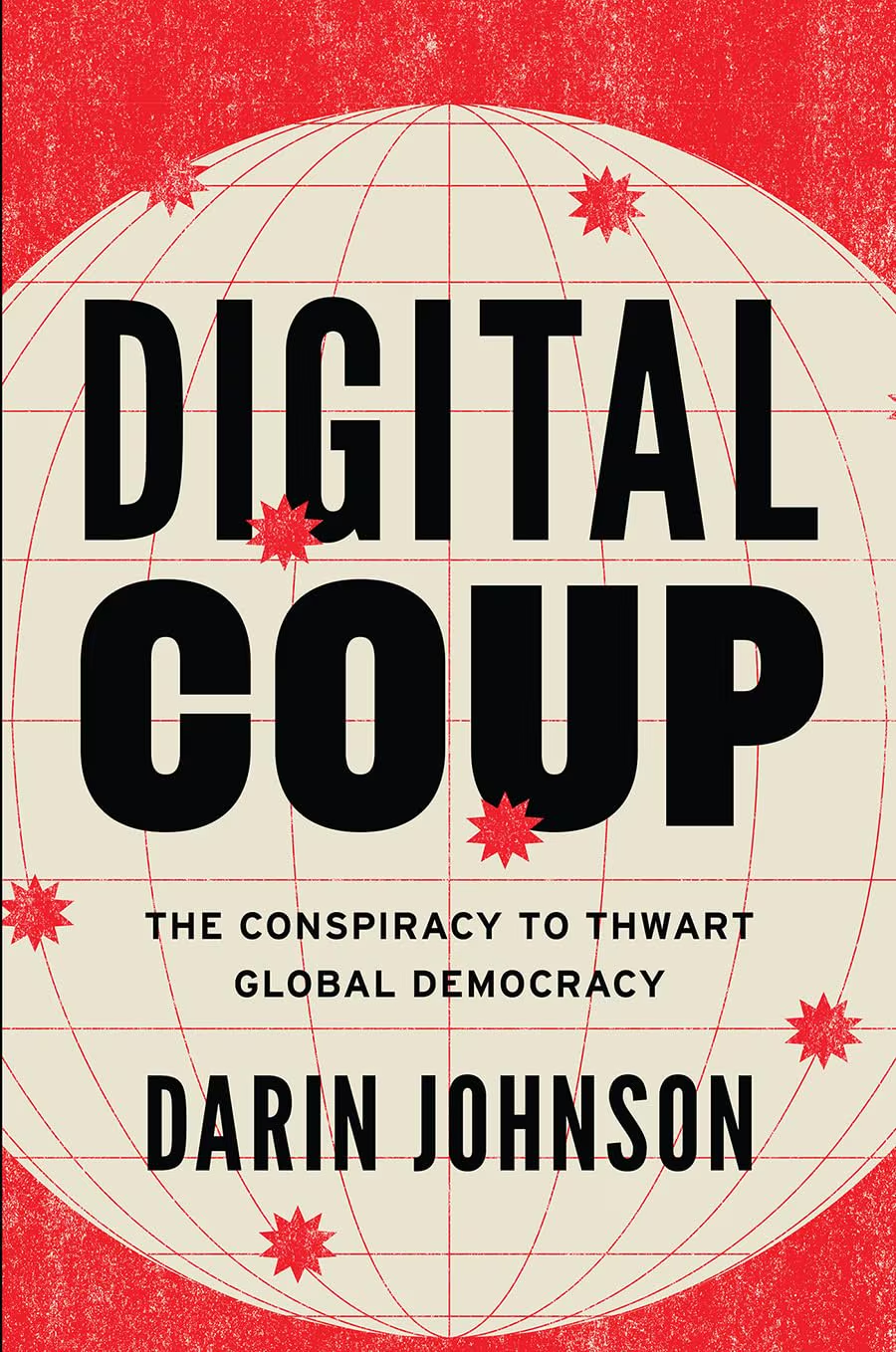
“Democracy around the globe is facing its greatest threat since World War II,” writes author Darin Johnson, who believes that threat is the widespread system of digital attacks that have been changing election outcomes around the world for several years. According to his book Digital Coup: The Conspiracy to Thwart Global Democracy, these attacks include social media bots; fake accounts and advertisements; misleading and false news reports; and digital ballot stuffing. My first thought was: Where is the lie?
Not much surprised me as a person who uses social media daily as part of my profession. In fact, anyone on social media, or who pays attention to the news, shouldn’t be surprised considering the findings of the Report on the Investigation into Russian Interference in the 2016 Presidential Election by Robert Mueller. Johnson says that document became the catalyst for writing his book. He describes being shocked and angry over how the Internet has been weaponized to interfere in elections by exploiting deep-seeded racial divisions in the U.S. According to Johnson, Russia is the mastermind that got this started.
One of the most disturbing ploys used Facebook to masquerade as a grassroots organization: “One Russian-created Facebook page, posing as a Muslim rights organization, attracted over 268,000 followers and posted an advertisement accusing Senator John McCain and Secretary [Hilary] Clinton of funding the terrorist groups ISIS and Al-Qaeda. Another advertisement, displaying Black women with guns protesting police brutality, was designed to stoke fear of an armed [Black Lives Matter] uprising.” Russian agents had to become deeply knowledgeable about the racial tensions long simmering in the U.S. to manipulate voters on both sides so effectively. I knew the interference existed. I didn’t know the extent.
It should also be no surprise that digital coups are big business. Johnson explains that digital attacks are now a global private industry with operations in more than thirty countries. There is even a private group, “Team Jorge,” that sells its services running digital coup campaigns around the world. Democracy isn’t just under attack. It’s for sale.
At times, Johnson’s writing felt repetitive with the same points restated in different ways. The repetition sometimes dulled the impact of his message until he started dropping details that haven’t shown up repeatedly in my social media doomscrolling. It was an eye-opening revelation to learn that the algorithm of TikTok, a China-based company, doesn’t amplify negative, harmful content to young people inside of China. Studies cited in the book show the algorithm intentionally induced addiction to the app in younger users outside of China. China uses a version called Douyin “which emphasizes educational content and limits the daily time that youth can use the app.”
This angered me much more than the weaponization of social media and race. The world already knows the U.S. has a problem acknowledging its racism and reconciling for its effects. Knowing that another country’s technology is purposefully harming youth worldwide, regardless of race, while safeguarding its own children through education and content regulation is what really spun my wheels. My dismay wasn’t directed at China so much as at governments, especially the U.S., that allowed this “digital depression” to take hold unchecked. This is perhaps the most devastating part of this digital coup phenomenon; nurturing young generations in one country while contributing to the demise of everyone else’s.
The U.S. government appears to be making feeble attempts to curb digital coup attempts and has failed miserably. Johnson explains that many hackers overseas are unlikely to ever be extradited to the U.S. to face trial. Meanwhile, social media companies get slaps on the wrist for not doing their part regarding data privacy and guardrails against fraudulent use. What can be done if there haven’t been serious consequences?
Johnson believes digital coups should be treated as war crimes among other proposals, most of which are beyond the reach of the average citizen’s capability. However, he does suggest the average person resist, but resistance can’t be done alone. Johnson’s idea of implementing processes where citizens have official pathways to ensure their vote counts sounds great in theory, but a long way off in practice. While Johnson cites other governments’ success in election oversight, giving the U.S. federal government more control does not sound prudent.
But there is hope. The European Union appears to be leading the way with the Digital Services Act (DSA), which Johnson calls “the world’s first comprehensive attempt at regulating disinformation through government oversight.” Beyond providing a model for how governments can work together to address digital attacks, countries outside the E.U. may indirectly benefit from the DSA forcing social media companies to meet higher standards wherever they operate.
One strategy Johnson proposes to combat digital attacks is to move backward. France and Germany use paper ballots, limiting their dependence on vulnerable digital systems. Their reliance on technology is not as heavy as it is in the U.S., so this may not be a viable option here. Another proposal sounds like it may be a necessary headache. Romania adopted a new practice of annulling and redoing elections when it’s proven there has been significant foreign election interference. Who determines when those would be needed? How would that be determined? How can do-overs be safeguarded against those who don’t like the true outcome?
Coincidentally, I was nearing the end of this book as the U.S. Supreme Court ruled on the Louisiana v. Callais case. The six-three majority decided that the new redistricting map in Louisiana was unconstitutional racial gerrymandering under the Fifteenth Amendment. Many on the political left view the decision as further gutting of the Voting Rights Act (VRA), which enacted federal enforcement of voting rights for Black Americans. Critics believe the ruling will give more congressional power to Republicans. Many on the right view VRA as no longer necessary. It is under this charged umbrella of racial discord that digital coups have become so effective in the United States and will likely continue to be. Bottom line: “We need a new system of verification and transparency for our electoral processes,” Johnson states.
Thankfully, Johnson avoids writing in dense legalese, which is much appreciated given the author is an accomplished attorney and law professor. The book accomplishes what I think Johnson set out to do, which is to bring this urgent issue to the forefront as a problem that needs to be fixed immediately. For that reason alone, Digital Coup is worth reading.