 Bookshop
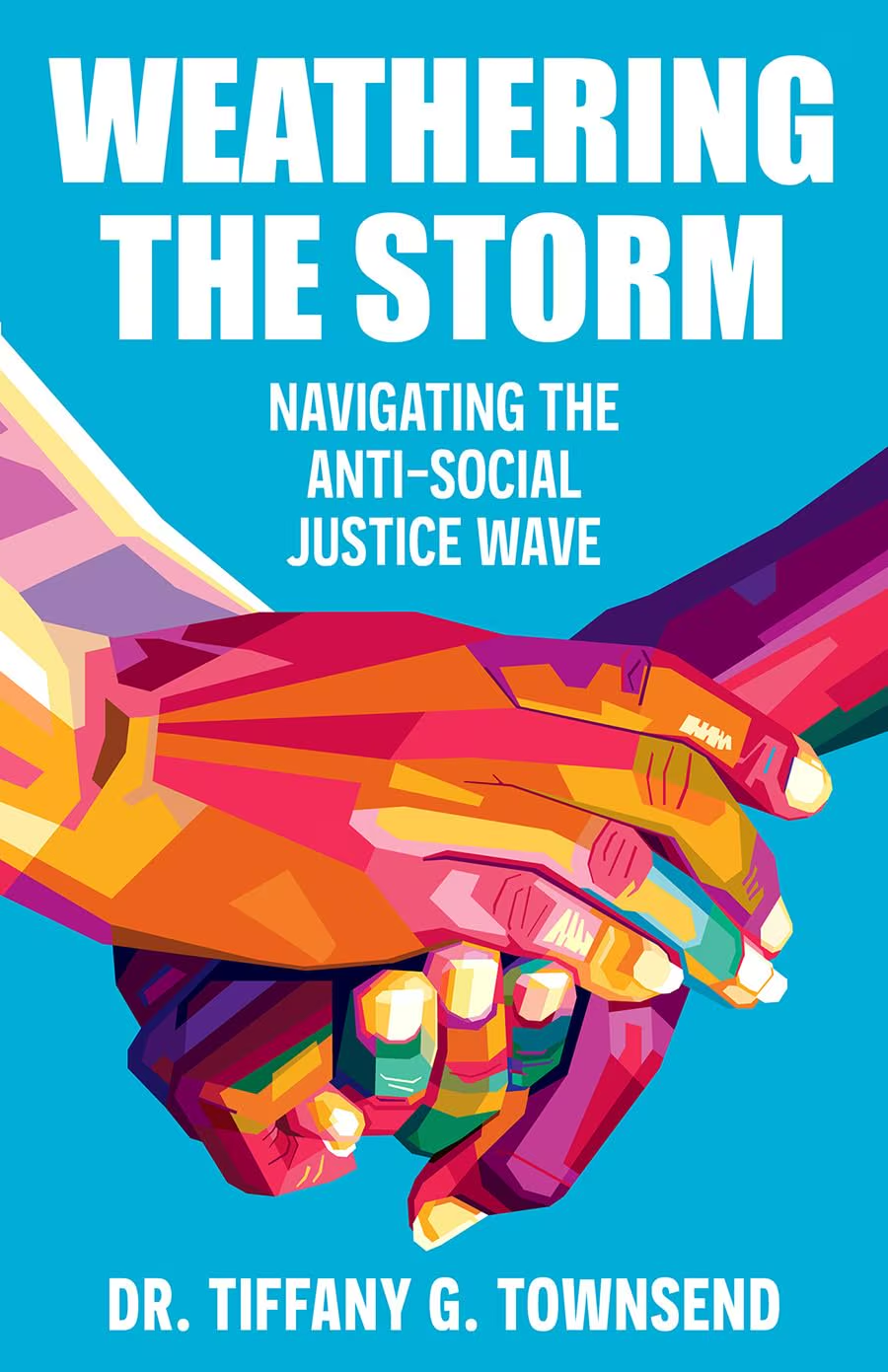
In writing Weathering the Storm: Navigating the Anti-Social Justice Wave, author Tiffany G. Townsend, PhD, addresses the broader challenge of navigating the anti-social justice wave in ways that fluctuate — sometimes good, other times bad — across academic, social, political, and other spheres. What I enjoyed most about Weathering the Storm were the author’s personal stories of growth and determination, particularly while she was a college professor teaching in predominantly white small-town America. What I enjoyed least were the conversations surrounding racial intimidation found in the early chapters, as there were subconscious “Rosewood Massacre” moments of reflection that caught me off guard. When reading those passages indicative of violence, my mind shifted and — even if only for a moment — I involuntarily froze. That’s how real the reading experience felt.
Dr. Townsend speaks of growing resentments, stereotypes, and microaggressions, and emphasizes America’s “old tactics and new landscape.” She identifies how clearly politicians have long understood that stirring racial tension not only sows division among allies, but also serves as a powerful distraction. When quoting former President Lyndon B. Johnson, she mentions that “overt racism was socially unacceptable and legally prohibited.” So, to me, the question becomes: “What happened?” I found the answer to be, simply put, that white folks were bamboozled. Case in point: the white male student who challenged her credentials during classroom instruction early in both the story and her career.
To President Johnson’s point: “If you can convince the lowest White man he’s better than the best colored man, he won’t notice you’re picking his pocket.” This observation still holds true decades later, as phrases like “undeserving poor” and “illegal aliens” have become commonplace. Add to that a sense of entitlement and feminism, and one can see how Townsend constantly found herself on the receiving end of assumptions that she was either a student or somehow lacking professionally, despite being both a college-educated instructor and educator.
In discussing the dangers of stereotyping, the author references the brutal beating of Rodney King by the LAPD, which took place only thirty-five years ago. Additionally, she reminds some readers — and introduces others — to the murder of fifteen-year-old Latasha Harlins. Harlins is used as an example to illustrate how her murder by store owner Soon Ja Du was reduced to a symbol of perceived danger, rather than recognition of the vibrant adolescent she was. Townsend relates these incidents to demonstrate how we are not far removed from danger, yet she then transitions into what appears to be a sense of feeling sheltered and protected under the cover of her HBCU experience.
She circles back to her time as an undergraduate at Spelman College and reflects on how “liberated from concerns about being perceived negatively because of gender, race, or the intersection of the two” she felt. Admittedly, she maintains a “profound belief in the liberating force of education,” yet still recognizes that the miseducation exhibited by some foreigners and business owners plays a significant role in where America stands today.
The book includes noteworthy historical and scholarly references pertaining to the fight for social justice; however, I found Townsend’s stories about her great-grandfathers most inspiring. She takes readers on a journey through her ancestry that reveals a high level of expectation, an emphasis on education, and the responsibility of education as liberation.
On one side, there is a great-great-grandfather who was enslaved yet literate. He was paid as a professional and saved enough to purchase some of the land he had once labored on — land that is still being passed down through generations. On the other side, there is a great-grandfather who was also enslaved and learned to read well enough to understand the law. While he lacked the credentials to practice law, he possessed the knowledge, wisdom, and expertise that allowed him to purchase a large portion of the land where he too had labored, eventually turning it into a general store and farm.
It’s no wonder Townsend begins and ends her book with the business of education. She comes from a long line of people who believed education was a vehicle for greater options and broader opportunities, freeing them from the limited expectations imposed by white society. They also believed they were independent vessels for transferring the knowledge necessary to aid the next generation. Her book, Weathering the Storm: Navigating the Anti-Social Justice Wave, is part of that effort.
If we can force ourselves to confront racism in ways that heal us collectively and take what she calls “collective action,” then we can remain vigilant when witnessing “assaults on social progress unfolding on a political stage.” We can also speak clearly about the dismantling of DEI programs and the removal of diversity professionals from educational institutions and federal agencies. This was the call to action I felt most strongly by the book’s conclusion: self-awareness and the building of allyships.
When we open ourselves to naming things as they truly are — not what is intended, but what they actually are — and seek to understand them alongside others who recognize them similarly, whether microaggressions or microassaults, then we can have healthy conversations, healthy exchanges, and healthy interactions. At the end of the day, isn’t that what we should all be striving for? Weathering this storm together.