 Bookshop
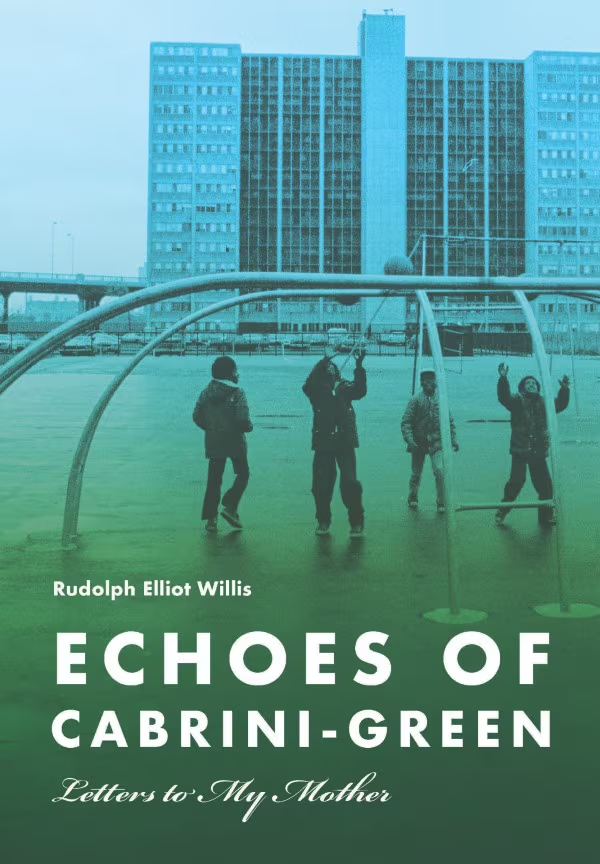
In Echoes of Cabrini-Green, Rudolph Elliot Willis writes letters to his late mother, narrating the events of his childhood leading up to the demolition of the Chicago Cabrini-Green public housing projects where they once called home. What emerges from these letters is not simply a memoir of upward mobility, but also a meditation on faith, identity, grief, and the enduring architecture of a mother’s love.
The book traces Willis’s journey from Chicago’s Cabrini-Green to a distinguished career in medicine and research. However, this is not a rags-to-riches narrative. It is a story about loss, deep community roots, personal reflection, and what sustains a child’s drive long before their first taste of success.
Willis skillfully captures the emotional contrast within his childhood environment. His father’s presence was steady but reserved—a reflective veteran and musician, quiet in nature. His mother, by contrast, filled their lives with warmth and song. She had once been offered a record deal but chose family instead, and her sacrifices ripple through the pages. His mother’s faith, hope, and encouraging words become the spiritual spine of the book in which Willis often reflects. In a childhood conversation, Willis asked his mother how she keeps her faith when times get hard. Her response: “Faith isn’t something that you look for. It’s something that swells up from the heart.… And if you cling to it when it comes your way, it never ever lets go.”
Faith does not remove hardship. Willis grew up amid instability, loss of key family members, and the unpredictable dangers of his environment. Yet the memoir does not dwell in trauma for spectacle. Instead, it reveals how resilience is cultivated quietly—through encouragement, discipline, and a refusal to let circumstances dictate destiny.
One of the memoir’s most compelling threads is Willis’s relationship with knowledge and learning. As a child, his curiosity set him apart. He immersed himself in language and possibility, even when those around him did not fully understand him. That intellectual hunger eventually carried him through elite academic institutions and into groundbreaking medical research. Science, he writes, became “a sanctuary… where my mind felt at home.”
Yet Echoes of Cabrini-Green is not content to celebrate achievement without interrogation. Willis thoughtfully critiques the history of racialized science and later confronts the sobering reality of inequity in cancer care. He makes clear that disparities are not accidental. The statistics have always been there, but until recently no one was talking about them. His perspective as both a research scientist and a Black man gives these reflections substantial weight.
The memoir gains additional resonance in its moments of return. In one powerful scene, Willis revisits Cabrini-Green and speaks with a young man navigating the same environment that once shaped him. The exchange is not framed as saviorism, but as recognition—a passing of perspective from someone who left its presence without forgetting how it shaped him. In uplifting that young man, Willis completes a quiet, powerful circle. The boy who once needed reassurance became the man offering it.
After his mother’s death, writing to her becomes an act of continuity. In one of the book’s most tender passages, he recalls, “Silence belonged to Dad. Music belonged to you.” His mother singing hymns, which quieted her children’s fears at night, soothed Willis during critical moments of uncertainty in adulthood. Even at the “mountaintop” of professional accomplishment, he admits to moments of solitude and reckoning—an awareness that success does not erase origin.
The reflections on the demolition of Cabrini-Green are especially poignant. Watching the towers fall from a distance, Willis understands that what is disappearing is not just concrete but memory—community, struggle, survival. He resists romanticizing the environment while still honoring its imprint. The buildings may crumble, he suggests, but what they shaped endures.
At times, the reflection feels carefully restrained, shaped by the discipline of a scientist accustomed to precision. Still, that restraint also feels authentic to Willis’s voice—tender, thoughtful, analytical, and steady. The sections detailing Willis’s early AIDS research add a powerful layer to the memoir, revealing intellectual vigor as well as the emotional weight of working in a competitive, high-stakes lab environment.
Ultimately, Echoes of Cabrini-Green: Letters to My Mother is less about professional accolades and more about inheritance. It asks what remains when the towers fall, when parents have passed on, when the applause quiets. For Willis, what remains is faith—not abstractly but embodied in a mother who taught her children to lift their heads no matter what they faced.
This memoir will resonate deeply with readers who value stories of first-generation academic achievement, the intersection of faith and science, and narratives of Black perseverance rooted in family. It is especially meaningful for those reflecting on legacy—what we carry forward and how we give back, while always remembering who carried us first.