 Bookshop
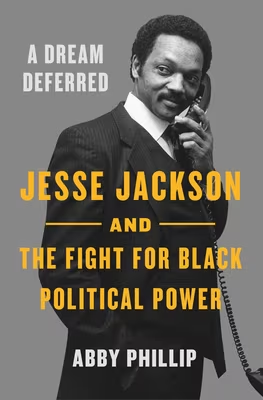
With the recent death of Jesse Jackson, America has lost one of the most progressive political activists ever to stand on the national stage. CNN anchor Abby Phillip’s new book, A Dream Deferred: Jesse Jackson and the Fight for Black Political Power, pays tribute to the charismatic politician and civil rights icon.
Phillip, a wordsmith expert in presidential politics, the Congress, and political campaigns, paints a vivid picture of a person who was “…the ultimate celebrity candidate, someone who understood the media on a profound level” with a penchant of his own agenda. Along with a revealing collection of anecdotes, she emphasizes Jackson’s steadfast work ethic, social and cultural openness, and gift of gab.
Starting with the first chapter of a visit to Jackson’s hometown of Greenville, North Carolina, his story is a massive cultural reinvention much like Cary Grant and Malcolm X. He talked of his fathers—the one who adopted him and the biological one whom he didn’t know until he was ten years old. He spoke with a stutter, except when he talked in front of a group. He worked very hard at odd jobs. He was a star academically and athletically during high school.
When the cultural hero and sports figure Jackie Robinson came to town in 1959, everyone took notice, especially Jackson. On July 17, he and seven friends marched into the public library there and refused to leave, so they were arrested. “That’s how I lost my fear of death and jails,” he later said. In September 1960, he convinced the president of North Carolina Agricultural and Technical State University, Samuel DeWitt Proctor, to admit him. Later, he performed several acts of nonviolent protest using the themes of CORE (The Congress of Racial Equality) and married a lovely university student.
What led Jackson to his partnership with Dr. Martin Luther King Jr. was his need for a man to fulfill a suitable father role, an element of his character Phillip writes so effectively about—a reliable patriarch that the young man could count on. Andrew Young, King’s closest aide, said Jackson wanted both Dr. King and him to fill that role. When Jackson became an organizer of Dr. King’s Southern Christian Leadership Conference, he’d travel anywhere to speak to potential voters, regardless of threat or danger. Others in the group feared for him.
Jackson saw Dr. King, the chief civil rights spokesman, in real time: he was frugal, smoked, drank, and shot pool. People flocked to him like a rock star. When Dr. King returned to Memphis to support the work stoppage by the city’s sanitation workers, Jackson was familiar with the many threats against the activist and minister. He was invited to join Dr. King for dinner on that fateful day at the Lorraine Motel in 1968 when a single shot in the head felled the leader. He cradled the slain pastor in his arms, the blood bleeding out on his protégé’s shirt.
Phillip states that Jackson’s two presidential campaigns, in 1984 and 1988, set the strategic template for the popular progressive movement. She comments on its potency and durability. She writes toward the end, “Jackson has now lived to see many of his so-called radical ideas become mainstream—and long enough to see those who came after him go farther than he ever could.”
Phillip doesn’t linger on two flaws in Jackson’s private life. She touches on his 1979 trip to the Middle East to promote US and Israeli cooperation with the Palestine Liberation Organization. It didn’t help that Louis Farrakhan, a leader in the Nation of Islam, was one of his closest advisers when Jackson allegedly made a racist Jewish slur. This cost many white votes and cut his political potential. Another crisis in his personal life Phillip flirts with was the tabloid’s revelation of Jackson fathering a twenty-month-old child of a staffer, causing a crisis with his marriage with the mother of his five children.
In 1988, Jackson did all what was required of him. In one instance, he went to a poor church in Meridian, Mississippi, where he addressed his usual spiel for change, uplift, and unity to a stunned crowd. “…I understand… They call you outcast, low down, you can’t make it, you’re nothing, you’re from nobody, subclass, underclass; When you see Jesse Jackson, when my name goes in nomination, your name goes in nomination.”
A Dream Deferred is one of the most revealing biographies about a complex, complicated, and even conflicted man who was committed to the unrepresented, disenfranchised people in our supposedly free society. Yes, he had his flaws, with a penchant for self-promotion. He continued in his later years to advocate for a “Rainbow Coalition.” Phillip writes a full-scale portrait of a true believer, a larger-than-life myth, something more than the work slogan “I Am Somebody.” Her compelling book rates more attention than some of the whitewashed, stale images of his recent departure presented in the media.