 Bookshop
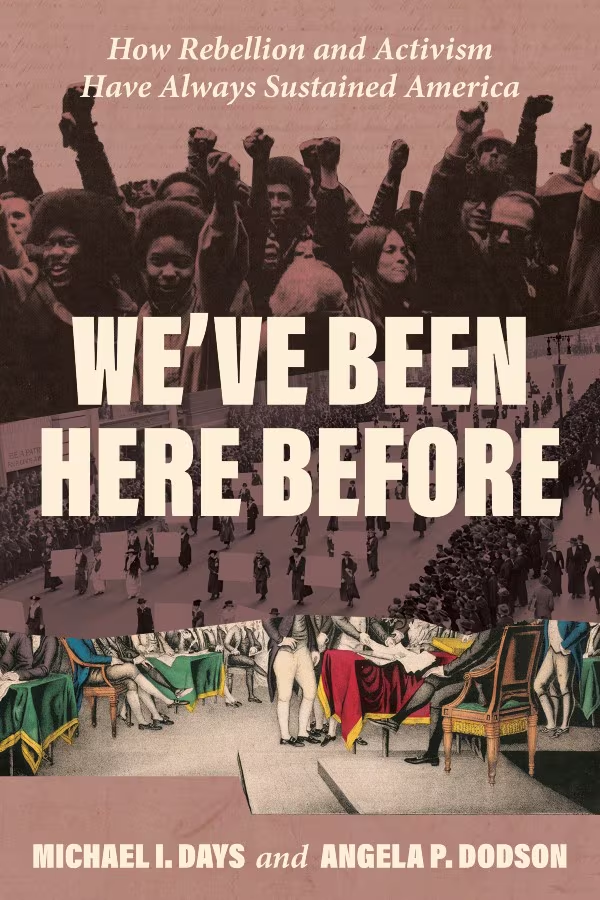
We’ve Been Here Before: How Rebellion and Activism Have Always Sustained America by Michael I. Days and Angela P. Dodson is a timely and thought-provoking examination of America’s recurring struggles over justice, citizenship, freedom, and equality. Published as the nation approaches its 250th anniversary, the book challenges readers to consider not only how far the country has come, but also how often it has revisited the same debates over who is entitled to the promises of American democracy. We’ve Been Here Before carries additional significance because coauthor Michael I. Days, an accomplished journalist and former editor of the Philadelphia Daily News, passed away before its publication. His influence remains evident throughout the book’s strong reporting, clear-eyed analysis, and commitment to confronting history honestly.
Days and Dodson organize the book around important movements that have shaped American democracy, including Indigenous resistance, religious freedom, slavery and abolition, women’s suffrage, labor organizing, civil rights, and anti-war activism. Their message is clear from the title: America has been here before. Progress has rarely been linear, and nearly every advance toward equality has faced resistance. Through each chapter, the authors show how ordinary people and determined activists pushed the nation closer to its ideals, often at tremendous personal cost.
One of the book’s greatest strengths is its refusal to smooth over the complexities of history. In the chapter on enslavement, the authors challenge the myth of passive endurance by emphasizing that “survival is a form of struggle.” They highlight resistance in all its forms, from everyday acts of defiance to organized rebellions and escape networks like the Underground Railroad. Likewise, the chapters on abolition and women’s suffrage resist easy narratives. Rather than centering a handful of familiar figures, Days and Dodson spotlight the contributions of Black abolitionists, labor organizers, reformers, and activists whose work is too often overlooked.
The writing is accessible, journalistic, and engaging. The authors move seamlessly between historical events, firsthand accounts, statistics, legislation, and contemporary examples. As a result, the book never feels trapped in the past. Instead, it consistently asks readers to consider how historical struggles continue to shape present-day debates.
I especially appreciated the way the book connects movements that are often discussed separately. Labor rights, women’s rights, racial justice, Indigenous sovereignty, immigration, and free speech are presented as interconnected efforts to expand the definition of “We the People.” The labor chapter was particularly compelling, reminding readers that many workplace protections we now take for granted were won through sacrifice, violence, and collective action. From the epigraphs to the notes, the reader gets a sense of the research involved in the project.
The book feels particularly relevant as the United States prepares to celebrate its 250th birthday in July 2026. In the epilogue, Days and Dodson reflect on Frederick Douglass’s 1852 observation that America was still a young nation capable of learning “high lessons of wisdom of justice and of truth.” They argue that although the nation is older today, the work of building a more inclusive democracy remains unfinished. Rather than viewing the anniversary as a simple celebration, they encourage readers to see it as an opportunity for reflection. Have we lived up to our ideals? Who is still fighting to be fully included in them? Their answer is hopeful, but not complacent.
My primary critique is that the book occasionally covers too much ground. Some chapters move through decades of history at a rapid pace, leaving readers wanting more depth of some information. The later chapters also take on a more openly political tone that may seem less balanced than the historical sections. Yet that sense of urgency appears intentional and is central to the book’s purpose.
Overall, We’ve Been Here Before is an engaging and important read that reminds us democracy is not something we inherit and keep automatically. It requires participation, vigilance, and a willingness to learn from the past. As America approaches its 250th anniversary, Days and Dodson offer a critical reminder that the nation’s story is still being written.