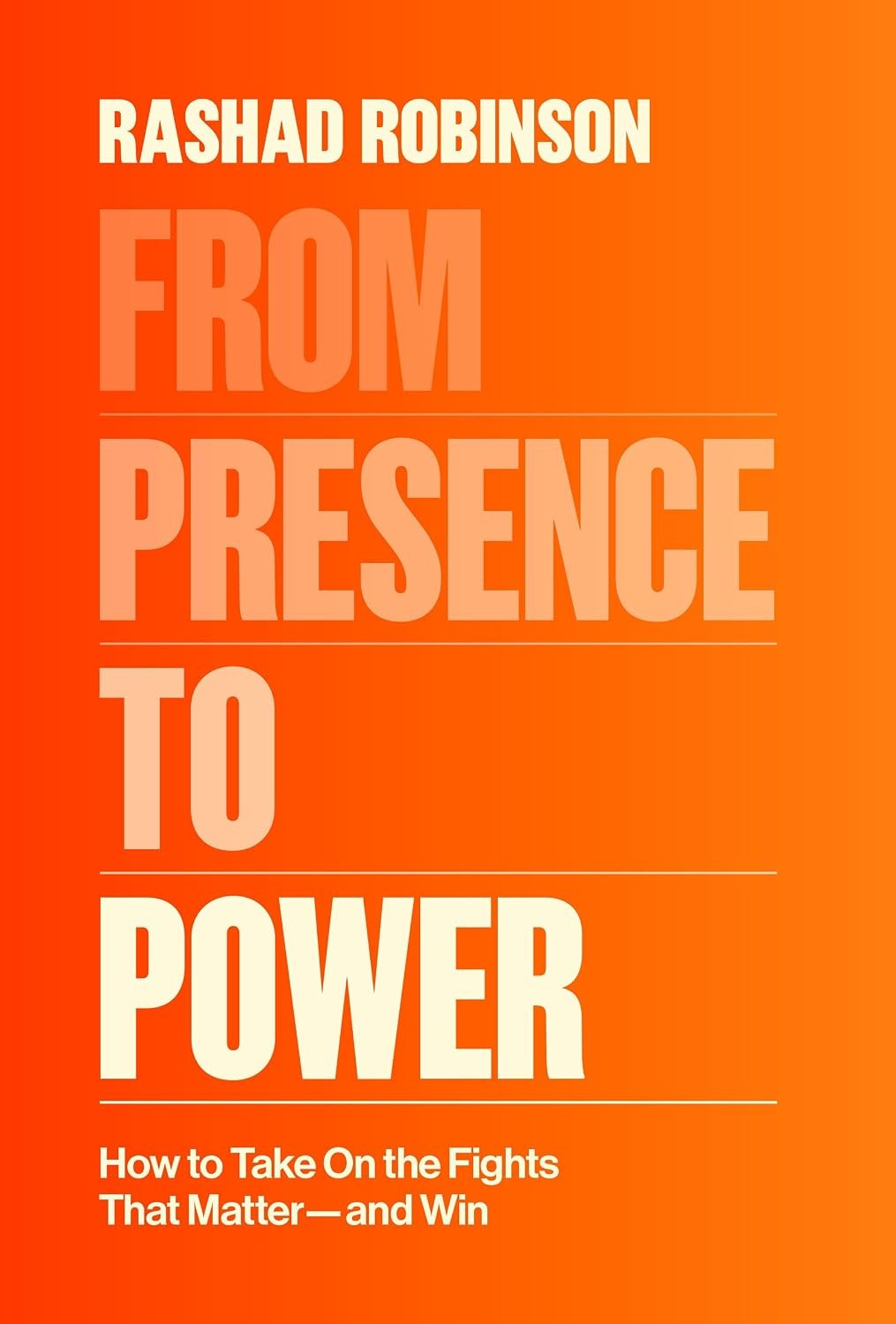
From Presence to Power: How to Take On the Fights That Matter—and Win
Buy from AALBC
Add to Cart — $32.00More Book Details
Nonfiction, Hardcover, 400 pages
Publisher: Penguin Random House
ISBN: 9780593243565
 Bookshop
Excerpt
1
Presence Is Not Enough
Definition: Presence is about visibility, the ability to make something—a cause, an issue, a big new idea, a person or an organization—widely recognized and popular. Achieving presence can include making an issue or idea trend on social media, landing a story on the front page of a newspaper, or motivating thousands of people to show up at a rally—that is, making your thing the thing everyone is talking about.
Challenge: Achieving presence can make us feel powerful, even when we’re not. It can be hard to accept that raising our voices doesn’t automatically translate into increasing our power and impact. Presence, even at the most widespread level, doesn’t necessarily lead to change. We live in a time when it’s easy to get preoccupied with achieving presence and lose focus on gaining the real power we need to win the actual changes we want. To be powerful, we must know that presence is not power.
An Unnatural Disaster
There was a time when Kanye West told the truth. On September 2, 2005, he participated in A Concert for Hurricane Relief, a televised fundraiser that brought in millions of dollars in response to the ongoing destruction from Hurricane Katrina, which hit New Orleans and the larger Gulf (of Mexico) Coast just days before. Almost all of the celebrities participating in the benefit concert stuck to the scripted story about the devastating event that, even its first week, had already been designated the largest natural disaster in American history. Kanye did not.
The scale and impact of Hurricane Katrina revealed how little our country had changed over decades of nominal progress toward racial equality. The floodwaters quickly washed away any naïve notion that people in power care about everyone equally. People who call the shots in government agencies, news networks, churches, and corporations showed us exactly who they are—and whom they care about most.
George W. Bush had been president for four and a half years before the storm. During those years, he made decisions that would turn Katrina into a devastating force. Bush and those around him actually played a prime role in manufacturing a crisis that could have been avoided—and then pretending it was natural. As if it came out of nowhere. But Katrina was no surprise.
In 2003, Bush merged the Federal Emergency Management Agency (FEMA) with the newly formed Department of Homeland Security. That decision deprioritized disaster response. It drastically reduced the budget for addressing the oncoming threat of larger and more frequent storms that communities along the Gulf Coast were facing. Even Bush’s own head of FEMA warned in an internal memo that budget cuts and other changes dangerously reduced its ability to respond to disasters, including by leaving it without the trained and experienced staff required to do so.1 (The number of decisions being made by Trump today, setting us up for endless disasters to come in every aspect of life, is almost too large to count.)
When we look at the past, we too often get trapped in the story that people in the present want us to believe about it. One of the biggest lies they tell us: We couldn’t have known at the time. In the case of Hurricane Katrina, local officials knew the dangers of not protecting the city from predictable weather patterns, and they warned the federal government repeatedly, making specific and clear requests for support.
People at every level of government knew the New Orleans levees, built to fend off storm floods of a much lesser degree, could never withstand a high-powered hurricane. They hadn’t been quiet about it, either. Louisiana officials had asked the government for funds to strengthen the levees. They had documented very real threats and the very real need for $27 million in hurricane preparation and response funds.
Bush aimed to give them only $4 million for the entire year, the same amount that he and Vice President Dick Cheney’s corporate contractor friends were getting every twenty minutes during the war they started in Iraq, based on fabricated claims about weapons of mass destruction. (Congress stepped in to help New Orleans, but that resulted in an allocation of merely $5.7 million.)
A flood of bad decisions turned Katrina into a disaster. And after the hurricane hit, more bad decisions kept coming. As just one example, basic evacuations were mishandled, creating barriers to survival instead of critical lifelines. Many of the deaths that resulted from Katrina occurred in homes. People who had survived the initial storm surge could not get to safety in the aftermath, and so they were swept away. They either were blocked from getting out of the city or had gotten out but returned to help family members and couldn’t get back out again. Far too many Black lives were lost because the people whose job it was to give victims a lifeline couldn’t have cared less about them.
A later investigation by a committee in the U.S. House of Representatives revealed that the Red Cross was also part of the failed response to Hurricane Katrina. According to the committee’s report, “Many Black communities were forced to turn to ‘churches and civil rights groups . . . dubbed “the Black Cross,” . . . to provide aid in the absence of the Red Cross.’” The Red Cross later “acknowledged that its response to minority evacuees during Katrina and Rita was lacking, with some African American communities having less access to aid than white communities.”2
Corporations turned their backs on the Black communities of New Orleans, too, with equal effect. In a targeted practice, insurance corporations made it nearly impossible for many Black residents to get homeowners insurance in the years leading up to Katrina. And, for those who did have insurance, those corporations failed to process their claims after the storm. That made the fallout much worse for Black people than for other people. It was a setup: They would not be able to rebuild, and many were forced to surrender their homes. State Farm was ultimately forced to pay the federal government $100 million in restitution for how it mishandled Katrina claims.3
The real disaster of Katrina was not the one nature created, but the one people in positions of power created. And it hit Black people the hardest, not only because Black people were living in the storm’s path but also because they lived in the path of injustice.
At the time, of course, the prevailing story in the news wasn’t that Black people had been abandoned by their government or victimized by people in power, but rather that they were not resourceful enough to help themselves.4 (We heard this same rhetoric during the pandemic and in many other contexts.) News media and politicians didn’t portray Black people as displaced disaster victims carrying supplies back to their families, which was how they portrayed white people doing the same thing. Instead, they decided to portray Black people as looters who needed to be controlled. The most influential public conversations about the crisis pointed to Black people’s decisions, not the decisions that had actually created the disaster. That narrative was about unfortunate Black people who couldn’t be helped because they were fatally flawed as a people. The narrative suppressed by most news outlets and political chatter was about the unjust actions of the people in power whose biases and choices caused the worst damage and suffering.
What is the logical conclusion of a story that makes us believe people’s suffering is unfortunate rather than unjust? It’s not a commitment to holding people responsible or creating change. It’s an offering of charity. And so that was the story people in power needed to reinforce in order to continue deflecting the blame.
Cue the celebrity concert. And Kanye.
Read One World’s description of From Presence to Power: How to Take On the Fights That Matter—and Win .
Copyright © 2026 Penguin Random House/Rashad Robinson. No part of this excerpt may be reproduced or reprinted without permission from the publisher or author.
Reader Comments (0)
Log In to Join the Conversation
Commenting is reserved for registered AALBC members to maintain high-quality discussions.
No comments yet. Be the first to share your thoughts!
Advertisement