Hurston/Wright Legacy Award Nominees and Winning Books
← Back to Main Awards Page
Introduced in 2001 The Hurston/Wright Legacy Award was the first national award presented to Black writers by a national organization of Black writers. In tribute to Zora Neale Hurston, the Foundation has renamed the awards for each category for Fiction, Nonfiction, Debut Fiction, and Poetry – The Zora. These awards are presented at the annual The Hurston/Wright Legacy Awards.
Each October, the award winners are celebrated during the Hurston/Wright Legacy Awards that draws hundreds of literary stars, readers, representatives of the publishing industry, the arts, media, politics, and academia. Learn more at the Hurston/Wright Foundation’s website.
3 Books Honored by the Hurston/Wright Foundation in 2003
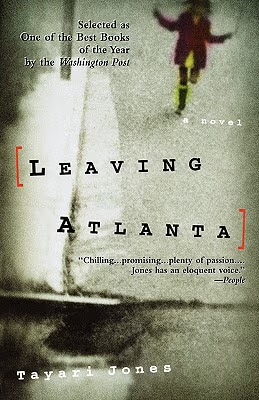
Leaving Atlanta
by Tayari Jones
Buy from AALBC
Add to Cart — $14.99More Book Details
Fiction, Paperback, 272 pages
Publisher: Hachette Book Group
ISBN: 9780446690898
 Bookshop
An award-winning author makes her fiction debut with this coming-of-age story of three young black children set against the backdrop of the Atlanta child murders of 1979.
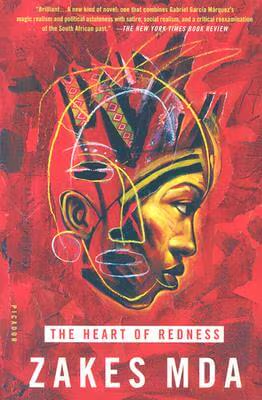
The Heart of Redness: A Novel
by Zakes Mda
Buy from AALBC
Add to Cart — $17.00More Book Details
Fiction, Paperback, 288 pages
Publisher: Macmillan Publishers
ISBN: 9780312421748
Camugu, recently returned to Johannesburg and disillusioned by the new democracy, moves to the remote Eastern Cape. There in the nineteenth century a teenage prophetess commanded the Xhosa people to kill their cattle and burn their crops, promising that the spirits of their ancestors would rise and drive the English into the ocean. The failed prophecy split the people in two, with devastating consequences. One hundred and fifty years later, the two groups decendants are at odds over plans to build a vast casino and tourist resort, and Camugu is soon drawn into their heritage and their future and into a bizarre love triangle as well.
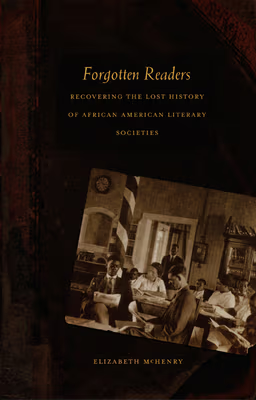
Forgotten Readers: Recovering the Lost History of African American Literary Societies
Buy from AALBC
Add to Cart — $30.95More Book Details
Nonfiction, Paperback, 440 pages
Publisher: Duke University Press Books
ISBN: 9780822329954
Over the past decade the popularity of black writers including E. Lynn Harris and Terry McMillan has been hailed as an indication that an active African American reading public has come into being. Yet this is not a new trend; there is a vibrant history of African American literacy, literary associations, and book clubs. Forgotten Readers reveals that neglected past, looking at the reading practices of free blacks in the antebellum north and among African Americans following the Civil War. It places the black upper and middle classes within American literary history, illustrating how they used reading and literary conversation as a means to assert their civic identities and intervene in the political and literary cultures of the United States from which they were otherwise excluded.
Forgotten Readers expands our definition of literacy and urges us to think of literature as broadly as it was conceived of in the nineteenth century. Elizabeth McHenry delves into archival sources, including the records of past literary societies and the unpublished writings of their members. She examines particular literary associations, including the Saturday Nighters of Washington, D.C., whose members included Jean Toomer and Georgia Douglas Johnson. She shows how black literary societies developed, their relationship to the black press, and the ways that African American women s clubs which flourished during the 1890s encouraged literary activity. In an epilogue, McHenry connects this rich tradition of African American interest in books, reading, and literary conversation to contemporary literary phenomena such as Oprah Winfrey s book club.
Reader Comments (0)
Log In to Join the Conversation
Commenting is reserved for registered AALBC members to maintain high-quality discussions.
No comments yet. Be the first to share your thoughts!
Advertisement