
The Souls of Black Girls
Provocative Documentary Examines Image of Black Females Propagated by
the Media
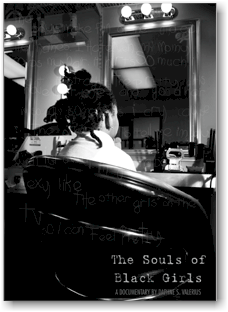 The Souls of Black Girls
Click to order via
Amazon
Unrated
Running time: 52 minutes
Distributor: Femme Noire Productions
Film Review by Kam
Williams
Excellent (4 stars)
Why have African-American women become so maligned by popular culture
that we have a Pulitzer Prize-winning author,
Karen Hunter, writing a
best seller seriously posing the question, ’Are black women necessary?’
And how has this shocking state of affairs affected the psyches of the
sisters of the Hip-Hop Generation shaped during the dominance of gangsta’
rap, an age marked by misogyny and an embracing of a European standard
of beauty?
These are the questions posed by The Souls of Black Girls, a provocative
documentary which suggests that African-American females are suffering
from a form of self-image disorder. Produced and directed by Daphne
Valerius, this provocative examination of a timely subject features sage
contributions from such icons as actresses
Regina King, Jada Pinkett-Smith,
Juanita Jennings and Amelia Marshall, PBS news anchor Gwen Ifill, Public
Enemy’s Chuck D, BET producer Darlise Blount, Essence Magazine fashion
editor Pamela Edwards, historian Dr. Lez Edmond and cultural critic
Michaela Angela Davis.
These famous faces share screen time with several representatives of the
demographic being discussed, articulate teens who weigh-in with their
heartfelt feelings on hot-button issues ranging from their dating
desirability to skin color preferences to hair straightening to absentee
fathers to promiscuity to their weights and shapes. The overall point
being driven home is that they are generally frustrated by their
inability to measure up to an unachievable ideal which places thin white
females with hour-glass figures up on a pedestal.
Apparently, out of a sense of desperation to be seen as attractive, some
girls compromise their values by engaging in binge dieting and
unprotected sex in an attempt to mimic the lewd behavior of the
scantily-clad dancers they see cavorting seductively in rap videos.
Unfortunately, in those exploitative, masturbatory male fantasies, as
Dr. Edmond points out, ’Black women are very rarely presented as
something to be respected.’
The film also asks, ’Have black men abandoned black women?’ with one
expert suggesting that slavery might be responsible for that fragmented
relationship. Others, however, see the phenomenon as a relatively-recent
development, an outgrowth of a BET-led trend toward a sexualizing and
debasing of the African-American female.
Ms. King bemoans that we have ’a whole generation of lost women who
don't that it’s okay to be you.’ Meanwhile, Jada reflects upon having
herself gone ’through a period of shame.’ Fortunately, the participants
are ultimately optimistic and offer positive solutions, such as Ms.
Ifill who proudly asserts ’My beauty has value’ and finds satisfaction
when greeted by young aspiring journalists who see her as a role model.
An overdue debate about who gets to define what is beautiful.
Related Links