Dr. West’s Prognosis for the Country's Prospects
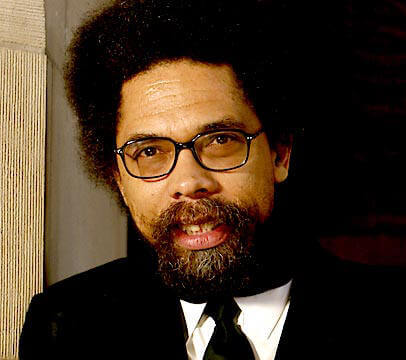
Dr. Cornel West is a prominent and provocative public intellectual dedicated to democracy. Currently the Class of 1943 University Professor at Princeton University, he graduated Magna Cum Laude from Harvard in three years and obtained his M.A. and Ph.D. in Philosophy at Princeton.
Since then, he has taught at Union Theological Seminary, Yale, Harvard and
the University of Paris. He has written 19 books and edited 13 other. He is
best known for his classic
Race Matters,corn as well as "Democracy Matters,"
and his recent memoir,
Brother WWest: Living and Loving Out Loud.
He appears frequently on the Bill Maher Show, Colbert Report, CNN and C-Span
as well as on Tavis Smiley’s PBS-TV Show. And since last fall, he can be
heard regularly on The Smiley and West radio program.
He has also appeared in over 25 documentaries and recorded 3 spoken word
albums. In short, Cornel West has a passion to communicate in order to keep
alive the legacy of Dr. Martin Luther King, Jr.—a legacy of telling the
truth and bearing witness to love and justice.
Here, he discusses his participation in “America’s Next Chapter,” a forum
hosted by Tavis Smiley where a panel of luminaries will wrestle with the
question, "How do we make America as good as its promise?" The event took
place on Thursday, January 13th at George Washington University’s Lisner
Auditorium
Dr. Cornel West - The “America’s Next Chapter,” Interview
with Kam Williams
Kam Williams: Hey, Dr. West, thanks for the time.
Cornel West: It’s a blessing! Happy New Year to you, brother!
KW: Thanks! And the same to you. By the way, a mutual friend of ours, Rhea
Kinnard, asked me to say hello to you for her.
CW: Yes, a lovely sister, indeed.
KW: I have so many questions for you from my readers that I want to get
right to them. FSU Grad Laz Lyles says: I love that America’s Next Chapter
is a multi-ethnic forum. Why aren't there more forums of this type?
CW: I think it has to do with the vision of my dear brother,
Tavis Smiley.
There ought to be more forums like this which are concerned with informing
folks about some of the painful realities of our country. It would be
wonderful for them to be multi-cultural and multi-racial but, most
importantly, they have to be willing to speak to those truths.
KW: Laz’s follow-up is: Given our cultural history, is there more of an onus
on African-Americans to be more inclusive with social and national
discourse?
CW: I think that’s certainly the case, because there’s no doubt that many of
the mainstream white institutions tend to be cosmetic and symbolic when it
comes to including African-Americans, whereas we black folk tend to be much
more sensitive about embracing others, and we have a long history of that.
KW: Sister Patrice Muhammad says: After the
State of the Black Union, some
people said it was just a bunch of talk. Then "The Covenant with Black
America" was published. Haven't heard much about that lately. Where does The
Covenant stand today? Any work being done in our communities based on that
document? Has "The Covenant" been upheld in your opinion? What do you hope this
conversation will produce?
CW: I don’t think talk is just talk. I firmly believe that talk can change
people’s lives. Each life is precious. Talk can’t change a whole society,
but it is not to be degraded or devalued. Talk is very important and not to
be trashed. As for
The Covenant, we had volume two,
The Covenant in
Action, which built on volume one in conjunction with local activists all
across the country. And volume three,
Accountability
[Accountable: Making
America as Good as Its Promise], was a call to keep
track of all the promises that President Obama made. So, I think that what
was originated by The Covenant is still ongoing. But unfortunately, when you
look at the Obama administration, it hasn’t done that good a job at all in
terms of poor and working people. It has been much more beholden to Wall
Street oligarchs, and to pharmaceutical and private insurance companies.
KW: Teri Emerson asks: At the point where President Obama is now, what would
be your view on what he would need to do improve his chances for reelection?
And would focusing more on the African-American community's problems help or
hinder his reelection?
CW: Reelection ought not to be the primary preoccupation of any politician.
It ought to be standing up for truth and justice. If he is to be a
statesman, he would act like Lincoln, and stand up for something that might
be unpopular but not allow the right-wing to dictate the agenda, meaning Fox
News, the Tea Party and others.
KW: Ilene Proctor wants to know whether, given the bleak economic outlook
due to corporate malfeasance, global outsourcing, and a decline of empire,
and with the U.S. facing challenges that were never as pervasive, there is
any cause for optimism that American ingenuity and can-do spirit will help
turn the country around.
CW: That’s a deep question. I don’t think there are any grounds for any
sentimental optimism. But black folks have never really been optimists.
We’ve been prisoners of hope, and hope is qualitatively different from
optimism in the way that there’s a difference between The Blues and Lawrence
Welk. The Blues and Jazz have to do with hope while the other is sugarcoated
music which has to do with sentimental optimism.
KW: Children’s book author Irene Smalls asks: What does "America's Return to
Greatness" mean? Has America been great to and for all groups in this
country?
Is greatness domination or collaboration? Can American greatness permeate
the class structure and have a multi-ethnic approach?
CW: So much hangs on your definition of "greatness." I’m a Christian. I
believe that greatness has to do with the quality of love shown to the least
of thy brethren and the quality of service to those who are catching hell.
When you look at it in that sense, I’d say America has had great moments,
but I wouldn’t call it a great nation. I don’t think there have been any
great nations in the history of the world, because in every nation you find
poor people being subjugated. So, I see the term "great nation" as a
contradiction, as an oxymoron.
KW: Attorney Bernadette Beekman asks: Do you think that an increase in
grassroots activism by the political left will counter the activities of
those on the right? It seems that the Tea Party and their ilk have had an
impact, based on the last election.
CW: That’s a very good question. Sister Bernadette’s absolutely right. The
most important assets we have are our bodies and our energy which can be put
to good use as resources in political activism for poor and working people.
KW: Filmmaker/Author/Professor
Hisani Dubose says: I’d like to know what you
think of the movement to pay teachers based on merit. Children, urban
children specifically, come to school with a lot of issues that prevent them
from learning or even being in the frame of mind to learn. Do you think
merit pay might simply push troubled kids further behind?
CW: For one, I feel that the recent demonizing of teachers and the teachers’
union is nothing but scapegoating. Therefore, all the talk of merit pay is
part of that kind of mentality that wants to view the teachers as somehow
the culprit, especially in our urban centers and rural pockets of poverty.
Finland is the #1 country in the world in terms of education, and 98% of
their teachers are unionized, and their students don’t take standardized
tests at all. What they do have is an average class size of just 14
students, with 2 teachers in each classroom. That’s what exclusive prep
schools like Andover, Exeter, Lawrenceville and the school that Barack
Obama’s kids go to do. Until we reach the point that we treat our precious
poor children the same as we treat our rich children, all this scapegoating
of teachers is just an excuse to not confront the real issue.
KW: Harriet Pakula Teweles says: Since "America Matters," how can we
re-define ourselves as a nation if as the 20th Century belonged to the
United States, the 21st Century might belong to China? In other words,
perhaps the greatest legacy we can leave future generations is a reframing
of our national consciousness. How can we learn to still take pride in
ourselves knowing that, in the 21st Century, America must be an eminent
nation among other eminent nations and not the dominant, pre-eminent nation?
CW: I think that every empire suffers from hubris, arrogance and
condescension, and therefore a moral blindness. That’s true of the American
empire, it was true of the British Empire in the 19th Century, and it will
certainly be true of the Chinese Empire in the 21st Century. When we talk
about America mattering, I take very seriously what the great Rabbi Abraham
Joshua Heschel had to say in 1965 when he said that the legacy of
Martin
Luther King, Jr. will serve as the major means by which the best of America
can be preserved. If that legacy wanes, America wanes. And that’s what we’ve
seen since the death of Martin.
KW: Harriet also asks: How can the panel discuss 'The Next Chapter' on the
Smiley show if we continue to be stuck in this chapter, economically,
socially, politically and internationally? It sounds discouraging, but maybe
we can't leave as glorious a future to the next generation.
CW: That’s a wonderful question. For one, when Brother Tavis and others talk
about "The Next Chapter," they’re really talking about dealing with the
present chapter, because there will be no next chapter unless you deal with
the present chapter. And if you don’t deal with the present chapter in the
way that one ought, the next chapter might very well be the last chapter.
KW: Legist/editor Patricia Turnier says: During segregation, the U.S had
signs reading: ''No Colored" and "Whites Only.'' Now we hear: ''You're not a
good fit for the organization.'' What can be done to help African-Americans
enter the job market and break the glass ceiling?
CW: Again, so much has to do with going beyond treating black people as
cosmetic and symbolic items, as opposed to genuine personalities and human
beings. And that is a deep moral and spiritual issue, which can of course be
backed up by Civil Rights Commissions which enforce the laws against any
form of discrimination.
KW: Patricia also says: about 4.2% of all physicians are black, 3.8% of all
lawyers are African-Americans, barely 5% of all college professors are
black, and the majority of them are in HBCUs. Only 3.7% of all engineers are
African-Americans. Given those statistics, do you think that Affirmative
Action is effective enough? What can be done to correct this situation?
CW: I think we need much more Affirmative Action across the board. There’s
no doubt about that. But Affirmative Action is not the primary issue in and
of itself. The primary issue is that we need for more young black people to
fall in love with the life of the mind and to become voracious readers and
writers. And we also need institutions of higher learning to be more
receptive to black, brown, red and yellow talent.
KW: Felicia Haney wants to know your thoughts on Islamophobia. She asks:
With nearly 7,000,000 Muslims living in the U.S. now, how do you see Islam
fitting into America's next chapter?
CW: Islam has always been a crucial part of America, and it is becoming even
more crucial to America as a whole as more Islamic brothers and sisters come
here and as more citizens convert. Islam has a rich, prophetic tradition. We
need more prophetic Islam figures like Malcolm X. If we could understand and
try to grasp Malcolm after Mecca, we’d have the greatest example of what it
means to be a prophetic Muslim who loves the people, especially the poor and
working people across color and across culture, and who has the courage to
stand up.
KW: Ryan Davis asks: Do you still believe that President Obama is, as he
said a year ago, "The friendly face of the American Empire?"
CW: Oh yes, absolutely, although in some ways he’s becoming less friendly.
KW: The bookworm Troy Johnson question: What was the last book you read?
CW: I just finished
Griftopia by Mike Taibbi. That brother lays it out,
man.
KW: The Ling-Ju Yen question: What is your earliest childhood memory?
CW: Ummm… Probably just playing with my brother and spending time with mom
and dad when I was about 2½.
KW: The Tavis Smiley question: What do you want your legacy to be?
CW: I don’t think about my legacy too much, Kam, because I’m still very much
alive. Every day has to do with how much love, how much decency, how much
compassion, how much kindness, and how much tenderness one is able to enact
vis-a-vis others. So any legacy, for me, has to do with: How deep was your
love? What were you willing to sacrifice? What were you willing to give up?
What price were you willing to pay for others?
KW: Is there a good question that reflects your consciousness that you could
give me to ask everyone I interview?
CW: Yes, what price are you willing to pay for a cause that is bigger than
your own self interest?
KW: Much appreciated! I’ll be sure to call it the Dr. West question. Thanks
for another excellent interview.
CW: Thank you so much, Kam. Stay strong, and Happy New Year!
Reader Comments (0)
Log In to Join the Conversation
Commenting is reserved for registered AALBC members to maintain high-quality discussions.
No comments yet. Be the first to share your thoughts!
Advertisement