
Freedom Riders (American Experience)
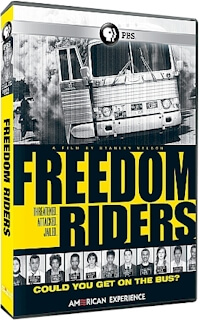 American
Experience: Freedom Riders
American
Experience: Freedom Riders
Click to buy via Amazon.com
Number of discs: 1
Rated: NR (Not Rated)
Studio: PBS
DVD Release Date: May 17, 2011
Run Time: 120 minutes
Average Customer Review: Be the first to review this item
ASIN: B004AR4VRW
FREEDOM RIDERS is the powerful harrowing and ultimately inspirational story
of six months in 1961 that changed America forever. From May until November
1961, more than 400 black and white Americans risked their lives—and many
endured savage beatings and imprisonment—for simply traveling together on
buses and trains as they journeyed through the Deep South. Deliberately
violating Jim Crow laws, the Freedom Riders met with bitter racism and mob
violence along the way, sorely testing their belief in nonviolent activism.
From award-winning filmmaker Stanley Nelson (Wounded Knee, Jonestown: The
Life and Death of Peoples Temple, The Murder of Emmett Till) FREEDOM RIDERS
features testimony from a fascinating cast of central characters: the Riders
themselves, state and federal government officials, and journalists who
witnessed the Rides firsthand. The two-hour documentary is based on Raymond
Arsenault's book Freedom Riders: 1961 and the Struggle for Racial Justice.
“I got up one morning in May and I said to my folks at home, I won't be back today
because I’m a Freedom Rider. It was like a wave or a wind that you didn't know where it was coming from or where it was going, but you knew you were supposed to be there.”
— Pauline Knight-Ofuso, Freedom Rider
Despite two earlier Supreme Court decisions that mandated the desegregation
of interstate travel facilities, black Americans in 1961 continued to endure
hostility and racism while traveling through the South. The newly
inaugurated Kennedy administration, embroiled in the Cold War and worried
about the nuclear threat, did little to address domestic civil rights.
"It became clear that the civil rights leaders had to do something
desperate, something dramatic to get Kennedy's attention. That was the idea
behind the Freedom Rides—to dare the federal government to do what it was
supposed to do, and see if their constitutional rights would be protected by
the Kennedy administration," explains Arsenault.
Organized by the Congress of Racial Equality (CORE), the self-proclaimed
"Freedom Riders" came from all strata of American society—black and white,
young and old, male and female, Northern and Southern. They embarked on the
Rides knowing the danger but firmly committed to the ideals of non-violent
protest, aware that their actions could provoke a savage response but
willing to put their lives on the line for the cause of justice.
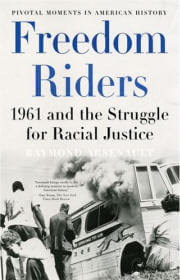 Freedom Riders: 1961 and the Struggle for Racial Justice Click to buy via Amazon.com Paperback: 704 pages Oxford University Press, USA (February 19, 2007) Dimensions: 8.6 x 5.7 x 1.9 They were black and white, young and old, men and women. In the spring and summer of 1961, they put their lives on the line, riding buses through the American South to challenge segregation in interstate transport. Their story is one of the most celebrated episodes of the civil rights movement, yet a full-length history has never been written until now. In these pages, acclaimed historian Raymond Arsenault provides a gripping account of six pivotal months that jolted the consciousness of America. |
Later, Mississippi officials locked up more than 300 Riders in the notorious Parchman State Penitentiary. Rather than weaken the Riders' resolve, the move only strengthened their determination. None of the obstacles placed in their path would weaken their commitment.
The Riders' journey was front-page news and the world was watching. After nearly five months of fighting, the federal government capitulated. On September 22, the Interstate Commerce Commission issued its order to end the segregation in bus and rail stations that had been in place for generations. "This was the first unambiguous victory in the long history of the Civil Rights Movement. It finally said, ‘We can do this.' And it raised expectations across the board for greater victories in the future," says Arsenault.
"The people that took a seat on these buses, that went to jail in Jackson,
that went to Parchman, they were never the same. We had moments there to
learn, to teach each other the way of nonviolence, the way of love, the way
of peace. The Freedom Ride created an unbelievable sense: Yes, we will make
it. Yes, we will survive. And that nothing, but nothing, was going to stop
this movement," recalls Congressman John Lewis, one of the original Riders.
Says filmmaker Stanley Nelson, "The lesson of the Freedom Rides is that
great change can come from a few small steps taken by courageous people. And
that sometimes to do any great thing, it's important that we step out
alone."