

- Open Club
- 2 members
- Rules
RMCommunityCalendar
- All Calendars
- AALBC.com's Literary Events Calendar
- BlackGamesElite: BGE Calendar
- DOS earliest literature: Recent News
- RMCALENDARS: RMWorkCalendar
- RMCALENDARS: Black Artist Birthday Calendar
- RMCALENDARS: RMCommunityCalendar
- RMCALENDARS: Black Artist of Tumblr Calendar
- RMCALENDARS: MidnightHour Calendar
- With 'RMCommunityCalendar'
- Download iCalendar export
- Subscribe to iCalendar feed
ALL
DAY
-

07 October 2258
Black Building Wealth today, spurred by profdThis event begins 10/07/2025 and repeats every year forever
POST URL
MY COMMENT
@ProfD
And all the middle easterners black gold has the blood of middle easterners on it shed by other middle easterners.
I support all your points to nonviolent financial growth. but I have to say, whites whether they be arab/asian/latino/african/male/female/christian/muslim/ or others have intentionally killed each other for financial gain. The gold rush, the oil rush, the manifest destiny land grabs, prohibition era liquor fortunes, first stock market era, all had mostly white people killing white people while total complicity by law enforcement, once the first people/native americans were eliminated for the land if needed. One thing I rarely read or hear black people say, especially in the american continent, is that we in modernity don't have that strong a heritage of murder for financial gain. I argue with no true proof, only personal experience or views that most black on black financial crimes happen today than ever before. Whereas for whites they killed each other in the near past way more than today for fiscal wealth.
Black people in the usa at the least were enslaved and financially penniless permanently while whites were killing each other for land or oil or gold or liquor. So Black people have started our internal wars over money in the 1900s. Consider madam cj walker was the wealthiest black person in the usa, lived in Urban harlem, think on that. She was blocks from poor black people. She wasn't in a scenario like downtown manhattan's gilded age where rich people had houses lined up next to each other.
If you consider black people in the usa started to be attested by whites as financially wealthy in the 1900s then based on usa history with the european colonies, the first phase of usa history, starting in the 1500s whites [european/asian/latin/male/female/arab/muslim/christian/ or other] had four hundred years to become financially wealthy by any means necessary while blacks have only been allowed to become financially wealthy within the law from in the 1900s. That is a variance.
And, to @Pioneer1 initial point, the culture of white latin americans trying to become pure white stems from the simple fact that unlike the english european colonies that brought white women along, the spanish/french/portuguese colonies were overhwhelmingly male, so latin american whiteness is primarily mestizo, the spawn of a white european and an indios female , indios being first people/native american. It is minority mulatto, the spawn of a white european and a black african woman. Mestizo or mulatto children were and are taught in the castas of latin america or its modern derivatives that whiteness could be achieved through a mating structure. Even though genetic lineage doesn't matter how many matings are forced, a human beings lineage is never deleted. so, the mating concept is perpetual because it's goal can never be achieved, but its goal is always emphasized.
Now that the neutral truth or history is out of the way,
to the positive
I like your nonviolent financial calls. They each have positive value. I will mention warnings alongside the positives.
1) owning our talents and abilities, intellectual property
In modernity with the internet, owning your creativity is huge. I don't know the numbers but any artists knows , intellectual property theft in various fashions is rampant today, rampant. So I concur to this as a modern importance. It was important in the past, but with the modern internet, the ability to make profit off of intellectual property theft is much quicker than the past. My warning is, the law around intellectual property is really messy. It isn't an accident that the fiscal wealthiest media firms spend so much money or effort redesigning characters so that they can gain copyright on a newer version. Or that many of said firms don't release media that has public domain characters , cause the ability to legally deny others to profit is... a task, and since most court cases end up settling out of court, well, the expense is to high.
2) using a Black bank
I want to be more specific, not a black bank. but a Black Credit Union. I have nothing against Black Banks but credit unions are easier to start and more focused in their design. Credit Unions will allow financially applicable segments of the black community to have a bank for themselves. When I look at the fiscal wealthiest black community in any city in the usa, that being los angeles, they should have a credit union for themselves and to my knowledge they do not. I assume similar for the atlanta black fiscal elite. The black fiscal elite in new york city to be blunt, should have it as well. But, I rather black people of wealth in small regions make credit unions and then new black money can join whenever they can. Financially poor black people can't afford the extra fees or limitations of small banks, especially in context with pensions or similar financial tools.
3) supporting Black businesses
As someone whose household members have always supported black owned businesses, I do support, buying black. But, I do think black people need to imagine how to own their own businesses moreso. From Jacobs to Famous to Lighthouse to Make My Cake to Jumbo to Charlie's to King Barka to various laundromats or hair salons , multiple Black businesses exist in Harlem that have thrived for decades to recently opened. But New York City proves starting a firm requires more thought. I have witnessed multiple chinese owned restaurants fall in recent years, but I also recognized one chinese restaurant survive and thrive well. why? The one that thrived well is near columbia universty and was getting tons of asian customers even when i was a kid. My point is,the black dance school , liquor gallery, all failed. The black architect seems to be stable. But NYC is hard. Some business will never honestly work in NYC unless the average wealth increases at a rate above the average in the usa or the cost of living decreases at a rate below the average in the usa.
So support black businesses but I rather hope black businesses focus on being efficient. instead of a dance school maybe you can operate in a school. instead of a gallery maybe you can get a church to be the host of a gallery and your wine, harlem has many black churches that do nothing most of every day, that are locked up or gated. I know churches members have issues with certain activities but be a business person and make it work. Contracts, figure it out.
Jacobs
https://www.jacobrestaurant.com/jacob-soulfood-restaurant-locations.php
Famous
https://www.famousfishmarketnyc.com/
Lighthouse
https://www.lighthousefishmarket.com/
Makemycake
https://www.makemycake.com/
Jumbo
https://www.sugarhilljumbos.com/
Charlie's
https://www.charlespanfriedchicken.com/locations
King Barka - don't hate, websites cost money
https://www.restaurantji.com/ny/new-york/king-barka-/
4) buying sports franchises
Not for me. In a soccer community elsewhere members were talking about owning a sports team and if I was a multi billionaire (meaning I have three hundred billion dollars in a bank account, not including stock evaluations/bonds/partial investments in firms or dividends from investments or stock) I wouldn't invest one penny in sports clubs. I have said it in this forum before. I am not sold on sports franchises.
The business model for sports franchises is simple. You buy a franchise and over time the speculators, the people who see, continually state the value of the franchise is worth more, based on the increased ad revenue and real estate value of the club. It is the NFL model, which is applied to all sports today. But here is the problem.
In the EPL, english premier league, the pandemic caused a catastrophic stop of the epl, where franchises had to take out ten million dollars a week or more, let alone the financial money pit of other teams. The problem with sports franchises is any investment in them has to assume, a financially positive environment, where sponsors will be able to pay increasing fees, fans will be able to buy increasingly expensive content, the real estate value with grow. But I can't assume a financially positive environment will exist for any firm all the time, and sports franchises in negative financial environments are some of the worst properties to own. If anything, the best time to buy or start a sports franchise is when the economy is at its lowest, because you are buying or starting on the cheap and you should be able to ride the bad times. The example is the NY Giants, the white family who owns them were bookkeepers, they bought the giants for a hundred dollars or thousand dollars in bad times. so... buy sports franchise , not for me, not now , maybe if the shutdown continues for three years, all the unpaid rents of federal workers and utility bills and etcetera may shake the market enough to cause problems. Al the most profitable sports teams have situations that matter. The yankees, Real madrid have a legacy that requires time + success. The New York Knicks or rangers have an excellent location far better than most including the yankees. Like every NFL team, MAnchester United and every other epl team have a sponsorship deal that is totally disconnected to athletic merit. But is a closed system to new clubs for the most part.
Yes, the saudis now own newcastle united, the qataris own paris saint germain, the emirates own manchester city and nyfc, redbull own various sporting enterprises. But the oil lords invest because they want to keep their currency low. If the oil lords don't spend they accumulate so much wealth their currency will have to rise in value which will only help the usa as most countries currencies are pegged to the dollar. This is why during the covid 19 they were the only set of countries looking to spend, they had the money to spend and didn't want their currencies to skyrocket as other economies were falling during the covid 19. As for redbull, well, they have basically found a way to use the NFL model in all sports. They use specualtion and marketing to get an advertising industry to finance their ventures which allows them to skim off the top and market manipulate.
5) investing in land and real estate
rough, as someone who was born and raised in NEw York City, land and real estate seem very wise long term BUT during the covid 19, many small business failed which meant many offices struggled. It is only because the city/state/federal government provided a bunch of financial crutches that the real estate industry didn't implode. But, again, that is bad fiscal capitalism. Based on revenue in my lifetime, all the banks in the usa should had closed permanently, all the investment houses in the usa should had closed permanently, all but the ford motor company should be around as car manufacturers (I will never forget how ford wanted to not get the government aid but the government demanded they get aid, ), all the airlines in the usa should had closed permanently,most food production firms should had closed permanently, most real estate properties in nyc should had been bought by the city government way under market value for inability to pay debts.
Too often in the usa, the federal/state/city governments provide welfare to failing businesses, which is dysfunctional. People complain about unemployed people getting welfare but welfare to the unemployed serves the function of maintaining a certain quality of life for the unemployed, which helps peace amongst the masses. But welfare to firms spits at the important function of being able to fail in free market capitalism. When a firm fails that means it was mismanaged. Every firm in the usa in my lifetime who was given welfare to survive did it to itself.
AT&T sold Warner bros under market value to the discovery channel because it was unprofitable. It was a failure. AT&T demanded discovery channel accept all the warner bros debt, so AT&T had clean books with all of its profitable branches.
The mergers of firms isn't because firms are making money, they merge because they are failing.
The banks who take all races of peoples homes every day or treat Blacks or First peoples/native americans negatively compared to white customers crawled and begged in washington d.c. in their tailored suits far more sinfully in my mind than any "shaniqua" in an urban black neighborhood to the welfare office.
So not for me. If you want to invest in land or real estate go ahead, but if you don't have a wise way to turn that land or real estate into revenue then your playing the common game today in the usa of tax breaks and tax liens and false speculations and overall market gambles that... not for me.
6) buying stocks and bonds
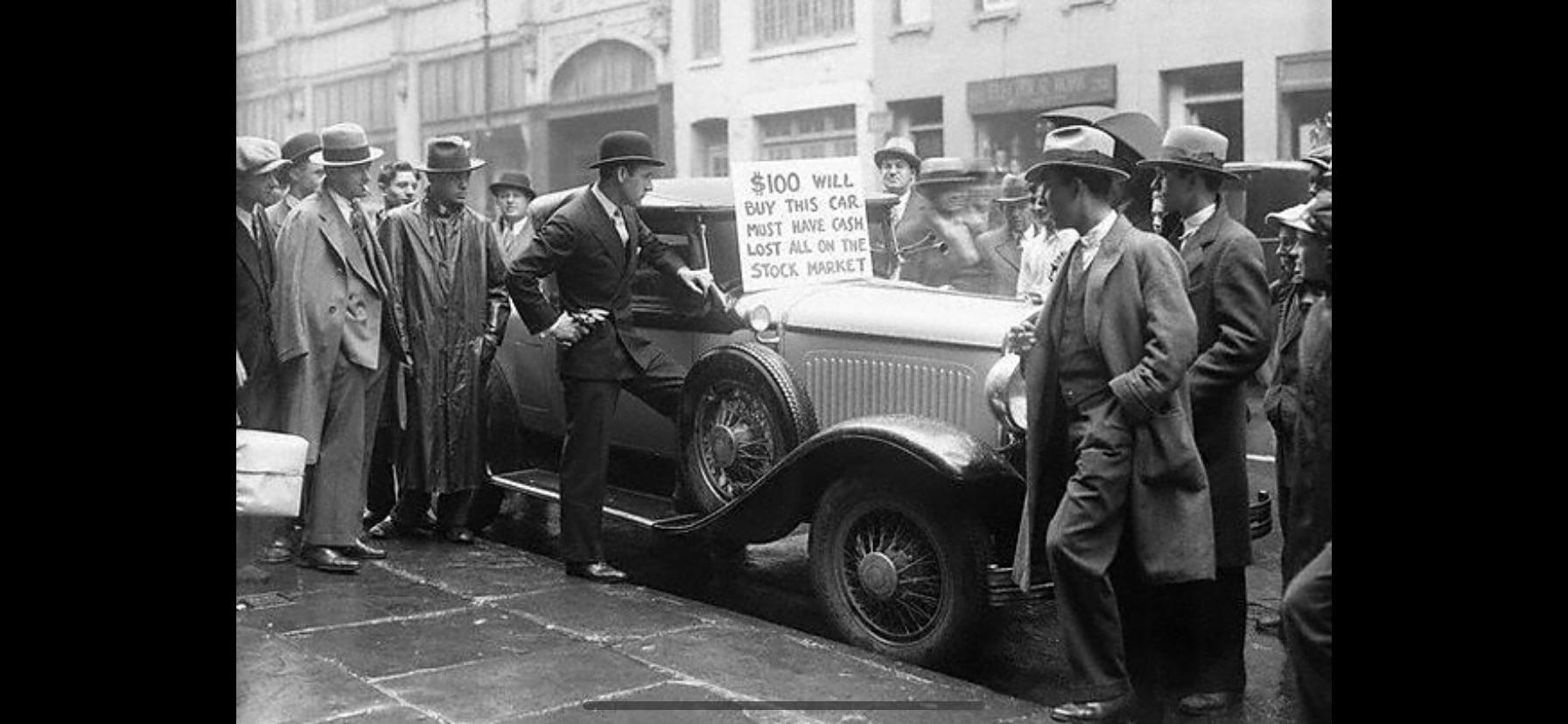
I always think of that white man standing with the car.
The stock market craches don't include the bitcoin crashes, which they should cause it is the same situation.
https://en.wikipedia.org/wiki/Stock_market_crash
When anyone invest in a trading environment the key isn't their investment, the key is when they pull out. I recall in New York city, many bitcoin billionaires who professed in local media, NY Times and Wall Street Journal, how they don't need money, they have bits, they are living it up... and then some time later, they looked like a modern variant of the man above or below:) in their case, holding a mop or holding a sign by themselves.
Black people invested in the freedman's bank, that frederick douglass spoke for... black people of the late 1800s in the usa , most of DOSers who had any money lost all their money in the implosion of the freedman bank. So invest? yeah ok. But.. people look at some pension funds and say you see, invest. but many and i argue most pension funds in the usa went belly up. If you are so inclined only invest in stocks or bonds, perishable revenue or income.
bitcoin crashes
https://www.webopedia.com/crypto/learn/biggest-bitcoin-crashes/
someone assessed the grey scale and made a color version. ahh chrysler, internals are worthless, but the cabin, nice:)
IN CONCLUSION
Of the six, I think 2 with adjustment +3 with focus have the best value overall. 1 has legal issues which are mighty. 4+5+6 are all true gambles. They each require a situation or environment which is not certain.
Black Credit Union, yeah, I like that idea. focused, small, relies on true financial quality. gives great leeway once you pay the legal fees, protects from operations of other or larger banks.
More black people own business in the usa today than ever before , holistically. But, too many black businesses fail in the usa as well, you have to think more on the financial reality of the industry you are in. It can't be village save me.
MY COMMENT REFERRAL URL
https://aalbc.com/tc/topic/11939-mejorando-la-raza/#findComment-76710
-
08 October 2258 14 October 2258
Indigenous People's DayThis event begins 10/08/2025 and repeats every year forever
I want to honor the legend of Jonas Caballo. Who fought against the USA in the Seminole wars in Florida, fought again the White and non Black indigenous citizens or residents in the USA in the trail of tears, fought the borderland groups on either side of the USA /Mexico border to find a home for his people, that still exist in northern mexico , today.
One of my favorite ancestors.
Columbus day is the second monday in october, so indigenous peoples day has to be the same day, but the second monday in october is one day from october 8th to october 14th , every year.
His descendants are considered indigenous tribe
https://www.milenio.com/estados/declaran-pueblo-indigena-tribu-negros-mascogos
TEXT
The Negro Mascogos Tribe is declared an indigenous people The governor of Coahuila emphasized that this is important primarily because they deserve it and it is a commitment that Mexico has made regarding human rights. Ana Ponce Saltillo, Coahuila / 09.05.2017 14:57:24 Governor Rubén Moreira Valdez issued the decree declaring the Negro Mascogos Tribe an Indigenous People of Coahuila. In the community of "Nacimiento de los Negros Mascogos" in Múzquiz, the governor met with this tribe and representatives from different levels of government to make the appointment. He emphasized that it is important primarily because they deserve it, and because it is a commitment Mexico has made regarding human rights and to providing dignified conditions for Afro-descendant peoples. [OBJECT] "Normally, people think about the states of Oaxaca, Guerrero, and Veracruz, where there are Afro-descendant settlements, but the north is rarely mentioned, and today we have to feel proud of that," he said. "Today, the history of the Mascogo people, as well as the Kickapoo, the Chinese emigration, and the caravaners, is already in our textbooks, in the third-grade textbook," he added. Moreira Valdez said he hopes that after this decree, people will be able to access benefits from the National Institute of Indigenous Peoples and considered that this is the fight that must be started, since the Mascogo deserve to receive the resources that the country allocates to indigenous tribes. "It's not a concession, it's not a matter of whether you want it or not. It's there in their budgets. And they've delayed this allocation for one reason or another. But I hope that with this decree, for the 2018 budget, the Mascogos will be included among those communities that receive resources, because they deserve them, that's true," he specified. "But also because Coahuila contributes much more to the budget than it receives. Of what we contribute, we should be receiving 40 percent, 30 percent of what we contribute. If we have access to those resources, we will surely improve in this regard," he emphasized.
Some thoughts on the Mascagos
https://letraslibres.com/wp-content/uploads/2023/10/convivio-zaid-mex.pdf
TEXT
Mascogos by Gabriel Zaid The Mascogos arrived in Mexico fleeing from American slavery. The current inhabitants have lost some typically black features, but they adhere to their traditional festivals, songs, clothing, and dishes with a certain affirmative militancy of their identity. A few Black people arrived in Mexico with Hernán Cortés. They continued arriving from the Antilles, and almost three centuries later (in 1810), there were 10,000 Black people and 624,000 Afro-mestizo people, compared to 15,000 Europeans, 3.7 million Indigenous people, and 1.8 million other mestizos, for a total of 6.1 million inhabitants. In Coahuila, the total did not reach 17,000 in 1803 (Gonzalo Aguirre Beltrán, The Black Population of Mexico. Ethnohistorical Study, 3rd ed., revised and expanded, Fondo de Cultura Económica, 1989, pp. 19 and 233). Mexico had a president of Black, Indigenous, and Spanish descent: Vicente Guerrero (almost two centuries before Barack Obama assumed the presidency of the United States). Not only that: President Guerrero decreed the abolition of slavery in 1829 (decades before the United States Congress did so in 1865). During that 36-year period, seeking refuge in Mexico was an opportunity to escape slavery or persecution. Refugees arrived illegally. But in 1852, John Horse (leader of the Black Mascogos, who was of Black, Indigenous, and Spanish descent, like President Guerrero) and Wild Cat (leader of the Seminoles) obtained permission from President Mariano Arista to settle in El Nacimiento, Coahuila, near the border, in exchange for defending it from Apache and Comanche raids. In that rural town in the municipality of Múzquiz, located in the valley where the Sabinas River rises, President José Joaquín Herrera had granted the same permission to the Kickapoo two years earlier. Some call the Mascogos Black Seminoles; however, they are not Seminoles, although the two ethnic groups were once neighbors and eventually interbred. The Mascogos are Black people who arrived, the Seminoles, Indians who were there and welcomed the Mascogos. The Mascogos were slaves, the Seminoles were not. The Mascogos performed forced labor on sugarcane, cotton, and rice plantations, while the Seminoles were small farmers. The Mascogos were fleeing their owners, who wanted them recaptured alive for the plantations; the Seminoles were fleeing settlers, who wanted them dead to ensure the dispossession of their lands ("The best Indian is a dead Indian"). It is unknown how many Mascogos arrived in Mexico, perhaps half a thousand. Today there are about three hundred. According to census data compiled by pueblosamerica.com (search for Mascogos on this site), in 2020 there were 270 Mascogos, with a 2% illiteracy rate, seven years of schooling, piped water, electricity, a television, and a refrigerator. There are also Mascogos in Texas and Oklahoma. According to Belem Concepción Muñiz Estrada (August 24, 2023, by phone in Saltillo), there is a floating population of Mascogos that varies greatly depending on whether they go to work in other locations or return. She conducted interviews in El Nacimiento in 2014 and wrote the book cited below, as well as the article "The Black Mascogos of Múzquiz, Coahuila, and Their Self-Sustaining Community" (online), where she points out, among other things, the support the Mascogos receive from the Coahuila government for reforesting walnut trees. They speak Spanish, English, and (the older ones) Mascogo. They have gradually dissolved as an ethnic group through marriage. In the videos, you can see that the older ones speak English, the younger ones, Spanish; and that typically Black skin, face, and hair are not predominant. However, they cling to their traditional songs, clothing, and dishes, with a certain militant affiliation with their identity, which attracts tourists. Like Black people in the United States, they have celebrated Juneteenth, Juneteenth Day, since 1866. In 2021, President Biden declared it a national holiday. The Mascogo sing in English (not Spanish or Mascogo), in a choir, a cappella (without musical instruments), clapping their hands to mark the rhythm. Their songs are indeed spiritual. A few books in Spanish have the word Mascogos in the title; about twenty in English have Black Seminoles. On YouTube, there are about twenty videos in Spanish (under mascogos) and fifty in English (Black Seminoles). There are Wikipedia pages in Spanish, English, and Arabic under Mascogos, and also (in a dozen languages) under Black Seminoles. E. F. Nava López transcribes the Coahuila recording of "A Religious Song of the Black Mascogos" (Annals of Anthropology, July-December 2016) in Mascogo, English, and Spanish, with musical score. The lyrics are the beginning of the Christian Creed. Song lyrics, transcribed from English and translated into Spanish: PACKING MY SUITCASE I'm packing my suitcase. I'm getting ready to leave. Lord: I'm packing my suitcase. I'm getting ready to leave. My mother has gone, and she was ready to leave. My mother has gone, and she was ready to leave. Lord: I'm packing my suitcase, I'm getting ready to leave. My father has gone, and he was ready to leave. and he was ready to leave. My sister has gone, and she was ready to leave. My sister has gone, and she was ready to leave. Lord: I'm packing my suitcase, I'm getting ready to leave. Source: Belem Concepción Muñiz Estrada et al., Negros mascogos. An Odyssey to Birth, Saltillo: Universidad Autonomous de Coahuila, 2020, p. 111. The song was transcribed and translated by Paulina del Moral. The complete book is online. HIS NAME His name is malasta. I don't know. His name is malasta. I don't know. His name is malasta. I don't know. NEW YEAR The year has passed. Happy New Year. Happy New Year. Very happy, happy New Year. Very happy, happy New Year. THE GOOD PATH Oh, please tell me how long it's been since I took the path of God. Oh, please tell me how long it's been since I took the path of God, and I won't turn back until Judgment Day. Source: Mascogo Songs, in English, documentary video by Karla Rivera Téllez, Ministry of Culture of the Government of Coahuila, 2020. Available on YouTube. There is a Mascogo Cookbook from Coahuila, 2nd ed., National Council for Culture and the Arts, Indigenous and Popular Cuisine Collection #51, 2014, compiled by Paulina del Moral and Alicia Siller V. ~ GABRIEL ZAID is a poet and essayist. His most recent book is Translated Poems (El Colegio Nacional, 2022).
And more
https://www.eluniversal.com.mx/articulo/estados/2016/09/19/mascogos-siempre-listos-para-partir/
TEXT
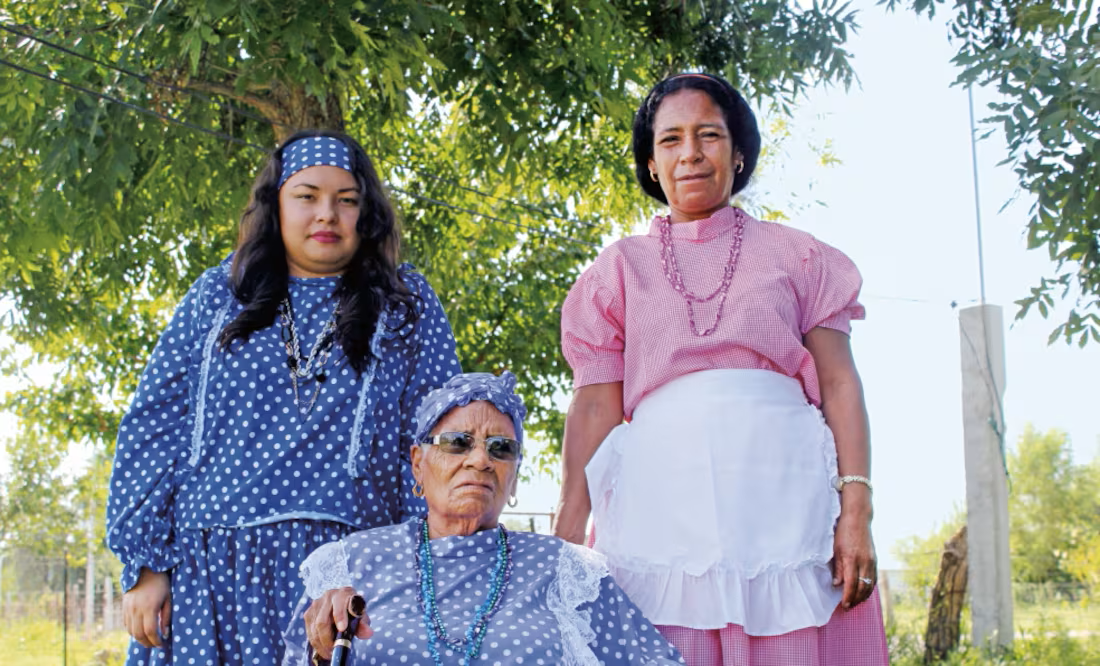
Mascogos. Always ready to leave Mestizaje wiped out the pure Afro-descendant population in Coahuila, who arrived fleeing slavery in the United States. Lucía Vázquez (center) is 85 years old and the last pure Afro-descendant in the community of El Nacimiento, Múzquiz, Coahuila (FRANCISCO RODRÍGUEZ) States | 09/19/2016 | 03:10 | Updated 09/19/2016 08:03 Lucía Vázquez is 85 years old and at times bursts into tears because she's convinced that when she dies, no one will sing to her. She wanders around her house or sits outside with a blank stare, a stare that has been deteriorating for the past two years, just like her hearing. Lucía is the last pure Black woman in the community of El Nacimiento, in the municipality of Múzquiz, in the state of Coahuila, a community of African descent that arrived in Mexico in the 19th century. Lucía is wearing a long white dress. She is sitting in a rocking chair outside her house, on the road that crosses the community of 55 houses, home to about 300 residents, some still descendants of Black Seminoles who arrived in Mexico in 1850. They are called Mascogos, but Lucía reproaches: "Who knows where they got the name Mascogos? Before, they were just Black people." With her, a pure race that settled in the El Nacimiento colony in 1852 will end, when the Mexican government gave 7,022 hectares to them, the Kickapoo tribe, and the Seminole Indians in exchange for protecting the border from the Apache and Comanche raids that were ravaging settlements. It will end because she married a man from Palaú, a town in the coal mining region, with whom she had seven children. “There were no more Black people; they had all left,” Lucía says, as if trying to justify herself. “My children are pure Cuarterones,” she says. With the exception of Lucía, the rest of the Black population in El Nacimiento is the result of a mixture of races. “I married a Mexican, he married a Mexican woman,” they often say, as if they weren't also born in Mexico. For the Mascogo community, the El Nacimiento colony is like a nation within a nation. Just as no one—according to Lucía—told her the story of the arrival of Black people to Mexico, no one has promoted capeyuye, a cappella singing accompanied by applause; most are sung at funerals, Christmas, and New Year's. "Who's going to sing to me? Before, they were little Black people, but I'm the only one left," she laments. A community with history The community of El Nacimiento is located 30 kilometers from the municipal seat in Múzquiz, a mining municipality in Coahuila. At the entrance, there is a sign that reads: Black Mascogos and Seminoles. Francisco Cázares, coordinator of Popular Cultures of Coahuila, explains that the Mascogos arrived with the Kickapoos and in a kind of alliance with the Seminole indigenous group. He mentions that they fled persecution by the United States government and slavery in the mid-19th century, and that it was not until the agrarian redistribution that they were granted the territory as an ejido. In the United States, they are recognized as Black Seminoles. When they arrived in Coahuila, they began to be called Mascogos, apparently because of the Muskogee language they spoke. “They came from Florida. There are versions that say the Mascogos were slaves of the Seminoles, because at that time, Native Americans had the right to own slaves. Other versions—including the main one—explain that they formed military allies, hence the name Black Seminoles,” explains Cázares Ugarte. She says they are considered runaway slaves, that is, rebel slaves who escaped from slave-owning regions. Yolanda Elizondo, president of the Friends of the Culture of Múzquiz, Coahuila A.C. Trust, has another version. She says that the Black Seminoles lived with the Seminole Indians as a formal group, who united when the United States government decided to send all the tribes to a large reservation in Oklahoma. She claims they were free Black people and that on their way to Mexico, they were joined by runaway slaves. “There were Black Seminoles in Florida, but not as slaves; they accepted these Black slaves and naturally they mingled,” she explains. Some historians explain that the term “cimarrón” referred to groups of African descendants who maintained a status of freedom by living in the desert and mountains. In El Nacimiento, when residents are asked what their parents or grandparents told them, the African descendants say little. “I hear comments now that they were slaves, but I don't remember,” says Estela Vázquez Núñez, 77. However, the community holiday is June 19—Juneteenth Day in the United States—the day the slaves of Galveston, Texas, learned they were free. The community of El Nacimiento celebrates in a walnut grove where they prepare the few remaining traditional dishes: soske (corn atole), tetapún (sweet potato bread), pumpkin or piloncillo empanadas baked on steel, and mortar bread, mainly. The women wear long dresses with white beads, an apron, and a headscarf. However, many don't even know why they celebrate. "It's the day of the black child," "it's celebrated when they arrived," "it's celebrated because that's when they were given the land," are some of the comments from the community. "These are groups that have a more open attitude toward issues of racial mixing. They are people with less protection over their race," explains Francisco Cázares, of Popular Cultures. They were rented out as mules. Homero Vásquez is a tall, lanky old man. He sits in a rocking chair outside his house. Hanging from it is a Mexican flag missing the red part. He is the son of Teodoro Vásquez, who told him that Black people came from Florida fleeing the war and slavery. “They were rented out as mules,” he says his father told him. Homero says his father told him that in the 1930s, many people came to the area to farm, and that since then, people began mixing with Mexicans, which is why English is no longer spoken. His mother came from Parral, Chihuahua, at the age of 15. His father told him that there was a severe drought that forced people to leave the colony, and that many went to Brackettville, Texas, where there is a cemetery for Black Seminoles who served in the US Army between 1879 and 1914, in a unit called the Seminole Negro Indian Scouts. “My grandmother there was named Tina Goren, but here she was called Carmen Flores. They used a different name for each reservation,” says Homero, who of his nine children, five live in the United States. Homer takes out of his house a large portrait of John Horse, the great Afro-Seminole leader, son of a Black mother and a Seminole Indian father. According to history, he led the longest and most massive slave escape in the history of the United States. He arrived in Mexico with Gato del Monte, the Seminole chief, and Papikua, the Kickapoo chief. In Mexico, he was awarded the rank of colonel in the Army. Many people left "I'm a mere descendant. My father was a clean Black man," says Ricardo González Núñez, known as Chito, a man who is about to turn 80 and has served more than 20 years as a judge of the ejido. Chito leaves his house slowly, with the top buttons of his shirt undone. "I was putting aloe vera on my bones because they hurt a lot," he says. In his house, there are about ten chickens, roosters, and a peacock. He sits in a rocking chair. Most houses have a backyard where they raise animals. There are no houses joined together. Most people are engaged in agriculture, although no young people are seen in the neighborhood. Chito says that life used to be different. “There was a lot of black people,” he says. He owns goats and sells the milk. “It’s down. There’s no money,” he complains. He produces about 100 liters every three days and sells it in Múzquiz for 1.60 pesos per liter. He studied until fourth grade. He mentions that among the Mascogos, his father left him the tradition of behaving well and respecting others. His mother was a blonde from Chihuahua. Chito was a cowboy in the United States. He remembers that many people left because "they had to make a living." He suffered the segregation of Black people in the United States, when they had to ride in the back of buses. He has four children, two of whom live as slaves in the United States. They work in restaurants. "They're the ones who help us," he says. "We all have children of slaves here. Some come in with permission and stay. There's no life here," he adds. "What did your father tell you about their ancestors?" he is asked. "That they were fleeing slavery. Their grandparents told my father," he replies. "Do you feel Mexican or Mascogo?" "You have to be Mexican. Black, but Mexican," he says. Chito, like his father, also married a woman who was not of Black descent. “I knew her in my life,” she says. I'm packing my suitcase. Margarita González Núñez is 78 years old and also feels the sadness of those songs that are being lost. “Even though I don't understand them, I know they're saying goodbye, that they're singing to the dead,” she says, standing next to her daughter Narcedelia. “Now all that's left is food and clothing,” she laments about the loss of traditions. With Doña Mague is Dulce Robles Herrera, the great-granddaughter of Lucía Vázquez, the last pure Black woman in the community. “Aren't you leaving like the other young people?” Dulce is asked. “No, I don't like it. There [in the United States] are the police. They're alone. I have my family here,” she defends. Dulce says that Abuelita Lucía, as she calls her, starts to cry when she's with her. “She cries a lot because she says no one will sing to her. She wants a Black woman to sing to her,” Dulce comments. In the background of the conversation, Mascogo Soul plays, an album recorded by the last women who knew the capeyuye. Songs like "It's Maybe My Last Time" and "Glory in the Heaven" are featured, melodies with repetitive phrases. The song "I'm Packing Now" is heard, a song about escaping slavery that was often sung on slave plantations: I'm packing my suitcase I'm getting ready to leave I'm packing and I'm ready to leave Lord, I'm packing my suitcase I'm getting ready to leave My mother is gone and she was ready to leave My mother is gone and she was ready to leave…
wiki
https://en.wikipedia.org/wiki/John_Horse