 Bookshop
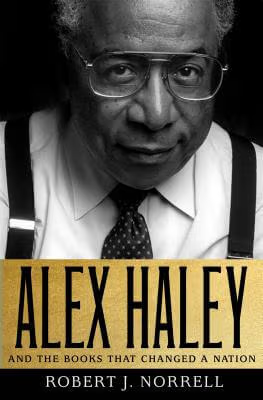
In Alex Haley and the Books that Changed a Nation, Robert J. Norrell, professor of history at the University of Tennessee, Knoxville (UTK), explores the complicated life of one of America’s most famous twentieth-century authors. Having had access to the Alex Haley Papers housed at UTK and inaccessible to most (if not all) researchers, Norrell sheds new light on his subject.
Although it was well known that Haley had money problems for much of his adult life, readers will learn of the unusual severity of that financial hardship. Norrell also investigates the emotional impact on Haley of his mother’s lack of affection, and her premature death at the age of thirty-one, when her son was ten years old. These tragedies, as the author suggests, might help to explain Haley’s adverse relationships with women and his children (Haley was a notorious womanizer and an inattentive father).
Norrell’s impressively researched biography of Haley provides us with a better understanding of the man and the impact of his work. But has the author probed and poked adequately at his subject. One gets the sense that Norrell was overly sympathetic in his depiction of Haley.
Take, for example, Norrell’s handling of the plagiarism charges against the author soon after the release of Roots. Several authors came forth insisting that Haley copied from their respective books.
The most celebrated case involved Harold Courlander, author of The African, who took Haley to court. In pre-trial testimony two Columbia University professors submitted a detailed analysis that unequivocally demonstrated that Haley plagiarized The African—Norrell makes only a brief mention of this report. Refusing to back down, under oath Haley stated that he had neither seen nor heard of The African.
At the eleventh hour, just before the judge was about to render a verdict (which, many believed, would have been to the plaintiff’s favor), Haley settled the case, paying Courlander a large sum of money. After the trial, Joseph Bruchac, an ethnic studies professor at Skidmore College in upstate New York, contacted Courlander and, in a written statement, maintained that well before the publication of Roots, he had given Haley his “own personal copy” of The African.
Despite the case against Haley, Norrell argues that the author was undeserving of the fallout that transpired. One wonders whether Norrell is neglecting his task as a biographer to depict his subject warts and all. Nevertheless, Alex Haley and the Books that Changed a Nation remains an interesting and well-documented study.
Editor’s Note: In December 1978, Alex Haley settled a plagiarism lawsuit by acknowledging that portions of his bestselling book Roots had been taken from The African by Harold Courlander. Courlander had sued for more than half the profits of Roots, arguing there were substantial similarities between the works. The case ended after six weeks of trial when Haley publicly conceded that “various materials” from The African had found their way into Roots. The settlement amount was undisclosed, but it was widely assumed to be substantial.
There was also an earlier plagiarism claim involving Jubilee by Margaret Walker. That case ended in dismissal in September 1978, with a ruling that the similarities between Jubilee and Roots were insignificant.
In his own testimony, Haley denied knowingly copying The African and insisted Roots was based on his maternal family’s history across seven generations. However, he conceded that three brief passages in Roots had “apparently” come from Courlander’s novel, suggesting someone had passed the material to him without attribution. That admission became a critical point in the case and helped pave the way for settlement.
Arnold H. Lubasch, “‘Roots’ Plagiarism Suit Is Settled,” New York Times, December 15, 1978, accessed June 27, 2026.