 Bookshop
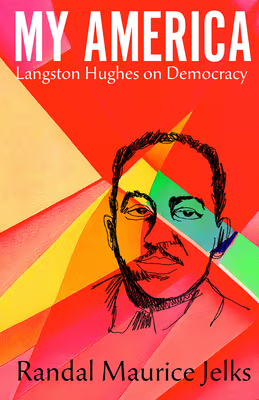
My America: Langston Hughes on Democracy by Randal Maurice Jelks is self-described as “a commentary on select Langston essays, poems, and speeches”; however, for readers who have long since engaged with the works of Langston Hughes, it also serves as a primer and historical record of his impact and legacy — an author who “wrote for forty-six years.”
Be prepared for an expansive lesson and a reflection on Hughes the activist, the explorer, and the artist who possessed the ability to forge political ties through both words and action. The text is bookended by a detailed preface that presents background and a narrative lens for the book, followed by twenty-seven pages of notes containing chapter breakdowns, references, and a subject index. This structure is important because the twelve chapters at the heart of the book are presented in dual voices, past and present. Many sections begin with a document in Langston Hughes’s voice — through narrative, speech, or poem — followed by a section marked “Commentary” in which Jelks provides historical context, personal reflection, and connections to the present day.
Early on, readers are introduced to Hughes’s travels throughout the United States and abroad: Chicago, Mexico, New York, Paris, and beyond during his youth. These scenes provide the perfect segue for Jelks’s commentary examining Hughes’s early background in Lawrence, Kansas. Jelks also offers insight into early twentieth-century racism during Hughes’s lifetime, insisting that Hughes’s sensibilities were “formed by the Midwest” and its distinctive political awareness within Black communities.
Jelks retraces Hughes’s steps using material from works such as the novel Not Without Laughter (1930) and the autobiographies The Big Sea (1940) and I Wonder as I Wander (1956) to illustrate not only Hughes’s experiences traveling throughout the world, but also how those experiences shaped his understanding of people and society. Hughes found kinship among ordinary people living day to day — a blues harmony rather than the world of upper-crust elites.
“Cross,” a poem from Hughes’s first book, The Weary Blues, opens the third chapter. The poem is meant to “challenge the reader to see the centuries of forced and unforced miscegenation,” according to Jelks, who then launches into a rich historical discussion of mixed-race themes in literature, film, and politics. Other noteworthy chapters continue to highlight pivotal works by Hughes, including “Goodbye, Christ,” written in 1932, and Hughes’s speech to the Second International Writers Congress in 1937, where he addressed race, fascism, prejudice, and the responsibility of Black writers “to understand their class solidarities with people in the United States and around the globe.” Also featured is Hughes’s controversial essay “My America” (1943), “penned during World War II,” a period “when racist violence exploded yet again against Black people.”
At the center of the book, Jelks introduces the roots of fascism and the international artistic coalitions formed in opposition to it. Readers see Hughes aligned with numerous domestic and global causes against racism: supporting the accused Scottsboro Boys, who were charged with raping a white woman in 1931; speaking out against segregation in the United States; and opposing the rise of fascism internationally through organizations such as the Alliance of Antifascist Intellectuals in Madrid, Spain. Domestically, Hughes continued working with Black organizations including the NAACP through The Crisis magazine and the Baltimore Afro-American.
My America reveals a side of Langston Hughes I was unfamiliar with. I did not realize he was this radical. Jelks does an excellent job packaging Hughes’s vast accomplishments as an activist on the mid-twentieth-century world stage into concise sections rich with historical value and contemporary relevance. The closing chapters solidify Hughes’s legacy not only as an outspoken critic of “Negro artists at the time” in Hollywood, but also as a determined fighter against Jim Crow in the American South.
Jelks notes that Hughes consistently championed the lives of the “so-called people on the margins [who] were filled with just as many poetic characters….” He leaves readers with a poignant question about Hughes in the present day: what would he say about the current state of democracy? This is certainly not a book to skim. Jelks’s portrait of Langston Hughes is one of a writer with conviction who compelled nations and communities alike to listen.
“Democracy will not come / Today, this year, nor ever / Through compromise and fear.”
— Excerpt from “Democracy” by Langston Hughes, 1949