 Bookshop
Unfortunately, there were efforts to demean the late Alex Haley’s Roots: The Saga of an American Family when it was published in 1976, the year of the nation’s 200th birthday. It took Haley twelve years of work to research and write the book; and after its publication and the soaring cultural craze, there were allegations of the book being a cut-and-paste literary job, questions about historical accuracy, and conservative whites took special offense against this “fairy tale involving a period in American history.” Both the novel and the TV miniseries, however, went on to have a phenomenal impact on American society and Black culture.
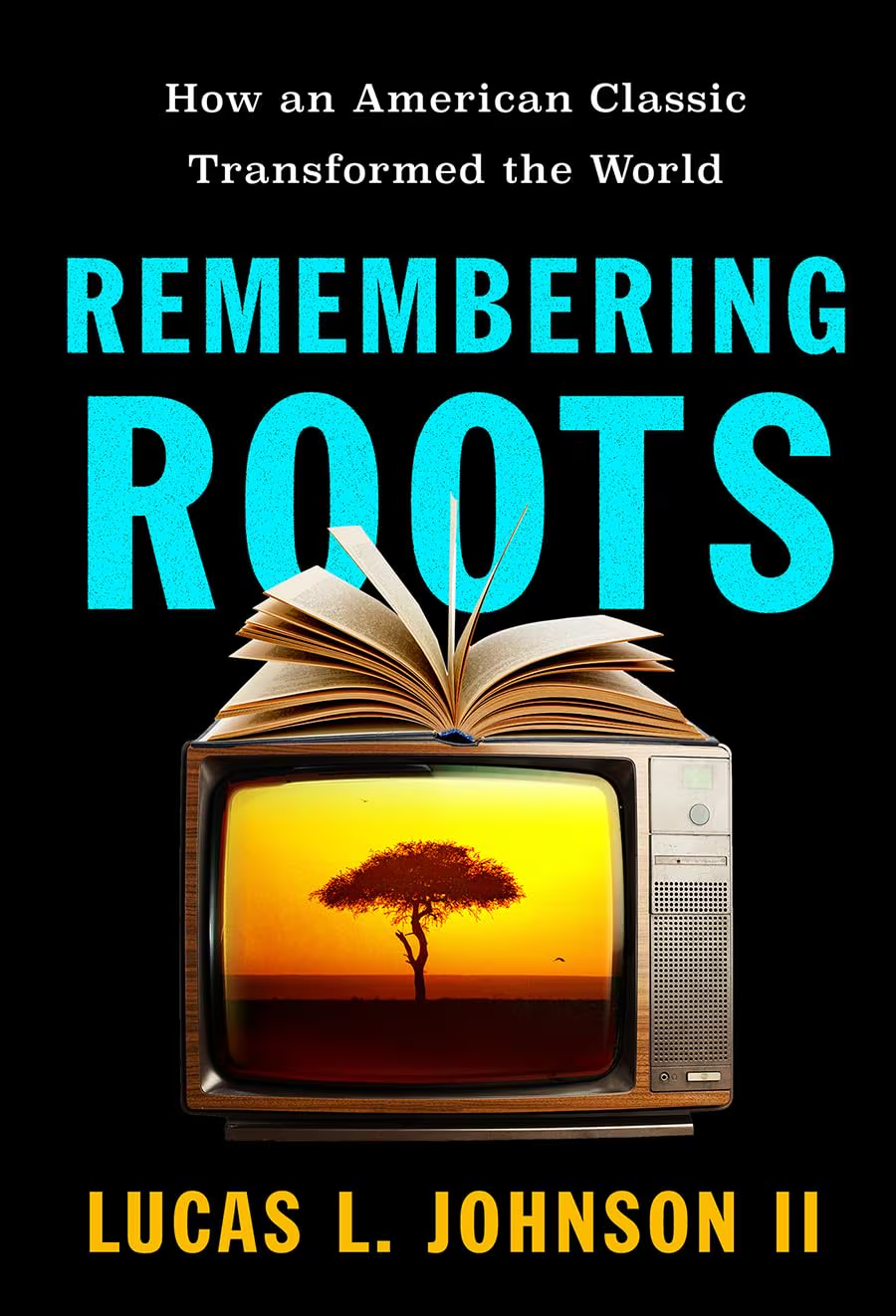
Lucas L. Johnson II, a former reporter for the Associated Press, compiled Remembering Roots: How an American Classic Transformed the World to resurrect the social and literary legacy of Haley’s megahit book. Johnson collected a series of remarkable remembrances and recollections of this premier 1977 TV miniseries of its time, about the stunning tale of a young African man named Kunta Kinte, kidnapped from Gambia and brought in bondage to America.
Johnson attempts to play down the roaring success of the book Roots, which topped The New York Times nonfiction bestseller list for twenty-two weeks, selling more than one million copies in less than a year. The following year, the book earned special citations from both the National Book Awards and the Pulitzer Prize boards. In 1979, the sequel TV miniseries Roots: The Next Generation featured James Earl Jones playing Alex Haley, telling the story of the griot and the Kinte clan. Although it lacked the dramatic emotion of the original, the miniseries satisfied enough fans without Kunta Kinte’s whipping scene, Kizzy’s courage, and Chicken George’s grit.
In Remembering Roots, Johnson acts as a collector of interviews, quotes, and dialogue. Where the author may have stepped aside in some instances, the other voices compensate for the lack of punch from the author.
Other than presenting quotes by members of the Haley family, Johnson places relevant statements about the original miniseries in his book from actors such as LeVar Burton, Ben Vereen, Tina Andrews, Hilly Hicks, and others who were impacted by the project, underlining the quality of the program. As Raymond A. Winbush, a professor at Morgan State University, wrote about Roots: “Let it remind you that the past is not dead—it lives in our names, our dreams, our fears, and our families. And in a nation that has always tried to bury and deny the past, remembering is itself a radical act of liberation.”
A poll taken of 1,000 Americans, Black and white, split racially on the original’s most memorable scenes of the brutalities toward enslaved people. Burton, then nineteen years old, was a sophomore at the University of Southern California. It was his first professional audition. “Very few peoples on this planet model the indomitability of the human spirit more than the Black people in America,” the actor said.
Switching gears, there was a concerted effort to drag Haley’s book through the mud in the late 1970s. The book’s publisher, Doubleday, and Haley found themselves in hot water after the initial charges of factual inaccuracies, plagiarism, and questions of how the book was categorized. Two writers stated Haley plagiarized their work, with one case dismissed and the other settled out of court. Many scholars, veterans of careers studying Africa and slavery history, were leery about Haley’s Gambian sources.
Like nonfiction novels such as In Cold Blood (1966) by Truman Capote and The Armies of the Night (1968) by Norman Mailer, Haley called his book “faction” and wrote in a Reader’s Digest article fifty years ago: “In this country, we have been like people who live in the same house and tend to stay in our own rooms, doing no more than peeking out and then ducking back. If only we could all come out together, say in the same room, and learn more about each other, we couldn’t help but benefit. It would show us our future as a collective people—retaining, being proud of, our differences, but coming together in collective strength. That, I believe, is the hope for America—hope for better days.”
Summing up the truly capable Remembering Roots, which proves the literary and cultural worth of Haley’s bestseller, it checks all the boxes as a book to be proud of. Journalist Michael Patrick Hearn, writing inThe New York Times some time ago, commented on the author: “Haley was not a historian, but he made history.”
Editor’s Note: In December 1978, Alex Haley settled a plagiarism lawsuit by acknowledging that portions of his bestselling book Roots had been taken from The African by Harold Courlander. Courlander had sued for more than half the profits of Roots, arguing there were substantial similarities between the works. The case ended after six weeks of trial when Haley publicly conceded that “various materials” from The African had found their way into Roots. The settlement amount was undisclosed, but it was widely assumed to be substantial.
There was also an earlier plagiarism claim involving Jubilee by Margaret Walker. That case ended in dismissal in September 1978, with a ruling that the similarities between Jubilee and Roots were insignificant.
Arnold H. Lubasch, “‘Roots’ Plagiarism Suit Is Settled,” New York Times, December 15, 1978, accessed June 27, 2026.