Alice Walker The “PBS American Masters” Interview
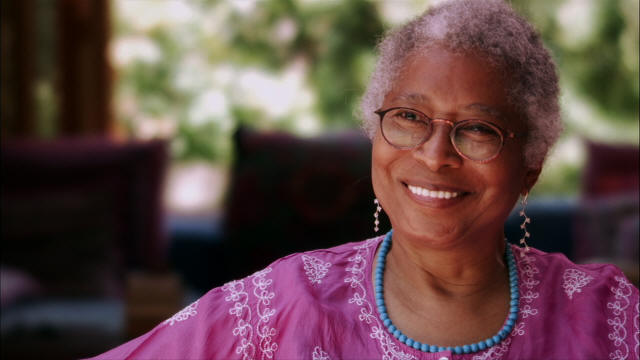
Alice Walker has been defined as one of the key international writers of the 20th Century. She made history as the first African-American woman to win a Pulitzer Prize for Fiction as well as the National Book Award in 1983 for her novel The Color Purple — one of the few literary books to capture the popular imagination and leave a permanent imprint. The award-winning novel served as the inspiration for Steven Spielberg’s 1985 film and was adapted for the stage, opening at New York City’s Broadway Theatre in 2005, and capturing a Tony Award for best leading actress in a musical in 2006.
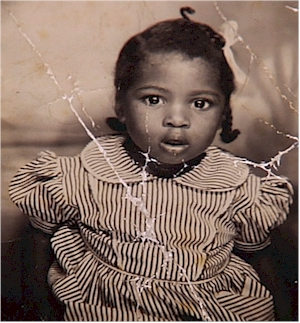
Alice Walker, Age 2, 1946
An internationally celebrated author, poet and activist, Alice’s books include seven novels, four collections of short stories, four children’s books, and volumes of essays and poetry. She has written many other best sellers, too, among them, Possessing the Secret of Joy (1992), which detailed the devastating effects of female genital mutilation and led to the 1993 documentary Warrior Marks, a collaboration with the British-Indian filmmaker Pratibha Parmar, with Walker as executive producer.
In 2001, Alice was inducted into the Georgia Writers Hall of Fame and, in 2006, she was honored as one of the inaugural inductees into the California Hall of Fame. In 2007, her archives were opened to the public at Emory University.
In 2010, she presented the keynote address at The 11th Annual Steve Biko Lecture at the University of Cape Town in South Africa, and was awarded the Lennon/Ono Grant for Peace, in Reykjavik, Iceland. Alice donated the financial award to an orphanage for the children of AIDS victims in Kenya and has served as a jurist for two sessions of the Russell Tribunal on Palestine.
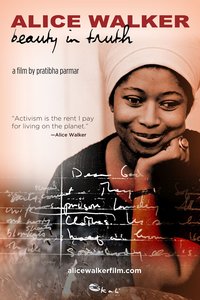
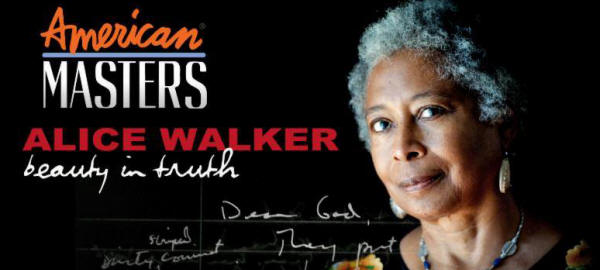
Here, she talks about her career and about the documentary “Alice Walker: Beauty in Truth” which premiered on PBS’ American Masters series on Friday, February 7th 2015.
Kam Williams: Hi Alice. I’m so honored to have this opportunity to interview you.
Alice Walker: Oh, I’m so glad to be talking with you, too, Kam.
KW: The only time I came close to meeting you before now was back
in the Eighties one summer, when I was invited to a party out in the
Hamptons that you were rumored to be attending.
AW: Oh, I did have a few friends near there, one in
Montauk, another on Fire Island. But oh, that was a long time ago.
KW: I’ll be mixing in my questions with some from readers. Harriet
Pakula-Teweles asks: how do you feel about having the biopic coming out
about you?
AW: Well, it’s very interesting because I almost never do anything for Black
History Month, because I feel it’s just another way to separate us. It’s
amusing to me that it would be coming out as a Black History presentation on
PBS. But on the level of the film, I like it. And I love the producer
[Shaheen Haq] and the filmmaker [Pratibha Parmar]. I think they were
incredibly devoted. They did it on a hope and a prayer, and at one point had
to rely on crowd-sourcing because of the huge expenses.
 KW: I learned so much about you from the film. For instance, I was surprised
to hear that Howard Zinn had been a professor of yours in college.
KW: I learned so much about you from the film. For instance, I was surprised
to hear that Howard Zinn had been a professor of yours in college.
AW: He was already teaching at Spelman when I arrived as a freshperson.
Then, I took his class the following year, because I had gone to the Soviet
Union and wanted to learn more about Russia, and I think he was the only
person in all of Atlanta who knew anything about Russian literature, which I
loved. He was teaching Russian literature, the language, and some of the
politics. We became really good friend when I took his class, but then he
was fired.
KW: For doing more than just teaching.
AW: He helped us desegregate Atlanta. That was moving because he took a lot
of abuse for that. He and Staughton Lynd, a fellow professor who was also
from the North, stood with us. They were certainly behind us. In fact, they
often stood in front of us. This had a huge impact on me. But one of the
reasons I was very careful about speaking about the relationship I had with
him and Staughton was because, in a racist society, if you acknowledge a
deep love for and a deep debt owed to white teachers, they tend to discredit
your own parents and your own community. And I was very unhappy about that
because I come from somewhere and from specific black people in the South,
including my parents, who built our first school, and rebuilt it after it
was burned to the ground. And they used to bake pies and cakes to raise
money to keep it going. So, I learned to struggle from a very early way in a
way that was truly indigenous to the South. You have to keep at it!
[Chuckles]
KW: The film also left me with an appreciation of your deep connection to
nature. I have that, too. I go for a walk in the woods every day. It’s very
spiritual to me.
AW: The forest is the first cathedral. I felt that from the time I was a
child. I credit my mother with that. I used to think it came from her
Native-American side. Whichever it was, she instinctively connected with
nature, and taught me that. Church just could not hold my spirit. It was a
beautiful, little church, too. As sweet as could be. It was at a bend in the
road, with a big, oak tree sheltering it. Still, I wandered right out the
window, mentally and emotionally, got into the trees, and never left.
KW: Kate Newell says: I’m more than awestruck about this opportunity to ask
you a question. How did you feel about the screen adaptation of The Color
Purple?
AW: I was worried about the film at first, because I’d never had a movie
made of any of my work on a big scale like that. There had only been a
couple of small, student efforts before that. The Color Purple was so
overwhelming that I actually brought a magic wand to New York City for the
premiere, and pointed it at the screen in the hope that movie didn’t
embarrass all of us. Lo and behold, it turned out to be a beautiful picture.
The audience was so into it, gracious and emotional, laughing when they
should be laughing, crying when they should be crying. I got to feel it as a
living work of art, as something useful. My interest in creating anything is
that it be useful. People can love the beauty of it, but they should also
use it to grow, to deepen.
KW: What was it like dealing with the blowback for the next several years
coming from critics who said The Color Purple was anti-black men?
AW: It actually lasted for a decade. How could you imagine that people could
be mad at you for so long? I felt a great deal of weariness. But because it
wasn’t the first time that I had been heavily criticized, I learned that you
just keep going and turn to other things. Which I did. I went on to write
“The Temple of My Familiar” which may be my favorite of my novels, because
it was a miraculous gift that I had no idea how I got it. I had a dream one
night that I went down into a non-existent sub-basement of my little house
in Brooklyn. There was a trap door and I went down further and found these
indigenous South American people speaking Spanish and making all these
incredible things. I didn’t speak a word of Spanish but I sensed that I was
being guided to a new focus. And to make a long story short, I ended up
going to Mexico, I learned one word, “leche,” which means milk, and I
started writing this novel. So, the blowback, in a way, faced me in a new
direction which was very interesting.
KW: Attorney Bernadette Beekman asks: What did you think of the
stage
version of The Color Purple?
AW: I so loved working with the musicians. It was just wonderful! It was
great and I felt like it was such a tonic for people to see it.
KW: Dinesh Sharma says: In my new book, "The Global Obama," Professor Ali
Mazrui refers to the President as a "great man of history."
Professor Henry
Louis Gates of Harvard agrees. You have written several essays about
Barack
Obama. How do you feel about his presidency thus far?
AW: I’m very disappointed in Obama. I was very much in support of him in the
beginning, but I cannot support war. I cannot support droning. I cannot
support capitulating to the banks. I cannot support his caving in to
Netanyahu [Israeli Prime minister Benjamin Netanyahu]. There’s a long list
of this administration’s initiatives that I find unsupportable. I think many
black people support him because they’re so happy to have a handsome black man
in the White House. But it doesn’t make me happy if that handsome black man
in the White House is betraying all of our traditional values of peace,
peoplehood, caring about strangers, feeding the hungry, and not bombing
children. I’m very disappointed. More than disappointed, I think I’ve
actually returned to a kind of realism about how the world works. That’s
helpful. Because in a way, no matter who’s in charge of the corporation that
the United States is, the direction in which it is taken seems to be
inexorable. So, you just get the job of being the front man for four or
eight years. Now, most people realize that’s what you are.
KW: Talking about being a good or bad president is like talking about being
a good or bad rapist.
AW: [LOL] That’s a very good thought.
KW: I think the black community sort of got checkmated in terms of its own
agenda. And very vocal folks who try to hold Obama accountable are having
their blackness questioned or their blackness revoked, like
Tavis Smiley.
AW: That’s okay. It’s better to have your blackness taken away than to stand
there and lie about who you actually are. That’s the trap. In fact, Cynthia
McKinney just sent me a piece by somebody [Editors Note: If anyone finds
this article please email troy@aalbc.com] about how, for the first time in
history, black people are supporting the wars, the military strikes on
Syria, and other awful things, as if they woke up and became entirely
different people. It’s totally distressing! Look at the NDAA [The National
Defense Authorization Act], look at the Patriot Act, look at the NSA, and
the ruthless droning of civilians. I pretty much lost it when they droned
the grandmother who was teaching her grandchildren how to pick okra. It
seems to me the ones who are the real threat are the ones who are in power.
KW: Film director Rel Dowdell asks: Did
Danny Glover fully personify the
character Mister in The Color Purple?
AW: No. I love Danny, and he did a good job, but no. Mister is a small man.
Danny is huge! And that matters, because what I was showing was how even a
small man can be a terrorist in the home because of all the patriarchal
weight that he brings to any situation. That would’ve been very powerful. In
a way, making Mister so big undercut that message because we’re kind of
afraid of big people anyway, because they take up so much room. I felt that
at times there wasn’t enough subtlety in his abuse of Celie and her sister,
Nettie, because what I’ve discovered and observed is that often it’s the
subtle oppression that deeply wounds the soul. The parting for instance,
which is so horrendous, where Nettie leaves, and is forced out by Mister. In
the novel, that’s handled with a lot of restraint. Filmed with that
restraint it would’ve been just as powerful, even with a little Mister, just
by virtue of his being a man and having patriarchy as his backup.
KW: Are you interested in writing your own screenplay?
AW: At this point, no, because I have gone back to writing poetry, which I
absolutely love. And I write on my blog, which I enjoy. And life being what
it is, every once in a while I’ll have a book which will have developed
without my actually having paid that much attention to that part of it. I’m
really only interested in each day’s gift.
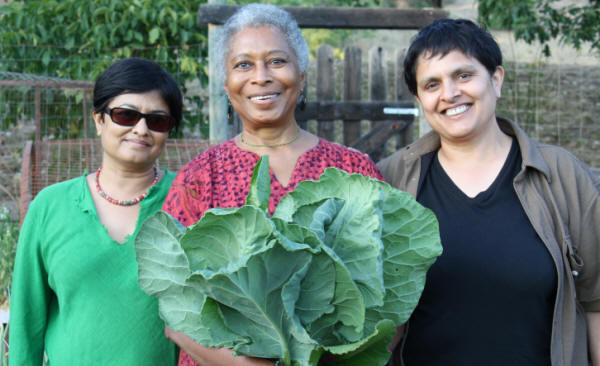
Director Pratibha Parmar, Alice Walker and
producer Shaheen Haq - Photo Credit: Trish Govoni
KW: I was struck by something you said in Beauty in Truth: “The pain we
inflict on children is the pain we later endure as a society.”
AW: Boy, is that scary, when you consider what we’re doing to children all
over the planet. They’re the ones who are truly being terrorized by all the
madness adults are perpetrating.
KW: Generational warfare. In the U.S., we even have it here between the
prison industrial complex and the indentured servitude of the young via
college loans they can never repay.
AW: They’re supposed to be slaves. And those that aren’t just slaves, can
become drug addicts. And the drug addicts that are caught get put into the
prison system to make a profit for the people who own the prisons. It’s all
worked out.
KW: Novelist and short story writer Suzan Greenberg was wondering whether
you had any idea that your short story "Everyday Use" would be so widely
anthologized?
AW: I did not, and I’m puzzled that it is, because it’s not the story that I
would’ve picked to be anthologized so widely. I think it’s chosen partly
because it reinforces some people’s notions of the Deep South, Southerners
and black people. That story has its own power, but it also permits a kind
of distance, as if it happened in the far past. I think that’s why people
use it opposed to more gritty stories like “Advancing Luna“ or “Laurel,”
which come out of the struggle in the South in the Sixties but are very
modern in terms of their sense of white and black people grappling with
issues of interracial rape and interracial love. I think it’s hard for
people to read those stories as dispassionately.
KW: Editor/Legist Patricia Turnier says: You have been a successful
authoress for decades. Only about a dozen female laureates have won the
literature Nobel Prize since its inception. Amantine Lucile Aurore Dupin had
to adopt the pseudonym George Sand to become a French novelist and
memoirist. Historically, it has been difficult for women to thrive in the
literary world and the word “writeress” has been excluded or erased from
some dictionaries. How can we break the glass ceiling as authoresses and
have our voices heard more?
AW: You can start by not tacking that “ess” onto the end of everything,
because you’re either a poet or you’re not, and either a writer or not. You
don’t have to accept someone else’s idea that you need to have a tail that
shows that you’re wearing a dress. [LOL] You are what you are. If you’re an
actor, you’re an actor. You don’t have to be an actress. As far as a glass
ceiling, I feel that all you can do is give it your absolute best with
whatever gifts the universe has given you. And if you make it in some way
that other people can recognize, that’s fine. But even if you don’t
quote-unquote make it, you’re fine, if you’ve given it your whole heart and
soul. You’re totally in sync with your purpose and with the universe. And
that’s fine.
KW: Patricia also says, you learned to read at a very young age. You were in
the first grade when you were four years-old. Illiteracy is still an ongoing
issue around the world. Do you think that exposing a child as early as
possible to education can be a determinant in decreasing the level of
illiteracy on a global scale?
AW: I know from having had a child, and from having been a child myself,
that children will copy you. So, the best way to get them to read, is to
read. The best way to get them to do anything is to do it yourself, and they
will absolutely copy you. That way, you don’t have to worry about what’s
supposedly age appropriate, a child will pick something up when the child is
ready.
KW: It was heartbreaking in Beauty in Truth to hear you talk about being
estranged from your daughter. It was very touching.
AW: Hmmm… I like hearing that it was moving, and provocative in a way,
because these things do happen to us. The very thing you think will never
happen to you, happens! And then you get to see, oh, that’s because life is
alive! [LOL]
KW: Toni Banks says: Thanks for “Meridian.” It’s my favorite work of yours.
She asks, was the novel biographical fiction?
AW: Not really. There was a young woman in SNCC [the Student Non-Violent
Coordinating Committee] whose name was Ruby Doris [Smith-Robinson]. She was
someone I didn’t really know, but I heard about how she was having such a
really hard time with the men in the organization. That was one of my early
introductions to patriarchal behavior which undermines progress. If the men
are going to try to keep the women down, everybody’s going to be stuck back
there somewhere. So, she was a person I was thinking about, and I also
wanted to write about the sort of spiritual and inspirational work that a
lot of people in the movement were doing.
KW: Reverend Florine Thompson says: Thank you for making the color purple
the sacred. If there was no color purple, what other color might you drape
yourself in?
AW: Well, I don’t really drape myself in purple, although people have sent
me some of everything in purple. So, I get purple shawls and coats and hats
and bathrobes and boots… You could pick any color, although purple is kind
of rare. The point about the color purple is just that to really see a color
is so remarkable! Anything that you can see that is beautiful is a gift.
Blue… green… black… yellow… All these colors are amazing.
KW: Reverend Thompson also asks: What’s the most important thing you’ve
found in your mother’s garden?
AW: Patience, because what gardening teaches us is that if you plant things,
they’ll come up. But you have to be willing to wait for them to bear fruit
because things are seasonal.
KW: Finally, Rev Thompson asks: What advice might you offer young adolescent
females searching for positive self-identity?
AW: Love yourself. Just love yourself. In fact, the love of the self cures
every kind of problem you have with yourself. For instance, if someone calls
you nappy-headed, it rolls right off your body, if you love nappy hair.
Or if someone calls you buck-toothed or too black, that won’t be a problem
if you love being buck-toothed or black. If you love it, then so what. The
development of self-love cures many of the ills that people suffer from.
KW: Thanks again Alice, it’s been a privilege.
AW: Thank you, Kam
Reader Comments (0)
Log In to Join the Conversation
Commenting is reserved for registered AALBC members to maintain high-quality discussions.
No comments yet. Be the first to share your thoughts!
Advertisement