
Marley
Revealing Biopic Chronicles Personal Life and Musical Career of Revered Reggae Icon
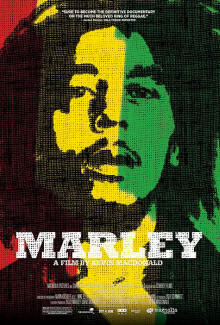 Marley [2012]
Order
via Amazon.com
In Theaters: Apr 20, 2012 Limited
Pated PG-13 for violent images, mature themes and cannabis consumption.
Running time: 145 minutes
Distributor: Magnolia Pictures
Documentary, Musical & Performing Arts, Special Interest
Directed By:Kevin Macdonald
Reviewed by Kam Williams on
Excellent (4.0)
When most people think of Bob Marley, what probably comes to mind is reggae,
Jamaica and marijuana. But how did a street urchin raised by a teen-mom in a
country shack with no electricity manage to become a beloved icon admired all
over the world?
That little-known side of Bob’s life story is the subject of Marley, an intimate
biopic produced by his son, Ziggy, and directed by Scotsman Kevin Macdonald.
Because of the participation in the project of so many relatives, friends and
colleagues, the picture paints a fascinating portrait which fully fleshes out
its subject, thereby resisting the temptation of merely placing him on a
pedestal.
At the point of departure we learn that Robert Nesta Marley was born in 1945 to
Cedella Malcolm, a young local gal, and Captain Norval Marley, a British
plantation overseer already in his 60s. Bob never really knew his father or the
rest of the Marleys, a prominent family with a construction business on the
island. In fact, his request for financial help to kickstart his career was
rebuffed out of hand by his relatively-rich white relations.
Rejection was a recurring theme during Bob’s formative years, when he was teased
as a “half-caste” by other boys for being mixed. And he was equally unpopular
with the opposite sex, since “Every girl’s dream in Jamaica was to have a tall,
dark boyfriend.” He was even abandoned by his mom who moved to America while he
was still in his teens.
Fortunately, Bob eventually found salvation through a love of music and the
embrace of the Rastafarian community. Seeing his guitar as a way out of poverty,
he let his hair grow while writing popular songs about equality, world peace,
and cannabis, which is considered a sacred herb by the dreadlocked adherents of
his pot-smoking religion.
 After struggling to make it for over a decade while getting ripped-off by
unscrupulous producers and promoters, Marley finally landed his big break in
1973 when he and the Wailers signed with Island Records. The group went on to
record such hits as “One Love,” “Jammin’,” “No Woman No Cry,” “I Shot the
Sheriff,” “Redemptive Song,” “Get Up, Stand Up,” “Stir It Up” and “Is This
Love?” to name a few.
After struggling to make it for over a decade while getting ripped-off by
unscrupulous producers and promoters, Marley finally landed his big break in
1973 when he and the Wailers signed with Island Records. The group went on to
record such hits as “One Love,” “Jammin’,” “No Woman No Cry,” “I Shot the
Sheriff,” “Redemptive Song,” “Get Up, Stand Up,” “Stir It Up” and “Is This
Love?” to name a few.
The 2 hour combination concert/interview flick allocates a decent portion of
time to archival footage of The Wailers’ performing many of the aforementioned
anthems. Attention is also devoted to the reflections of folks like Bob’s widow,
Rita, who talks about how she was really more of her his guardian angel than his
wife.
After all, he had 11 children by 7 different women and often needed help
juggling his groupies and baby-mamas. As Bob’s attorney, Diane Jobson, explains
it, her client considered himself faithful to God, if not his spouse.
Among Marley’s many lovers was gorgeous Cindy Breakspeare, Miss Jamaica 1976,
who went on to win the Miss World title. Not so lucky was Pascaline Ondimba, the
daughter of the African nation of Gabon’s prime minister. She recounts how Bob
had called her “ugly” because she straightened her hair, and had encouraged her
to cultivate and appreciate her natural beauty.
Sadly, Marley’s life was marked by tragedy, too, including an assassination
attempt and later the skin cancer to which he would succumb at the tender age of
36. Still, his “One Love” legacy is likely to withstand the test of time and
inspire generations to come with its all-embracing message of understanding and
tolerance.
A wonderfully-revealing, warts-and-all tribute to the human spirit of a Rasta
rock god!
Related Links