



- Open Club
- 2 members
- Rules
#BlackHistory337 - 8: Stageplays 10012026

Event created by richardmurray
This event began 10/01/2026 and repeats every year forever
URL
https://www.deviantart.com/hddeviant/journal/BlackHistory337---8%3A-Stageplays-1381899790
CONTENT
#BlackHistory337 is about the time outside the 28 days designated as Black History Month, an opportunity to celebrate the contributions of the Black community during the other 337 days of the year. Let's continue learning all year long, because history doesn't stop when February ends.

For this edition of #Black337 the focus is the stageplay. Now, any platform is a stage. From the elevated stages in Lincoln Center or the Metropolitan Opera , in downtown Manhattan, or in a high school's auditorium[place to hear] to a flat space aside a small town or a living room with the chairs or table cleared out. The stages are as old as the main halls of the pharaohs of yore or the fields where entertainers would perform dramas before kings or queens existed. And plays, come in all forms, from one person shows to musicals.
For the purpose of Black337 we will focus on Stageplays in the USA made by Black Americans whose forebears were enslaved or enslaved themselves.
One of the earliest stages for Black people in the United States of America is the African Grove Theatre[ 1820-1821] started by George A. Thompson jr. [located at 38 Thompson Street] In such a place, Thompson jr. wrote "King Shotoway". It is not available, or has been lost in time.
One of the people who saw plays at the African Grove Theatre was Ira Aldridge. (1807-1867) : first Black American honored by Haiti, King Frederick of Prussia honored him with the Prussian Gold Medal for Arts and Science.
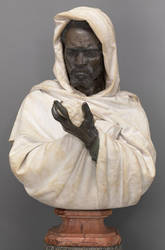
Alongside Ira Aldridge in Europe was Victor Sejour (1817 1874), arguably the French parallel. Sejour, author of the Mulatre, one of the earliest books published by a Black American, was born in New Orleans. Like Aldridge he fled the U.S.A. for Europe and was honored in Europe, a chevalier. The last thirty eight years of his life , Sejour wrote or acted in plays in Paris.
La Mulatre from Sejour
While Aldridge or Sejour fled the USA and its white populace for Europe, to gain the ability to lift their head. William Well Brown (1814-1884) born in Kentucky, escaped enslavement to whites after twenty years and lived in the U.S.A. He wrote a play "The Escape; or, A Leap for Freedom". I quote the beginning of the preface.
This play was written for my own amusement, and not with the remotest thought that it would ever be seen by the public eye. I read it privately, however, to a circle of my friends, and through them was invited to read it to a Literary Society. Since then, the drama has been given in various parts of the country.
And I quote the end of the preface.
The play, no doubt, abounds in defects, but as I was born in slavery, and never had a day's schooling in my life, I owe the public no apology for errors
Internet Archive with a photocopied version of Black Theatre USA. The link goes ot page 37 where, The Escape, begins.
https://archive.org/details/blacktheatreusar00/page/37/mode/2up
In the year 1865 , the War Between the States ended in the USA. At the end of said war over ninety percent of Black people in the United States of America were illiterate because of the anti-literacy positions by whites who owned blacks. Around the year 1910, two thirds of the Black populace in the USA could read while ninety five percent of the Black populace in the USA in the time frame had no financial support or opportunity or allowance while citizens of the USA.
In the light of that environment, as a contrast, musical comedy's thrived. Acts like the Hyers Sisters Combination produced Urlina, the African Princess. Sam Lucas, the black minstrel, with Sam Jack, white theater owner, created the very successful "The Creole Burlesque Show" . Egbert Williams (1876 - 1921) and George Walker (1872-1911) created a comedy show that used various Black entertainers to highlight their skills. Williams and Walker worked with: writer Jesse Shipp, composer Will Cook, lyricist Paul Dunbar. [ husband of writer Alice Dunbar Nelson, who is a great short story muse for me] created "In Dahomey, a Negro Musical Comedy"(1902); the play was performed in front of the royal family of England, and had a four year run in the United States.
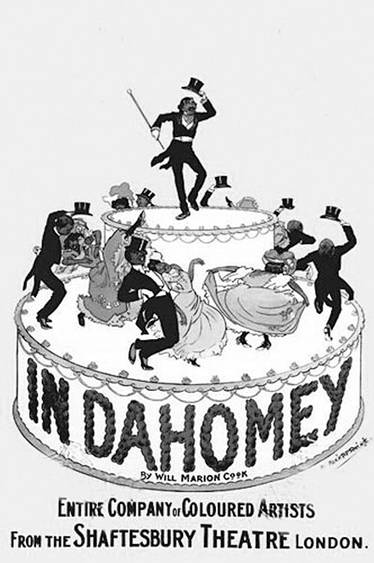
Poster for the London premiere of "In Dahomey at the Shaftesbury Theatre, 1903. The poster features the famous cake walk with Bert Williams, acclaimed comedian, at the top of the cake.
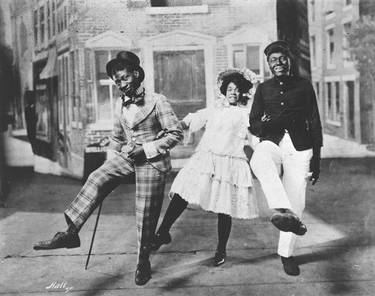
George Walker, Adah Overton Walker, and Bert Williams link arms and dance the cakewalk in the first Broadway musical to be written and performed by African Americans, "In Dahomey."
But one of the most vital stageplay forms in the late 1800s or early 1900s is Pageants. No not beauty pageants but stage pageants. Usually they reenact historical events with narration , costumes , dancing , music. The Wizard of Oz was made into a bawdy play that essentially was a pageant. W.E.B. Dubois(1868-1963), yes a founder of the National Association for the Advancement of Colored People, made a pageant called the "Star of Ethiopia" (1913), seen by tens of thousands, prepared by several thousand(for example 200 singers in the chorus).
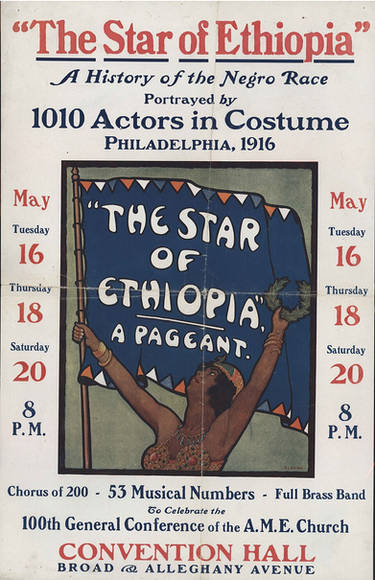
1916 philadelphia performance
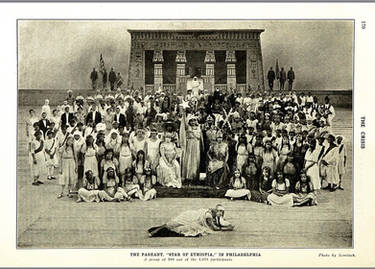
"A group of 200 out of the 1,078 participants", Philadelphia, 1916
Three years after the Star of Ethiopia , Angelina Weld Grimke(1880-1958) wrote Rachel (1916). The earliest complete drama for the stage written by a black women in the United States of America.
The first modern production of Rachel was in 1990 at Spelman college.
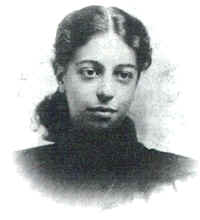
Unknown date photo of Grimke
Full Text of Rachel
https://en.wikisource.org/wiki/Rachel_(Grimke_1920)
In 1921 Shuffle Along was produced. The book is from F.E. Miller plus Aubrey Lyles. The music is from Eubie Blake. The lyrics are from Noble Sissle. It ran for 504 shows. It was the earliest broadway work for Josephine Baker(Would move to France and become an icon of film and stage), Paul Robeson(legendary lawyer/singer/athlete/shakesperean actor/made famous Showboat), Fredi Washington (the first peola [of "immitation of life"] in film), Florence Mills (legendary performer who died young), Adelaide Hall (was a great jazz entertainer and did the same as Josephine Baker). The song "I'm just wild about Harry" sung by Michigan J. Frog , comes from this play.
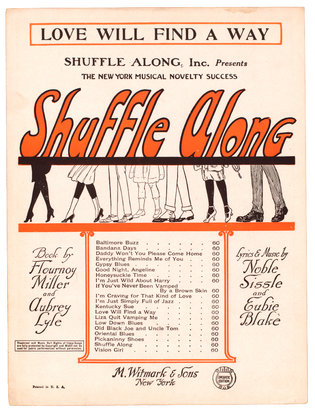
Sheet music for "Love Will Find a Way", a song from the show
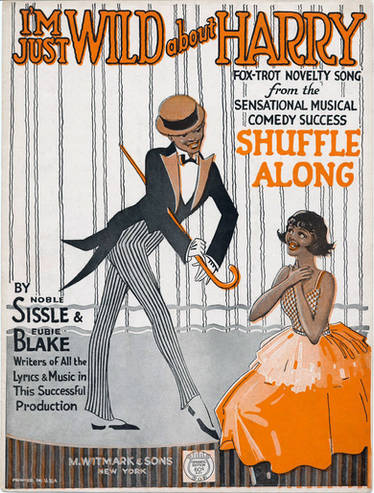
Cover page for "I'm Just Wild About Harry", 1921
Looking at the history of these early works you can see how multiform or imaginative while commenting Black Stageplay productions were in the past, even if the environment was a challenge.
I used the book "Black Theatre USA", "The Early Period 1847-1938" from James V. Hatch plus Ted Shine as a reference for most of the information stated. The images come from Wikipedia.
GALLERY OF INSPIRED WORK
Onto the 53rd Annual President's Play
Dawanga
The Journey of Sofie Wakten to become a witch
WHICH SUN IS FUN
The Asteroid of Dr Makup
MONTHLY CONTENT
The following is a stageplay from Richard Murray @HDdeviant
CUMYA CHILDREN
TITLE: CUMYA CHILDREN subtitle: A Black Fable
BLACK THEATRICAL CONTENT
List of ALL BLACK BROADWAY PLAYS
https://en.wikipedia.org/wiki/Category:All-Black_cast_Broadway_shows
#BlackHistory337 2026-2027 #1
Mar 14, 2026
#BlackHistory337 2026-2027 #2
Apr 1, 2026
#BlackHistory337 2026-2027 #3
May 1, 2026
#BlackHistory337 2026-2027 #4
Jun 2, 2026
#BlackHistory337 5 : Fables
Jul 4, 2026
#BlackHistory337 6 : Fictional Slave Narratives
Aug 1, 2026
#BlackHistory337 - 7: High Fantasy
Sep 1, 2026
#black337 #hddeviant #richardmurray #richardmurrayhumblr #blackhistory
User Feedback
There are no reviews to display.