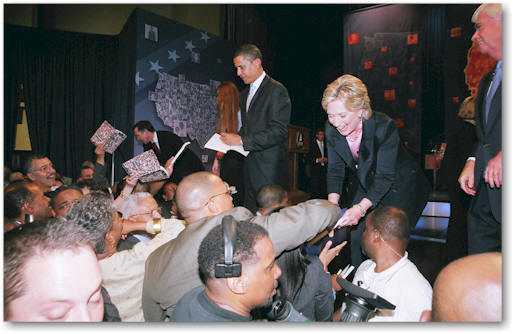
African Americans Figure Prominently in Presidential Debate
by
Jamie Walker
Washington, DC’Eight democratic hopefuls vied for their place in the
2008 election during the All-American Presidential Debate. Located on
Howard University’s campus in Washington, DC. The forum, which was
televised live on PBS on Thursday, June 28, 2007, marks the first time
in U.S. history that an African American moderator and three journalists
of color posed questions to presidential candidates during primetime.
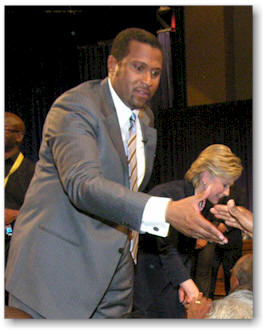
’We live in the most multi-cultural, multi-racial, multi-ethnic America
ever,’ said Tavis
Smiley, the forum’s moderator, who hosts The Tavis Smiley Show on
PRI Radio and a late night television talk show bearing his namesake on
PBS.
Commenting about ’the huge gaps’ between the wellness, stability, and
progress of people of color and white Americans, Smiley said: ’In this
critical election, candidates cannot ignore this reality. [They] must
put forward their vision on how to address these disparities. The
policies that improve the lives of people of color will raise the
quality of life for all Americans.’
Delaware Senator Joe Biden, New York Senator Hillary Clinton,
Connecticut Senator Christopher Dodd, North Carolina Senator John
Edwards, Alaska senator Mike Gravel, Ohio congressman Dennis Kucinich,
Illinois Senator
Barack Obama, and New Mexico Governor Bill Richardson stood their
ground during the hour and a half debate while Michel Martin (National
Public Radio), Ruben Navarrette, Jr. (nationally syndicated columnist),
and DeWayne Wickam (USA Today and Gannett News Service Columnist) asked
vital questions.
From healthcare, education, and housing, to the economy, post-Katrina
relief, and Iraq, the questions posed to the presidential candidates
reflected a growing consensus among many Americans who are ready for
renewal, significant progress, and positive change.
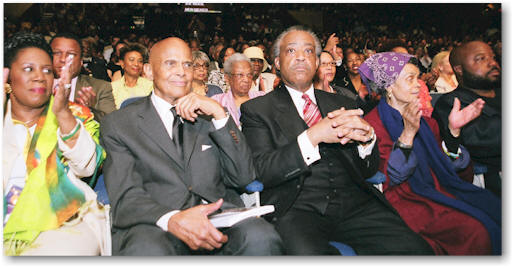
Many share a common bond when it comes to issues that
concern them the most in the 2008 election.
Several are frustrated (if not, devastated) by President Bush’s
four-long year occupation in Iraq, and would like to see American troops
pull out quickly. While we are deeply disgruntled and depressed with the
war, we are equally concerned about the rising costs of gas and
healthcare in this country; the disproportionate number of African
Americans being diagnosed with HIV; the outsourcing of American jobs;
affordable housing; the education of our youth; genocide in Africa;
gentrification and poverty in America.
Most of us want a sincere, conscious president that we can trust; a
president who believes in inclusion (as opposed to exclusion) and values
unity and cooperation (as opposed to extreme individualism). We want a
president to work for and with the people, actively seeking to uphold
justice while steadfastly remaining a conduit; a voice; and notable
beacon of hope for all humanity. Above all, we want a president with
integrity who will not waver or falter when times get tough, a president
who is fully aware of race and committed to eradicating racism, sexism,
classism, poverty and homophobia by any means.
Several members of the audience testified to this fact as presidential
candidates spoke. They listened eagerly, occasionally clapping and
nodding their heads assuredly each time someone said something that
piqued their interest or was greatly similar to their own spiritual and
moral values.
Those in attendance included, but certainly not limited to: Dorothy
Irene Height, Marian Wright Edelman,
Cornel West, the
Reverend Al Sharpton, Harry Belafonte,
Ruby Dee,
Sonia Sanchez,
Michael Eric
Dyson, David Satcher, Deval Patrick,
Iyanla Vanzant, and
countless others.
Hillary Clinton and Barack Obama were the forerunners in the debate.
 A convincing and
determined Clinton drew heavily on her previous experience in the White
House while an encouraged and thoughtful Obama took his time, searching
for the correct words to please his predominantly Black audience. If
Obama appeared to be a tad bit nervous at the beginning of his speech,
he most certainly must have felt at home at Howard University, a
prestigious, historically Black college, nestled in the heart of the
nation’s capital. Several times during Barack’s speech, for example, he
evoked the spirit of the Black church. His distinguished, resonant
voice, superior oratorical skills, and ability to incite a spirited call
and response from the audience caused audience members to feel as though
he were a notable Black preacher speaking from behind the pulpit.
A convincing and
determined Clinton drew heavily on her previous experience in the White
House while an encouraged and thoughtful Obama took his time, searching
for the correct words to please his predominantly Black audience. If
Obama appeared to be a tad bit nervous at the beginning of his speech,
he most certainly must have felt at home at Howard University, a
prestigious, historically Black college, nestled in the heart of the
nation’s capital. Several times during Barack’s speech, for example, he
evoked the spirit of the Black church. His distinguished, resonant
voice, superior oratorical skills, and ability to incite a spirited call
and response from the audience caused audience members to feel as though
he were a notable Black preacher speaking from behind the pulpit.
When responding to a question about the significance of race in America,
Barack drew upon the spirit of his ancestors, stating, ’It was their
fundamental recognition that for us to achieve, racial equality was not
simply good for African Americans, but it was good for America as a
whole.’
Tom Joyner, host of the Tom Joyner Morning Show, appeared to reiterate
this thesis when he noted from the stage: ’The issues for Black America
are the same for all of America.’
Barack said, ’We have made enormous progress, but the progress we have
made is not good enough. We live in a society that remains separated for
African Americans, for Latinos, and the rest of the nation.’ After his
speech, he stressed the importance of personal and social
responsibility, especially if we wish to ’rise up out of the problems we
face.’
Khalila Brown, a native of Windsor, Connecticut who is finishing her
Ph.D. in English at Howard University watched the debate from home. She
felt that the historic forum was significant because ’it featured both a
Black presidential candidate and a female one.’
Brown said that although Obama and Clinton aren’t the first to represent
women or minorities, she believed that this occasion marks ’the first
time that the possibility is beginning to look like a potential
reality.’
Having our needs, as African Americans, met in the 2008 election
certainly could not happen if we did not directly ask presidential
hopefuls, especially those who are neither African American nor a person
of color, how they felt about race in America.
When John Edwards was asked a similar question about race, he focused on
the alarming disparities between Blacks and whites in this country when
he alluded to his theme about there being ’two Americas.’
’We have two public school systems in America,’ said Edward, ’one for
the wealthy and one for everybody else. We have two health care systems
in America and we know that race plays an enormous role in the problems
that African Americans face and problems that African Americans face
with health care every single day.’
He continued, ’We have work to do. But we, all of us, have a
responsibility to build one America that works for everybody across all
racial barriers that still exist in this country.’
Dennis Kucinich, Joe Biden, and Christopher Dodd agreed.
Mike Gravel, however, talked about the war on drugs and how we can
combat addiction in the African American community whenever he was asked
about race.
’When will we learn that the issue of drugs is a public health issue,
addiction is a public health issue’not a criminal issue where we throw
people in jail and criminalize them to no advancement of the people?’
Gravel asked.
’If there is one group of people in this country,’ said Gravel, ’that
needs to face up to that problem’and we have to face up to it’that is
the African American community.’
Shawn McLeod, an aerospace engineer who resides in Laurel, Maryland,
said, ’That made me mad. [Gravel’s] answer to every question was Bush’s
drug war. It was like he was capitalizing off that. Are we that stupid?’
McLeod said, ’Gravel had only one solution to the problem. He answered
his questions to such an extent that it seemed [like] no matter what you
asked, you gonna’ get the same answer.’
Yolanda Joshua is a wife, mother, and Lockheed employee who lives in
Merritt Island, Florida. She noted, ’Many of the candidates on stage
appeared to be uninformed about issues affecting the African American
community.’
While Joshua admired hearing Edwards, Clinton, and Obama, she especially
appreciated the opportunity to also hear candidates like Gravel, Dodd,
Kucinich, and Richardson, who she didn't really know.
Democratic contenders were also posed questions about the alarming
disparities of Blacks and whites being diagnosed with HIV/AIDS.
According to the Center for Disease Control, for example, African
Americans make up 17% of the teenage population, however, they account
for 69% of all American teenagers diagnosed with the disease.
Obama responded: ’We don't talk about this. We don't talk about it in
the schools. Sometimes we don't talk about it in the churches.’ Obama
discussed the issue of prevention, which involves education and
dissemination of proper information. He also discussed larger issues
that contribute to the spread of HIV, including ’the problems of
poverty, lack of health care, and lack of educational opportunity.’
’When [people] are impoverished and … don't have jobs,’ said Obama,
’they are more likely to be afflicted’not just with AIDS, but with
substance abuse problems, with guns in the streets. And so it is
important for us to look at the whole [picture] here and make absolutely
certain that we are providing the kinds of economic development
opportunities and jobs that will create healthy communities.’
Much like Obama, Senator Clinton received a resounding applause from the
audience when she spoke out about the large disparities between African
Americans and whites who are diagnosed with HIV.
’Let me just put this in perspective,’ said Clinton. ’If HIV/AIDS were
the leading cause of death of white women between the ages of 25 and 34,
there would be outrage outside this country.’
Clinton noted that she was currently working with Medicaid to cover
treatment for patients with HIV. She also said she was ’working to raise
the budget for Ryan White, ’which the Bush administration has kept
flat.’
 Clinton said, ’There are
a lot of women … who are becoming infected with HIV in poor rural
areas, as well as underserved urban areas in states where, frankly,
their state governments won’t give them medical care. So, this is a
multiple dimension problem. But if we don't begin to take it seriously
and address it the way we did back in the 1990’s’when it was primarily a
gay men’s disease’we will never get the services and the public
education we need.’
Clinton said, ’There are
a lot of women … who are becoming infected with HIV in poor rural
areas, as well as underserved urban areas in states where, frankly,
their state governments won’t give them medical care. So, this is a
multiple dimension problem. But if we don't begin to take it seriously
and address it the way we did back in the 1990’s’when it was primarily a
gay men’s disease’we will never get the services and the public
education we need.’
Khalila Brown and Shawn McLeod admired Clinton’s response.
’Even if the plans Clinton suggested failed, her thoroughness was
impressive,’ said Brown. ’It was a sign that this wasn't the first time
she had thought about the issues.
Overall, many attendees were impressed with the presidential forum, as
they were able to hear the contender of their choice speak out about a
number of issues affecting our population, including ’the aftermath of
Hurricane Katrina, immigration policies, and the attempt to dismantle
affirmative action.’
One thing is certainly clear: We, as African Americans and people of
color, will continue to hold our leaders accountable for their actions
and will seek out justice’not just in presidential candidates, but also
at home and in our very own communities. While we want a president to
protect and defend our human rights, we also want the freedom to know
that we are the one’s we have been waiting for.
’’’’’’’’’’’’’’
Dr. Jamie Walker is a journalist and poet. Her most recent poetry
collection is called Signifyin’ Me: New and Selected Poems.
All photos: Copyright ’ 2007 Roy Lewis