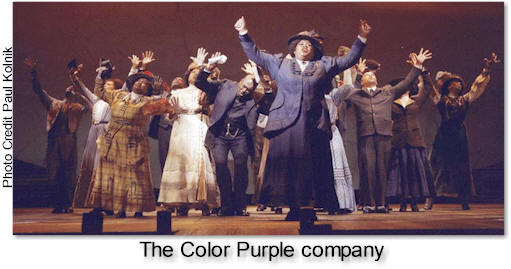
New York: Ever since its debut on Broadway, Alice Walker’s compelling narrative-turned-musical, ’The Color Purple,’ has brought out a host of well-wishers, supporters, critics, and fans.
|
ISBN: 0151191549 |
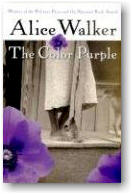
Walker’s acclaimed, best-selling novel received the Pulitzer Prize and an
American Book Award for fiction in 1983. In 1985, Stephen Spielberg (along with
Warner Bros. Pictures) turned the book into ’an internationally popular film.’
Directed by Gary Griffin with a libretto by Marsha Norman, The Color Purple: The
Musical actually made its world premiere at Atlanta’s Alliance Theater in the
fall of 2004. It was there that producer Todd Johnson (and his amazing cast) not
only received a host of positive reviews, but also garnered a ’Suzi Bass Award
for Outstanding Production.’
While previews of the Broadway show (which began November 1st) largely brought
out critics who were predisposed to a cast still somewhat getting on their feet,
Color Purple’s opening night on December 1st (and later, subsequent
performances) reveal a tightly woven, well-rehearsed, and solid cast whose
poignant, unforgettable, characters are enriched by Walker’s deeply personal
narrative and universal story of hope and redemption.
Donald Byrd’s inspiring choreography, Paul Tazewell’s beautiful period costumes,
and John Lee Beatty’s impressive scenic design are immaculate under the musical
direction of Orchestra Conductor Linda Twine. In addition, the contagious,
rhythmic lyrics and finger poppin’ tunes (arranged by Brenda Russell, Allee
Willis, and Stephen Bray) are cause enough to make anyone long for the future
release of the musical score on CD.
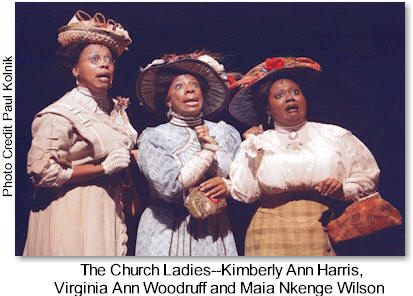
The Color Purple takes place in a deeply spiritual Southern Black community,
where Church Ladies (played by Kimberly Ann Harris, Virginia Ann Woodruff, and
Maia Nkenge Wilson) remind audience members that ’it takes a whole village to
raise a child.’
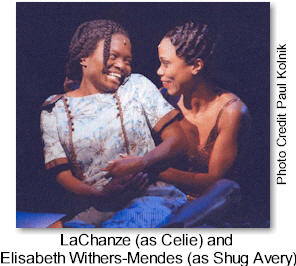
The story centers, primarily, on the life of Celie (played by LaChanze), a young
Black girl whose low self-esteem (and triple oppression by gender, race, and
class) threatens to stunt her growth, as well as her journey to
self-realization.
|
|

It is with the help, however, of strong Black women in her community like
Sophia (Felicia P. Fields) and Shug Avery (Elisabeth Withers-Mendes) who teach
Celie (a survivor of incest) how to resist marginalization, objectification, and
self-annihilation.
With Felicia P. Field’s unforgettable theme song called ’Hell No’ and Elisabeth
Withers-Mendes’ sultry rendition of ’Push Da Button’ (as well as other memorable
songs like ’Too Beautiful for Words’ and ’The Color Purple’), Celie finally
learns to love the skin that she is in. She is empowered to love herself
unconditionally, to embrace her beautiful smile, and to feel comfortable with
her new-found spirituality and liberated sexuality.
No longer viewing herself as an ’ugly’ victim, who feared whether ’Somebody
Gonna Love You,’ Celie (as actor LaChanze expresses most profoundly in songs
like ’Miss Celie’s Pants’ and ’I’m Here’) eventually realizes that the true love
she is seeking is deep inside herself.
By the end of The Color Purple, Celie, like Mister (played by a talented
Kingsley Leggs) has come full circle. She learns to love the God within; the God
inside herself that has been there all along, waiting to be actualized and loved
entirely.
Beverly Guy Sheftall, Director of the Women’s Research & Resource Center at
Spelman College, says she was ’thrilled to be in the audience of the Broadway
production of The Color Purple, especially after having seen its debut in
Atlanta, Georgia.’
Sheftall said, ’The acting was extraordinary, the music was exhilarating, and
the evening was unforgettable! Celie’s story on stage was as compelling,
riveting, and gut-wrenching as it was on the pages of Alice Walker’s now
canonical novel.’
According to Sheftall, Celie’s ’triumphant journey toward wholeness’ and
Mister’s redemption ’are refreshing in a world that many of us today find
insufferable.’
Like many of those in attendance at the Broadway production, Sheftall, who
co-authored a book with Johnetta B. Cole called
Gender Talk: The Struggle for
Women’s Equality in African American Communities (Ballantine 2003), left the
theater with ’a renewed commitment to engage in the struggle to bring about a
more humane planet for all of us.’
Aneesha Toliver, a 19 year-old psychology major at Howard University, agrees.
Toliver, a survivor of incest who remains on the Dean’s List at her college,
traveled all the way from Washington, D.C. to see the Broadway production of The
Color Purple on December 17.
 Toliver relates to Celie’s struggle with learning to love herself
unconditionally. ’I am still so far from being the spiritual Black woman I am
destined to be,’ Toliver said. ’But the messages that I received from The Color
Purple reminded me that I am still beautiful and full of love.’
Toliver relates to Celie’s struggle with learning to love herself
unconditionally. ’I am still so far from being the spiritual Black woman I am
destined to be,’ Toliver said. ’But the messages that I received from The Color
Purple reminded me that I am still beautiful and full of love.’
Toliver believes that Celie’s story of triumph can help to heal other African
American women who not only ’see themselves in Celie,’ but who are equally
empowered ’to confront their own past; to release the negativity that it has
inflicted upon us.’
Toliver said, ’Only through confrontation can we grow beyond the pain.’ Wise
advice from a talented young woman who has come to learn that beauty resides
deep within the center of her being.
Clarence Cooper, General Manager of the popular Sylvia’s (Soul Food) Restaurant
in Harlem, New York for over twenty years, believes Walker’s universal story of
hope and redemption is empowering for all genders.
Cooper remembers when few males protested the film version of Walker’s novel
when it first appeared in the early 80s. Cooper, who never involved himself in
the protests, claims that few men protested largely because of misunderstanding
and because once taboo subjects (childhood sexual abuse in the African American
community and violence against women) was ’now in front of them, in color, on
the big screen.’
’We were ashamed,’ said Cooper. ’We closed our eyes because we didn't want to
see.’
Cooper realized, however, that healing and progress cannot be made with
repression or sheer avoidance of topics that are central to the lives of members
in all of our communities.
 It is up to us to face taboo subjects (like same-sex relationships) if we truly
want to effect world change, or to foster understanding for all of the members
in our community.
It is up to us to face taboo subjects (like same-sex relationships) if we truly
want to effect world change, or to foster understanding for all of the members
in our community.
’Taboo subjects have always been there,’ says Cooper. ’It’s here now, and it
will probably continue to be here unless we embrace it and say, ’We must do
something about it. We must change.’
Like Carole Beaubien Gregory, professor of English at the Borough of Manhattan
Community College, Cooper believes that Walker’s womanist narrative, which
focuses on the development and empowerment of both African American women and
men) can serve as a necessary, healing ingredient for the entire world.
’I would say, ’Teach the truth,’ says Gregory. ’Teach tolerance of each other.
Teach
revolutionary concepts for the liberation of African-American people." Certainly
when any individual learns to love themself unconditionally in the face of
insurmountable oppression, this, in itself, is a revolutionary act.
’The African American woman has stood her ground,’ said Cooper. ’She has
established her perimeter and contributed a great deal. For women to embrace
this … about themselves … [about surviving childhood sexual abuse] …
it’s a huge step. Not just for the African American society, but for all
societies."
’The big step,’ Cooper argues, ’is that women are coming forth and saying, ’I
was a victim, but I’m going on about my life.’ And that’s a beautiful thing.’
A beautiful thing indeed, especially for survivors like Celie who, despite her
hardship or economic situation, lives to tell her story’in her own words. During
the era in which Celie lived (and also during the time that Walker published her
third narrative), there were few resources available to Black women who were
survivors of rape, childhood sexual abuse, or domestic violence.
Oprah Winfrey,
supervising producer and major promoter of The Color Purple who originated the
role of ’Sophia’ in the landmark film, testifies to this fact on her top-rated
television show. Winfrey, a survivor of childhood sexual abuse, fell in love
with Walker’s narrative when she first read it in 1982.
 ’Twenty years later,’ says Winfrey, ’I’m blessed to be a part of the team
presenting The Color Purple on the Broadway stage’it’s a full circle moment in
my life. It makes me so very proud to know that it will reach a whole new
generation and an even wider audience.’
’Twenty years later,’ says Winfrey, ’I’m blessed to be a part of the team
presenting The Color Purple on the Broadway stage’it’s a full circle moment in
my life. It makes me so very proud to know that it will reach a whole new
generation and an even wider audience.’
With the publication of novels like Toni Morrison’s The Bluest Eye, Maya
Angelou’s I Know Why the Caged Bird Sings (and even a long list of slave
narratives published before these noteworthy poets and authors), readers have
been provided with real life snapshots of their own history; mirrors of
themselves’not only on the printed page, but also on the world stage. Stories
like those featured in Alice Walker’s narrative remind us that we are each part
of a fierce legacy of struggle and culture of resistance.
The Color Purple: The Musical on Broadway reminds us that we are all part of the
living Spirit; that our ’living creativity’ and fearless, indomitable Spirit
resides deep in each and every one of us’regardless of age, race, gender, sexual
orientation, economic or religious background. We are ’One,’ Celie reminds us,
because God lives … deep inside you … and me.
Related Links