Black Hauntologies: Slavery, Modernity and Spectral Re-Vision, Volume II
Buy from AALBC
Add to Cart — $119.99More Book Details
Nonfiction, Hardcover, 250 pages
Publisher: Anthem Press
ISBN: 9781785278709
 Bookshop
Description of Black Hauntologies: Slavery, Modernity and Spectral Re-Vision, Volume II
Black Hauntologies is the second volume of a three-volume study that offers a fresh reading of African-American literary history by locating within the literature itself the terms for a revisionary account of Black writing, terms pursued along three distinct but interlocking pathways (each to be pursued in the Impact Series format):
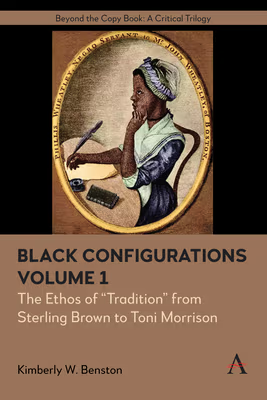
- By charting figurations of tradition among six of the most innovative practitioners of Black literary expression from Sterling Brown to Toni Morrison (Volume 1);
- By following the haunting pathways of spectral dialogues between slavery and African-American modernism (Volume 2);
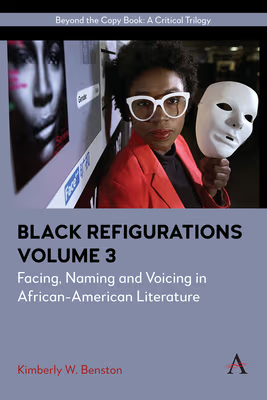
- By interrogating interlocking topoi of critique and assertion (naming, facing, voicing) across the history of African-American literary expression (Volume 3).
The critical trilogy presents a narrative of African-American literature as a continual, dialectical process, blending confrontation with traumatic origins and the quest for expressive transformation.
This project arises from the question: how does one construe and narrate the story of a tradition for which the conventional structure of literary history—that is, the relation between discourse and its referents—is itself such a politically and thematically charged issue? On one hand, the ideological exclusion of the African-American subject from authorized spheres of meaning and signification gives value to narrating Black literary tradition as the progressive emergence of a fully articulate presence and seems to find warrant in Black writing's persistent thematization of literacy, public performance, and self-definition.
On the other hand, such a narrative of fully realized agency and consciousness risks replicating the dominant ideology's own reductive vision of identity as a predetermined totality, thus imagining some singular and final form for African-American being. The study asserts instead that African-American literature is fueled by the simultaneous workings of a desire for a totally realized subject and the constant displacement of that desire by a willingness—in contrast to the oppressive system that would deny its agency—to put its own mode of being into question.