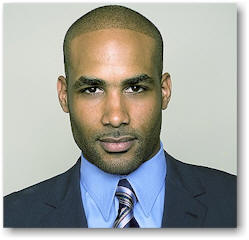
Boris Frederic Cecil Tay-Natey Ofuatey-Kodjoe was born in Vienna, Austria on March 8, 1973 to Eric, a physician from Ghana, and Ursula, a psychologist from Germany which is where he was raised along with his siblings, Patrick and Nadja.
While attending Virginia Commonwealth University on a tennis scholarship, the striking, 6’3’ student-athlete was spotted by a talent scout and signed to a contract with the Ford Modeling Agency. After appearing in ad campaigns for Ralph Lauren, Perry Ellis, Yves Saint Laurent and The Gap, Boris blossomed into a rarity, one of the world’s few male supermodels. So, it’s no surprise that he would one day be named one of the 50 Most Beautiful People in the World by People Magazine.
In 2000, he turned his attention to acting, making his big screen debut in Love & Basketball, following that up with well-received appearances in everything from Brown Sugar to The Gospel to Madea’s Family Reunion. On Broadway, he’s worked opposite James Earl Jones and Phylicia Rashad in Cat on a Hot Tin Roof.
On TV, he was cast in the hit series ’Soul Food’ as Damon Carter, a role for which he would land a trio of NAACP Image Award nominations. While doing the hit show, he fell head over heels in love with his attractive co-star, Nicole Ari Parker, and by 2005 the inseparable pair would marry back in his hometown, Gundelfingen, Germany. They now have two kids, Sophie Tei-Naaki Lee Kodjoe, 3, and Nicolas Neruda Kodjoe, 1. Despite being quite the power couple, they’ve decided to make their home away from the hustle and bustle of Hollywood in relatively-sedate Atlanta.
Here, Boris talks about all of the above and his latest movie, All about Us, a romantic dramedy about a Hollywood couple who decide to settle down in Mississippi after shooting a movie there, rather than return to L.A.
Boris Kodjoe:
The All about Us Interview with
Kam Williams
|
Actors: Boris
Kodjoe, Ruby Dee, Latanya Richardson, Morgan Freeman |
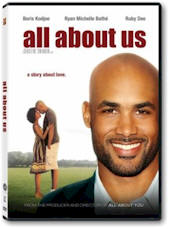
KW: Hi Boris, thanks for the interview. How are Nicole and the kids?
BK: They’re good. They’re on their way back from L.A. She
was doing a pilot for ABC, called Never Better.
KW: What interested you in doing All about Us?
BK: First and foremost was the script, because I rarely,
to that point, got a chance to consider playing a role like
that, a regular family guy who is basically trying to balance
his career goals with his obligations to his family. It’s a very
heartwarming story with some really interesting, fleshed-out
characters. And when I had a meeting with the director,
Christine Swanson, and her husband, Michael, I admired their
passion for what they were doing. I think it’s always a blessing
to get to work with people who have that fire about what they’re
doing.
KW: What was it like filming All about Us on location in
Mississippi?
BK: It was great. I encountered tremendous heat and
lovely people.
KW: The script was semi-autobiographical. So, it must have been
interesting to be acting out the filmmakers’ life story.
BK: Yeah, it was interesting. I talked with Michael about
the character, and about his path and his journey. And it was
fun to sort of associate certain things that he went through
with things that I’ve been through in my life. For instance, I
had a young daughter, too, so there were many parallels that I
could draw on. It was funny, because we were different people,
yet all young fathers obviously go through some of the same
stuff, and have some of the same concerns and anxieties. So, the
process was really cool to me.
KW: And you and Nicole left L.A. yourselves, in your case for
Atlanta.
BK: [His cell phone rings] Speak of the devil. [Talks
with
Nicole on phone for a minute]
KW: How did you decide to settle in Atlanta?
BK: We never wanted to raise the kids in Hollywood. We
wanted to be in an environment that spoke to us, culturally.
That’s how we chose Atlanta and found our dream home. Also, I
have family coming from Europe, and her family is in Baltimore,
so the choice was very practical at the same time.
 KW: I know you are quad-lingual: German, English, French and
Spanish. What languages are you going to teach your children?
KW: I know you are quad-lingual: German, English, French and
Spanish. What languages are you going to teach your children?
BK: Well, they speak three, right now: obviously English,
plus German and Spanish. Our nanny is Guatemalan, and she only
speaks Spanish to them. And we speak German to them.
KW: I heard that your mother’s Jewish. Is that true?
BK: Well, by blood, yeah. My grandmother’s part Jewish,
which makes my mother and myself Jewish, by blood. But we
weren’t raised in the Jewish faith. I remember my mother
teaching me from the age of about 3 or 4 that we had to find our
own way based on many different religions, that there were many
different doctrines but that they all had the same purpose. I
always remember that, because it was so simple, and so poignant
and deep at the same time. I try to apply that now and expose my
kids to many different ideas and philosophies, so they can find
their own way.
KW: Did you lose any relatives in the Holocaust?
BK: Yeah, on my mother’s side, my maternal
great-grandmother. It was ironic in a way, because my
grandmother wasn't pure-blooded Aryan, and therefore she wasn't
considered a member of the master race. But she got pregnant by
my grandfather who was 200% German. So, it was quite a
tumultuous time for her, because they had to hide her for her to
survive the Second World War.
KW: Did she have any close calls?
BK: Yeah, she told me that someone once reported her, but
she was lucky that when the SS came to investigate and found her
hiding in a back room, one of the officers was in a good mood
and didn't arrest her. She said those kind of experiences
occurred frequently. It was a time of sheer terror and no one
knew what was going on, and everyone knew somebody who had
suddenly gone missing for no reason. And apparently you didn't
talk about it over the dinner table at night. They were just
paralyzed with fear. You didn't utter a word about what could
possibly be going on or about what they had heard. It was a very
scary time.
KW: I hope she’s writing her memoirs.
BK: Yeah, I’m going to help her write it. She had some
quite interesting experiences. And then later in her life her
daughter brought home an African from Ghana, which didn't go
over so well with my grandfather. He kicked them out of the
house until I was born. They went back with me when I was a
couple months old, and said, ’Look, either you accept us, or
you’ll never see us again.’ And at that moment he made a 180
degree turn and accepted me from that moment on.
KW: Wow, you're going to have to write an autobiography, too.
BK: We all lived under the same roof. He had lost both of
his arms in the war from a Russian hand grenade. From when I was
4, I would shave him in the morning and feed him breakfast every
day.
KW: Did you have to deal with racism as a child? You must have
been one of very non-white kids in the neighborhood?
BK: Me and my brother were always the only black kids.
Racism is universal, but it’s very different in different
cultures. Where I grew up, racism was more about ignorance and a
lack of knowledge than a controlled and focused prejudice. So, I
was subjected to the type of racism where people called me
names, but I had a lot of great friends, too. Overall, it was a
great environment to grow up in. The place I was raised was in
the Black Forest and looks like The Sound of Music. We had a
great childhood, full of fun and outdoor adventure. It was very
sane and well-rounded. My mother always told us we were perfect
the way we were, and that we wouldn’t have to worry about what
people said because there are just a lot of ignoramuses in the
world, and that you will encounter them until the day you die.
That was her approach, and now when I look back, I can really
appreciate it.
KW:
Barack Obama also had a white mother and an African father.
What do you think of him?
BK: That’s just one of the aspects of him that I find
intriguing. I think that he’s an incredible and powerful man,
very charismatic and intelligent. He also has great integrity
and pride, and loves the country. I believe he’s someone who
will not only improve America internally in terms of the
economy, healthcare, education, the environment and Social
Security but also repair the country’s reputation which has
suffered around the world over the past eight years. He’s
someone who I believe can sit down with potential allies on the
international level and try to make the world a better place for
everyone. So, I’m supporting him wholeheartedly. I hope that
people will wake up and take the country back. It’s hard to
believe that we have a president who could officially deny the
fact that the world is being affected by global warming. It’s
embarrassing.
KW: What’s it like being named one of the 50 Most Beautiful
People in the World? Has it changed your life?
BK: [Laughs] That’s hilarious. No, it hasn’t changed my
life at all. It’s one of those things, like the tabloids, that
you can't really take seriously.
Obviously, I’m very flattered, but that’s as far as it goes.
It’s a nice thing, but I can't take any credit for it. I don't
wake up and go, ’Woo-hoo! I’m one of the 50 Most Beautiful!
Yeah!’ There are a lot of things that are much more important,
like being a husband and father. I’ve been blessed with a great
wife and amazing children who have changed my life. It’s not
necessarily a walk in the park every day, but it’s absolutely
the most rewarding gift ever.
KW: How was it playing Brick on Broadway in Cat on a Hot Tin
Roof?
BK: It was a dream come true, getting to play one of the
significant roles in one of the most significant classics. I was
honored and humbled by the experience. Everybody was so
supportive, James Earl Jones, Phylicia Rashad, Debbie Allen,
Anika Noni Rose and Giancarlo Esposito. And the crowd response
was great, everything was amazing.
KW:
Tasha Smith wants to know if you're ever afraid.
BK: Oh, absolutely? I’m terrified sometimes, not for
myself, but for my kids.
That’s one of the things they don't tell you when you become a
father, but along with unconditional love comes unconditional
fear.
KW: The
Columbus Short question: Are you happy?
BK: Extremely.
KW: Bookworm
Troy Johnson wants to know, what was the last book you read?
|
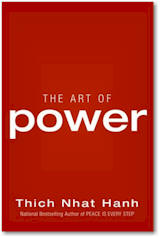
Hardcover: 240 pages by Thich Nhat Hanh With colorful anecdotes, precise language, and concrete practices, world-renowned Zen master, spiritual leader, and national bestselling author, Thich Nhat Hanh illustrates how the current understanding of power leads us on a never-ending search for external markers like job title or salary. The Art of Power boldly challenges our assumptions and teaches each of us how to access the true power that is within our grasp. |
BK: Right now I’m on a spiritual trip. I read a lot of
that type of book. The last one I read was The Art of Power by
Thich Nhat Hanh.
KW: Yeah, I’ve read some of his stuff. He’s great.
BK: He summarizes what we all know, like that the power
is within you, and that as long as you can visualize it you can
achieve it. Things along those lines.
KW: Is there any question nobody asks you that you wish
somebody would ask?
BK: What nobody ever asks me is how difficult it was to
come to sound like this, probably because they all assume I’m
African-American.
KW: True, your American accent has no traces of German. So,
how difficult was it to sound like this? Did you study English
in Germany?
BK: I learned it here. I took classes, had a dialect
coach, and watched a lot of MTV. When I prepare for a part, I
still have to figure out the appropriate accent and cadence.
KW: How do you want to be remembered?
BK: I want to be remembered as a great father, and as
someone who inspired people to have integrity and drive.
KW: What’s up next for you?
BK: I’m shooting a movie right now with Bruce Willis
called The Surrogates.
KW: Well, good luck with that, and I hope to speak to you again
when that gets released.
BK: Cool. Peace.
Related Links
Boris Kodjoe The �Addicted� Interview (2014)
A Trailer of All about Us: