
Anchoring the National Conversation on Race 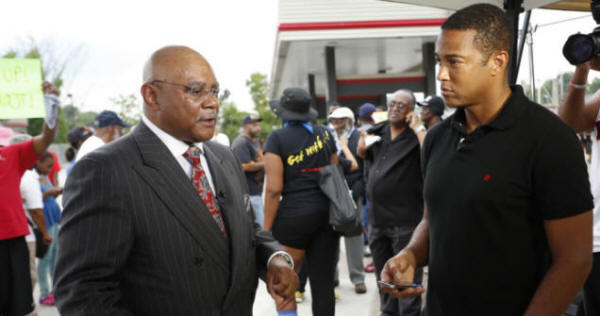
Don Lemon interviewing Mike Brown, Dorian Johnson’s
attorney
Photo Credit: Theo R. Welling
CNN’s Don Lemon has anchored and reported many breaking on-the-scene news
stories, including the George Zimmerman trial, the Boston marathon bombing, the
Philadelphia building collapse, the Sandy Hook Elementary School shooting, the
Colorado Theater Shooting, the death of Whitney Houston, the Inauguration of
President Barack Obama, the death of Michael Jackson, Hurricane Gustav in
Louisiana, and the Minneapolis bridge collapse.
In 2009, Ebony Magazine dubbed Don one of the 150 most influential Blacks in
America. Furthermore, he has won an Edward R. Murrow award for his coverage of
the capture of the Washington, D.C. snipers, and an Emmy for a special report on
real estate in Chicagoland.
Don earned a degree in broadcast journalism from Brooklyn College where he
currently serves as an adjunct professor, teaching and participating in
curriculum designed around new media. Here, he talks about CNN’s coverage of the
recent shooting of Michael Brown in Ferguson, Missouri.
Don Lemon The “Ferguson, Missouri” Interview
with Kam Williams
Kam Williams: Hi Don, thanks for another opportunity to interview
you.
Don Lemon: Hey, Kam, thanks for asking me.
KW: I appreciate your taking the time to speak with me, since you
seem to be on CNN 24/7 lately. It’s been wall-to-wall Don Lemon from
Ferguson, Missouri.
DL: [Chuckles] I don’t know about that. It’s been a tough go, but it’s an
important story. I wanted to make sure I got it on and got it right.
KW: I have a ton of questions sent in for you by viewers. Attorney
Bernadette Beekman asks: Do you think your ability to report from Ferguson,
Missouri was adversely affected by your almost becoming a part of the story
like when you got shoved or punched by that racist cop
or when rapper Talib Kweli put you in the awkward position of having to defend CNN’s coverage on the air?
DL: Well, I don’t know if I became part of the story. I just think we had
so many resources devoted to it that we were way ahead of the competition.
So, everyone tuned in to CNN, and they were watching us. [Regarding Talib
Kweli] I’m not the only one on the air who’s been put in a position of
defending our reporting. If someone comes on and criticizes it, we’re there
to tell them the truth. [Regarding Officer Dan Page] I got pushed by an
officer live on television, but that was just me doing my job. He pushed me,
so it wasn’t as if I’d injected myself into the story. We were standing
where we’d been instructed to stand, and he came around the corner and
shoved me when I just happened to be doing a live shot on The Situation
Room. I don’t think that made me part of the story. It was more that
everyone was watching when news was breaking live around me.
KW: Do you still teach as an adjunct? What grade would you give yourself on
the reporting of this story overall?
DL: Yes, I still teach occasionally at Brooklyn College, but I’m now more
than an adjunct. I’m on the board of trustees. I would have to give CNN an
A+. I think we did a really good job. No one compared to us, resource-wise.
We had every angle of that story covered. That’s why people saw it and felt
it as if they were there. We did a great job bringing people there. And
that’s that.
KW: Editor Lisa Loving asks: Were there any teachable moments for you as a
journalist covering the aftermath of the Michael Brown shooting?
DL: I think there’s always a lesson you can learn from any situation. In
this case, I learned how tightly people hold onto their beliefs. And, here,
people had really strong beliefs about this story on both sides. People
supporting the officer felt Michael Brown did something wrong. Those
supporting Michael Brown said the cop did something wrong. There was very
little that you could do to convince either side otherwise, or simply to be
objective and not jump to conclusions. So, if you were just reporting the
facts, and said “Michael Brown did this…” you’d be challenged by his
supporters asking, “How do you know that?” By the same token, if you said,
“Witnesses say the cop did this…” the officer’s supporters would challenge
you with “Well, how do you know that?” It reconfirmed that I have to be
objective in my reporting and allow viewers to read into it whatever they
want. So, the teachable moment for me was a reminder that I just have to
state the facts.
KW: Aaron Moyne asks: Are you satisfied that CNN has covered the Michael
Brown case objectively, devoid of bias and sensationalism?
DL: Absolutely! My answer is “yes” and I’m so happy that Aaron asked this
question because that means that people are paying close attention. So, it’s
incumbent upon us not only to be objective but to be passionate about our
reporting… meaning wanting to be there… wanting to tell the truth… and
wanting to tell the story from all sides.
KW: A crowd control police officer overtly referred to protesters as
“animals” on CNN. Is that
sound bite an accurate reflection of the state of relations between
Ferguson’s police officers and the African-American community?
DL: I can’t answer that because I’m not a resident of Ferguson. I can only
tell you what, from being there, people are saying to me. And I know that
there are some good officers in the Ferguson Police Department, and then
there are some bad ones, just as in any police department around the
country. But I don’t know if someone calling protesters “animals” is an
accurate reflection of the Ferguson Police. You’d have to ask the police and
the people of Ferguson. I know they have issues with the department. That’s
what you saw playing out on television. They are passionately distrustful of
the police. Many people are. There’s a disconnect between the police and the
community. And so that’s a question that’s better answered by those who live
there.
KW: Has the court of public opinion already outweighed any opportunity for
Officer Wilson to voice his rationale for shooting Michael Brown so many
times?
DL: No, I don’t think it’s outweighed his rationale. The officer is yet to
tell the public and the media what he did. I’m sure he’s already spoken with
investigators. What everyone else is really waiting on is to hear his side
of the story. But he can do that at any point. So, if anyone feels there’s
been some bias in the reporting of the story that’s because only one side is
telling their story. The officer hasn’t told his story in the first person.
In the beginning, the Ferguson Police gave a version. Then they turned it
over to St. Louis County. And then there’s an alleged friend of the police
officer who called a radio station to tell her side of the story. But that’s
really been it. So, you haven’t heard much from the officer’s side. However,
you have heard from witnesses on the scene who have a lot to say about what
they saw happen to Michael Brown. So, if you don’t have the officer or
someone speaking on his behalf, how do you tell his story? You can’t.
KW: In your opinion, was there a sufficient threat against the police for
them to don riot gear, use teargas and make such a show of deadly force?
DL: I don’t know about a sufficient threat, but I do know there were
agitators in the crowd. We saw some of them. Come on! We saw people get shot
in front of us. I wasn’t at every scene that turned into a violent
situation, but I did see protesters instigating in some instances. Still,
the overwhelming majority of people said they were doing nothing but
exercising their right to protest and to march on the street when all of a
sudden they came up against a heavy police presence pushing them out of the
way. I take them at their word that this was true. The police said to us
that we didn’t see everything that’s going on… that people were throwing
bottles of water and urine at them, and that when something’s flying through
the air they have no idea whether it might be a Molotov cocktail. So, while
I might tend to agree with the conventional wisdom that it looks like an
overly-militarized presence, just judging from the optics of it, I would
nevertheless take both sides at their word, because I’m not the police and I
wasn’t in the crowd 100% of the time. I think there was some instigating by
police, and I think there was some instigating by some of the people who
were out in the crowd.
KW: How has all the looting affected the public perception of the Mike Brown
case? Did the optics of that serve to divide the country along color lines?
DL: I think in a way it distracted us from the real issues: first, the
killing of Mike Brown and, secondly, the police’s relationship with certain
members of the community. When you saw people stealing, that changed the
narrative of the story. But it also showed how upset people are. I think
you’d be hard-pressed to go back in history and find any sort of major
change achieved without some sort of upheaval. Even during the peaceful,
non-violent Civil Rights Movement, something would break out. There are
often people in a crowd who will do things they’re not supposed to, even
during the celebration of winning the Stanley Cup, the World Cup or the NBA
championship. We see it all the time. It was no different in Ferguson. But
it doesn’t suggest that the people there are different from anyone else.
It’s just that there were a few agitators in the crowd. And yes, I do think
it did take our focus off of what’s really important.
KW: Do you have any qualms about the black community making Michael Brown
the poster child for police brutality, assuming he had robbed a store and
roughed up its owner just minutes before his confrontation with Officer
Wilson?
DL: Listen, I can’t make people act or react a certain way. They’re going to
do whatever they’re going to do. As with any situation, I would just urge
caution and that people reserve judgment until all the facts are out. But I
do know that, regardless of what happens with Michael Brown, it’s important
that we get to the truth. That doesn’t take away the distrust of the police
and the way certain people are treated by them in our society. This has
really opened up that line of conversation. So, if anything comes out of
this, hopefully it’s a conversation that encourages police departments
around the country to look at themselves and to figure out ways to serve
their communities better.
KW: Ray Hirschman asks: Based on the evidence surrounding the case now, do
you have a gut feeling whether the police officer will walk or be charged
with homicide and found guilty?
DL: You never know how these things are going to turn out. But, and I say
this knowing people are going to get upset, if you look back at the history
of similar cases, it’s very tough to convict a police officer in a situation
like this. Juries often decide that it’s easy for people to armchair
quarterback when they don’t know what a cop has to deal with out there on
the streets. I think the grand jury will have that in the back of their
minds. But I just want justice, whatever that is, whether the Michael Brown
or the police officer is right. And I think that’s what most people want.
However, history has shown that it’s very hard to convict a police officer
under circumstances like this. That’s not to say it’s not going to happen,
but it’s going to be tough.
KW: Steve Kramer asks: Is there any chance CNN would consider devoting an
equal amount of coverage to the horrific black-on-black killings being
committed by gangs against other gangs and innocent bystanders that occur
daily in so many inner-cities in places like Chicago, Detroit, Philly and
Newark?
DL: Steve may have a short memory, because we do devote a lot of attention
to that. We cover Chicago, black-on-black crime, and violence in big cities
a lot. The only reason people probably bring it up is because this is a
flashpoint, so you see it on the news now. Ordinarily, we spend more time
covering daily violence in big cities than we do covering a story like this.
I devote entire newscasts to what happens on the streets in major cities all
the time. It’s just that people might not have tuned in to see it, or it
might not draw the attention, because you don’t see any rioting or teargas.
But we do it all the time.
KW: Have you been the victim of a profile stop by police?
DL: I have had interaction with police officers, yes. What man of color
hasn’t? That’s the reality. I was also detained for “shopping while black.”
Listen, I live in America. If I live in this country, things are going to
happen to me, especially as a black man. I’ve talked about my experiences
before, but I don’t really want to be the story.
KW: Thanks again for the time, Don, and keep up the good work.
DL: You’re welcome. Sorry, if I sounded tired.
KW: You must feel exhausted. You’re on the air every time I turn on CNN. But
no need to apologize. This was another great interview. Get some rest.
DL: Will do. Thank you very much, Kam. I appreciate talking to you.