Edward Lansing Gordon, III was born in
Detroit in 1960. Both his parents, Ed and Jimmie, were
schoolteachers, although his father is best remembered for
winning a gold medal in the long jump at the 1932 Olympics. Ed
credits them both with instilling in him his dedication to the
tireless work ethic which served him well while earning his B.A.
in communications and political science at Western Michigan
University and subsequently in his Emmy-winning career as a
television journalist.
His name became synonymous with celebrity interviews while with
the Black Entertainment Television Network where he hosted
Conversation with Ed Gordon along with anchoring BET News and
BET Tonight. In that capacity, he is perhaps most famous for
landing the first post-acquittal one-on-one with O.J. Simpson.
Ed's impressive resume also includes intimate tete-a-tetes with
President Bill Clinton, Oprah Winfrey, Reverend Al Sharpton,
Halle Berry, Archbishop Desmond Tutu, Jamie Foxx, Minister Louis
Farrakhan, South Africa's President Nelson Mandela, R. Kelly and
Senator Trent Lott, just to name a few
Since BET, Ed has enjoyed stints at CBS as a correspondent on 60
Minutes and at NBC as a commentator on Dateline and The Today
Show. He is currently hosting a couple of nationally-syndicated
programs: Our World with Black Enterprise and NPR's News and
Notes with Ed Gordon.
Besides collecting his fair share of professional accolades such
as an NAACP Image Award and the National Association of Black
Journalist's Journalist of the Year Award, Ed has also been
named one of the 50 Most Beautiful People in the World by People
Magazine.
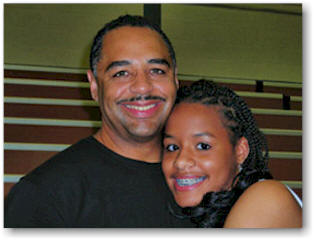
Though divorced, he remains very much a part of the life of his
14 year-old daughter, Taylor. Inspired by the positive response
to an article he wrote for Essence Magazine about his commitment
to Taylor, Ed recently launched his latest project: Daddy's
Promise (http://www.daddyspromise.com),
an initiative celebrating the bond between African-American men
and their daughters.
Ed Gordon - The Daddy's Promise Interview
with Kam
Williams
KW: Hey, Ed, I'm honored to get some time with you.
EG: No, my pleasure, I appreciate your taking the time
for this.
KW: What inspired you to write the article for Essence?
EG: Just the relationship that I have with
Taylor. I had always wanted kids and thought I'd have a boy.
But I had this little girl and she's just been such a joy to me.
I really only wanted to say that out loud. And after it was
published, the response was overwhelming. I always knew that
Essence was the Bible for black women, but I never understood
until then just how far-reaching it was. After that response, I
felt that I needed to do more, and we came up with Daddy's
Promise, a national initiative. Ironically, we knew we were
going to launch it around Father's Day, but Barack Obama's
recently speaking about the need for men to be fathers makes it
even more poignant.
KW: Do you think part of your originally wanting to have a son
might have had to do with you're being Ed Gordon, III and the
son of an Olympic gold medalist?
EG: Probably. My brother suggested that that was just my
little macho thing, wanting to relive my childhood and high
school years by watching a son play basketball and football and
date pretty girls. I suspect a lot of men feel like that. But my
brother also told me, ’you're about to receive a gift in a woman
who will love you like no other. Not like your mother, not like
your wife or any girl friend you've ever had. This person will
love you unconditionally, in a way which you won’t be able to
fathom until you experience it.’ He was so right. But I also see
the importance of men being in their daughters' lives.
KW: What do you hope the program will accomplish?
EG: We know that sisters are doing such a fine job going
to college and entering the corporate world, yet often when you
talk to them, many still have a void from not having a father in
their lives. And they might make certain decisions which, upon
reflection, they might wish they hadn’t made. But they didn't
have a road map. You can often tell a woman who didn't have a
father in her life.
KW: How can fathers get involved with your program?
EG: Go to the website,
http://www.daddyspromise.com, download the pledge, hand it
to your daughter, tell her you love her, and send us a picture
of the two of you to show the world that you are a good father.
we're trying to get people to stand up and say, ’Hey, I'm a good
one, and join me.’ The first wave is very symbolic.
KW: Are you at all worried about your message being misconstrued
the way some people unfairly labeled
Bill Cosby elitist and out of touch after his call for black
self-responsibility?
EG: I don't see that happening because this movement is
not doing any finger-pointing. I'm saying that, in general,
there are a lot of ills in our society and in our community that
we have to fix, period. And we need to be about fixing them.
This is a celebration of the brothers who are doing the right
thing. And those who aren’t know who they are. we're trying to
make this an initiative where brothers who aren’t doing the
right thing will want to come on board and turn things around.
KW: Did you have any problems with
Obama’s Father's Day speech in which he sharply criticized
absentee African-American fathers?
EG: No. Look, I think that as a community we have to be
willing to step up and examine our ills without being concerned
that we might be seen as blaming the victim or telling tales out
of school, so to speak. We have problems, as does the rest of
the world. We've faced a disproportionate share for a myriad of
reasons. It's not just because we're trifling, there are a
number of things that impact us. The point is we can't continue
to let those reasons, which run the gamut from racism to being
trifling and everything in between, stop us. The world is moving
at a very fast pace now, and we have to make sure that we stay
in this race.
KW: Do you think it was fair for Obama to talk about the ills of
the ghetto, when he was raised by his white mother and white
grandparents in the Midwest, in Hawaii and overseas?
EG: Here's my issue with that. I think it's unfair for
people to suggest, as you just did, that he didn't grow up with
a black experience. His was a black experience, just a different
one. We have to understand that the black experience includes
being a mulatto. Nobody complains about Halle Berry who was
raised by her mom. And Halle's been very up front about how she
sees herself and who she is.
The reality is that black America comes in all shapes, colors,
hair textures' the whole nine yards. And we have to start
embracing it all, because that's who we are. Barack Obama was
first criticized for, quote, not being black enough and for not
being able to understand the black experience. Now, when he
deals with some real black issues, people are still knocking
him.
KW: Do you feel at all funny about the popular notion that
because Obama won the nomination America is now a post-racial
society?
EG: I think it's important to note that he has never
suggested that. Often, the pundits are saying that. But I think
we have to be mindful that as wonderful as this Obama wave is we
still have to be careful. We are not beyond racism. This could
very well be an anomaly, much as after Hattie McDaniel won an
Oscar for Gone with the Wind, it took another three decades for
another black person to win an Academy Award. So, I think we
have to be mindful of what can occur. That being said, I do
believe that those of us who are of a certain age have to allow
for the baggage to drop. I do think that the younger generation
is less burdened by the weight of race. But let's not assume
that the vestiges of racism are gone just because Mr. Obama has
the Democratic nomination. It certainly is a milestone that
should be saluted. And it speaks to how far this country has
come in the last forty years, but it doesn't eradicate the
issues or the problems which still face us in a country so
consumed with race prejudice and quite frankly the question of
gender as well. We still have a ways to go, so we should
celebrate the accomplishment while being mindful that it is not
by any means complete.
KW: Have you interviewed Obama?
EG: I've interviewed him a number of times. The last time
was about a week or two before he declared. But we're going back
and forth with his folks right now about sitting down again with
him in the immediate future.
KW: What did you think about the flap between him and
Tavis Smiley, which resulted in Tavis' resigning from The
Tom Joyner Show.
EG: I think black America has to realize that this race
is bigger than one thing. That's how I see it. There are certain
things this candidate is going to do and rules he has to follow.
But it doesn't mean that he isn't with us. Barack Obama has been
masterful in being middle ground enough for white America to
embrace him but black enough for black America to say, ’That's
our guy.’
KW: Are you familiar with black conservative
Shelby Steele's new book explains why Obama won’t win the
Presidency because of his having to satisfy the competing
concerns of black and white constituencies? I had a pretty
interesting interview with him about it.
EG: Yeah, I interviewed him as well.
KW: Who are you supporting for President?
EG: Well, as journalists, as you know, because I'm on all
of these shows, I do not publicly suggest who I support. But,
eh, you know.
KW: Since you're originally from Detroit, how do you feel about
your hometown's embattled Mayor Kwame Kilpatrick? Do you think
he should step down?
EG: I think he has certainly placed himself in a position
that does not bode well for trying to hold the mayoral seat
because there are so many issues likely to sidetrack him. I will
be disappointed because Kwame is smart, charismatic and
everything you would want in a leader. I'm sorry that some of
the personal has involved itself in the political. And it has
made things more difficult for a city that's already reeling. In
terms of resigning, he says that he doesn't believe he should,
so at this point you just let the process play itself out.
KW: What was it like to be named one of the ’50 Most Beautiful
People in the World’ by People Magazine?
EG: Man, they had probably finished picking 49 and were
tired, and I just happened to be passing by. Look, Kam, it's
flattering, and I appreciate it, but you can't take that stuff
seriously. Just when you start buying into it, something slaps
you back down to Earth.
KW: When you interviewed O.J. Simpson, you asked him right off
the bat whether he did it. But in retrospect were there any
other questions you wished you'd asked him?
EG: No, I have learned over the years that as long as
you're well prepared, you do the best you can do. It's funny
because sometimes people will say you didn't ask this or that,
when you did ask those questions but the interviewee didn't
answer it in the way the viewer wanted. So, I've learned not to
beat myself up after these interviews. If I can say I went in
prepared, then I know I've done my best.
KW: That makes me think of the passing of Tim Russert who was
among the very best at preparation.
EG: Tim was one of those anomalies in the business who
started off at the other end, as an executive, and found his way
in front of the camera. And you can see just by the outpouring
of sympathy and well-deserved tributes that he's receiving that
he touched America deeply.
KW: How well did you know him?
EG: During my years at NBC, I was stationed in New York
while he was in D.C., so I didn't get to see him a lot, but we
would do a lot of cross-talks on the shows. And he, as everyone
has mentioned, always had very nice and supportive things to say
to you. Professionally, you could see that he had passion for
what he did. That's key. I don't know that you could find
anything that better suits someone for a career than passion.
So, it's a big loss.
KW: Which of your interviews did you find the most interesting?
EG: Honestly, without sounding too corny, I find almost
every interview I do interesting, because everyone has a story.
So, if you listen, you’ll see that there is a unique dynamic
when dealing with each person. But in terms of the interview
which was most special to me, while most people think it must be
either O.J. Simpson or R. Kelly, it actually was the first time
I had an opportunity to sit down with Nelson Mandela. I am
underwhelmed by most interviewees, but I was floored by this
man. Floored! I'm really meat and potatoes. I Ain't that deep.
But you could feel this man's presence when he walked into the
room before he even uttered a word. I'm probably most proud of
that interview because he's an extraordinary person and because
it was conducted in his home in South Africa.
KW: The
Columbus Short question: Are you happy?
EG: Most days.
KW: The
Tasha Smith question: Are you ever afraid?
EG: Hmm’ rarely, but yes.
KW: Is there any question that no one ever asks you that you
wish someone would?
EG: No, because I never think I'm that interesting. So,
no.
KW: Bookworm
Troy Johnson was wondering, what was the last book you read?
Boom!: Voices of the Sixties Personal Reflections on the
'60s and Today
Click to order via
Amazon
by Tom Brokaw
EG: The last book I read was [Tom] Brokaw's book,
Boom. I've always been fascinated by that era, the Sixties. I
was also intrigued by his coverage of race during the Civil
Rights Movement, and he dealt with a lot of that in the book.
It's very difficult for me to do a lot of reading for pleasure,
only because I do so much for work. When I finally get a chance
to relax, I generally don't want to read another thing. I
usually sit down and put a little music on and try to unwind in
that way
KW: Troy knew I was going to be speaking with you and he also
specifically wanted to know what you think of BET programming
and Bob Johnson's new film studio, Our Stories Films?
EG: I can't really comment about Our Stories Films,
because I haven't seen their first movie,
Who's Your Caddy. As for the direction of BET, look, BET is
what it is. I had concerns when I was there, and often fought
about the programming. But I also understood that it wasn't my
ball, and that the person that controls the ball controls the
game. So, I tried to represent the news department as best I
could. That being said, my disappointment is more with the fact
that until TV-One came about, black people only had one
television network, because competition spurs better programming
and better thought. So, my bigger disappointment was with the
industry itself and with the failure of black entrepreneurs to
give BET competition when it was more feasible, economically, to
get in the game.
KW: How do you feel about your longevity in this business?
EG:
I've been very blessed and feel very fortunate to be able to
work in a number of areas and to make some noise with the
interviews and programs I've done through the years, and to be
able to work continuously, which is not easy in our industry.
The fact that I'm hanging on and have some gray hair now, is
okay.
KW: How do you want to be remembered?
EG: As Taylor's daddy, and a good one.
KW: How did it feel to be on the other side of an interview?
EG: Some interviewers-turned-interviewees don't like not
being in control, but I wasn't really bothered by it.
KW: Thanks again, Ed. I appreciate the time.


 EG:
I've been very blessed and feel very fortunate to be able to
work in a number of areas and to make some noise with the
interviews and programs I've done through the years, and to be
able to work continuously, which is not easy in our industry.
The fact that I'm hanging on and have some gray hair now, is
okay.
EG:
I've been very blessed and feel very fortunate to be able to
work in a number of areas and to make some noise with the
interviews and programs I've done through the years, and to be
able to work continuously, which is not easy in our industry.
The fact that I'm hanging on and have some gray hair now, is
okay.