Misty Copeland: The “Life in Motion” Interview
Misty en Pointe
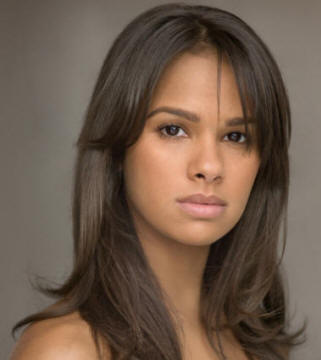
Photo Credit: Jade Young
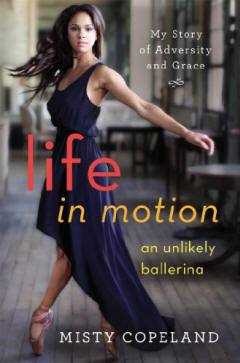
Born in Kansas City, Missouri on September 10, 1982, Misty Copeland is a soloist at the American Ballet Theatre. A recipient of the Leonore Annenberg Fellowship in the Arts, Misty is also an inductee into the Boys and Girls Club Alumni Hall of Fame. She lives in New York City. Here, she talks about her memoir, ‘Life in Motion: An Unlikely Ballerina.”
Misty Copeland The “Life in Motion” Interview
with Kam Williams
Kam Williams: Hi Misty, thanks for the interview. I really
enjoyed your
autobiography.
Misty Copeland: Thank you.
KW: What inspired you to write it at such a young age?
MC: I didn’t expect it to happen this soon, but it seemed like the right
time when I was approached by Simon and Schuster, based on the way it was
presented to me. It wasn’t going to be an end-all to me career, like “This
is what I’ve done.” Rather, it’s more focused on how I feel about all my
experiences in life and what I’ve learned from them, while I’m still in the
midst of my career. So, it’s almost like I’m sharing that, inviting people
into my world and bringing them along on a journey that I’m still on.
KW: You suffered a half-dozen stress fractures in 2012. Did having the time
to write while recuperating play a part in your decision?
MC: Absolutely! [Chuckles] I had a lot of time recovering from my surgery.
KW: The book is so well-written and you were so forthcoming that I already
feel like I know you before speaking to you.
MC: Good! [Giggles]
KW: You didn’t begin with ballet until you were 13, and yet you’ve made it
all the way to the top of the profession. That’s almost unheard of! How hard
was that?
MC: It’s extremely difficult, and not an approach I would recommend. But, at
the time, I didn’t grasp what it was I was doing. It was just fun, it came
naturally to me, and I enjoyed learning something new every single day. So,
I didn’t think of it as difficult at the time.
KW: In the book, you talk about being blessed with a perfect ballerina’s
body. Still I think of 13 as being around the age when most girls give up
ballet.
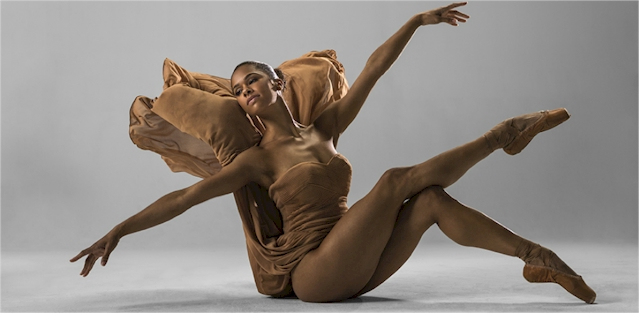
MC: Yeah, definitely. My body was ideal for ballet at that time. I was also
a very late bloomer in every way in my maturity. So, I was very much a
little girl when I started ballet.
KW: Harriet Pakula-Teweles asks: What is your favorite role as a ballerina?
MC: I believe I am yet to dance my favorite role, but I am pretty open to
adapting to different characters. Right now, I’ve really enjoyed doing the
role of Swanhilde in Coppelia. I’ve had a great process so far finding the
character and learning the steps. But I would love to be Odette/Odile in
Swan Lake one day. I think that would be the ultimate role.
KW: Do you think audiences still expect the Swan to be played by a white
female?
MC: I think that’s most people’s expectation and ideal, because that’s what
they’ve always seen in ballet. It’s almost a subconscious thing that makes
them think that only a white woman could portray that role. But she’s a
swan, she’s a character, so I believe she can be any color.
KW: In the book, you have a recurring theme where you say, “This is for the
little brown girls.” What do you mean by that?
MC: I feel like I represent every young dancer, and even non-dancer, who
felt they were not accepted by the ballet world. I’d like to think that they
can see themselves in me. So, every time I made that statement, I was sort
of saying, “I’m doing this for you, so it will be easier for you.”
KW: You remind me a little of
Venus and Serena Williams in how you came from
a humble background. They learned to play tennis on public courts in L.A.
and you were introduced to ballet, not at a prestigious program, but at your
local Boys and Girls Club, also in LA. How did you manage to fare so well
without any formal training before your teens?
MC: I think I always felt a connection to music and to movement. Growing up,
I was surrounded by R&B and Hip-Hop, and the closest thing I could find to
dance was gymnastics which I watched on TV. So, I just used those avenues I
found available right in my milieu to express what was inside of me. Ballet
was exactly what I was searching for, but my environment definitely made me
the dancer and the person that I am today. And the Hip-Hop culture was a big
part of it.
KW: What did it feel like to be ignored by the white ballerinas in your
dance company when you arrived in New York at the age of 16?
MC: I felt isolated because I didn’t know what the reason was at that age.
My being black had never been talked about in the studio where I trained in
California. I was just another dancer. When I moved to Manhattan, I first
thought I was being singled out because I had trained for such a short
period of time. But I was the only black girl.
KW: What did you think of two popular ballet movies: Black Swan and The
Company?
MC: The Company was interesting. I didn’t love it, although it might be
compelling to someone who isn’t a dancer. There wasn’t a lot of dialogue,
and you were just kind of observing the creative process of choreography and
in class. My reaction to the film was, well, this is my everyday life which
is not that interesting to watch up on the screen. However, Black Swan, I
did enjoy. It was super theatrical and over the top. Plus, I’m a Natalie
Portman fan. I wouldn’t say it was realistic, but I found it very
entertaining.
KW: Harriet also asks: How much is your dancing a role influenced by the
music—and do you have a favorite composer whose music just lifts you that
much higher?
MC: I love Philip Glass. It’s so complicated, if you really listen to it.
There’s so much happening in his music, yet there can be movement created
that’s such a contrast to it, that makes for a very pleasant experience when
you see dance with it. Yes, I’m definitely influenced by the music. We dance
to music, and you have to listen to it, and phrase your dancing and movement
in a certain way to compliment the music. We have to work hand in hand, the
dancer and the music. It depends on how I’m listening to the music to make
it work not just with the music but with the character I’m playing, because
when you’re dancing, you have to act out mime, which tells the story. And
the music reflects that mime. So, they kind of work together.
KW: Editor Lisa Loving asks: Who was your biggest influence?
MC: In the ballet world, I definitely have to give credit to Paloma Herrera,
because I idolized her in my early years of training. She was everything for
me. Then, getting to be in the company alongside her, to be able to face my
idol and dance with her on the stage, was just amazing!
KW: Lisa also asks: What is the most surprising thing people should know
about you?
MC: I think I’m pretty laid back. I like cooking, being at home, and going
to concerts. And I love to shop!
KW: What is your favorite dish to cook?
MC: I make a good salmon dish in the broiler that I marinate from scratch
with orange juice and soy sauce and scallions. I love fish!
KW: The Uduak Oduok question: Who is your favorite clothes designer?
MC: Oh, I love Helmut Lang! I love Stella McCartney and Diane von
Furstenberg and Christian Louboutin shoes. I love too many designers!
KW: Speaking of shoes, I was surprised to learn from your book that a good
pair of ballet shoes costs around $80.
MC: It takes a lot of money to be a part of the ballet world. Both the
training and the supplies are expensive, the shoes, the leotards and the
tights.
KW: I was also fascinated by the fact that your knees curve backwards.
MC: We call it hyper-extended. They’re beyond straight. And that creates a
very pretty line in ballet.
KW: Is there any question no one ever asks you, that you wish someone would?
MC: I can’t think of one. [LOL] I’ve been asked a lot of questions
throughout my career.
KW: Would you like to say something controversial that would get this
interview tweeted?
MC: No. [Laughs]
KW: The bookworm Troy Johnson question: What was the last book you read?
 MC: Seriously,
mine.
MC: Seriously,
mine.
KW: The music maven Heather Covington question: What was the last song you listened to?
MC: On my way here, I listened to “Worst Behavior” by Drake. [Laughs]
KW: The Mike Pittman question: What was your best career decision?
MC: Deciding to dance the part of the Firebird, even though I had six stress
fractures.
KW: When you look in the mirror, what do you see?
MC: A ballerina.
KW: If you could have one wish instantly granted, what would that be for?
MC: To have American ballet look like the rainbow.
KW: The Jamie Foxx question: If you only had 24 hours to live, how
would you spend the time?
MC: Dancing, listening to music, and drinking wine. [Laughs]
KW: The Ling-Ju Yen question: What is your earliest childhood memory?
MC: Playing with my siblings at about 5 years of age.
KW: The Kerry Washington question: If you were an animal, what animal would
you be?
MC: A dog.
KW: The Anthony Mackie question: Is there anything that you promised
yourself you’d do if you became famous, that you still haven’t done yet?
MC: No. I don’t think I’ve ever thought of that.
KW: The Melissa Harris-Perry question: How did your first big heartbreak
impact who you are as a person?
MC: I think anything that affects me in my personal life is going to help me
be a better artist on stage.
KW: The Viola Davis question: What’s the biggest difference between who you
are at home as opposed to the person we see on the red carpet?
MC: I definitely like to be natural and more relaxed and not wear a lot of
makeup.
KW: The Anthony Anderson question: If you could have a superpower, which one
would you choose?
MC: I’d fly!
KW: The Judyth Piazza question: What key quality do you believe all
successful people share?
MC: Striving for perfection.
KW: The Gabby Douglas question: If you had to choose another profession,
what would that be?
MC: A chef.
KW: What advice do you have for anyone who wants to follow in your
footsteps?
MC: To surround yourself with people who care about and support you. And to
do it for yourself and because you love it.
KW: The Tavis Smiley question: How do you want to be remembered?
MC: For making a positive change in the ballet world.
KW: Thanks again for the time, Misty, and best of luck with both the book
and with ballet. Now, I’m going to have to come and see you perform.
MC: Yes you do, Kam! Thank you.
Reader Comments (0)
Log In to Join the Conversation
Commenting is reserved for registered AALBC members to maintain high-quality discussions.
No comments yet. Be the first to share your thoughts!
Advertisement