



- Open Club
- 2 members
- Rules
The Echo Of Tanit's Cries 04/19/2025

Event created by richardmurray
This event began 04/19/2025 and repeats every year forever
The Echo Of Tanit's Cries
A poem
https://www.deviantart.com/hddeviant/art/1184895918
Title: The Echoes Of Tanit's Cries
She was known by other names before
Before cries along rare spoken lore
While ancient she exist vibrant today
Today she is smaller than the wee fae
And far aftdays glory will ahead
Head her great flock to Dione, safe from dread
What echo is when Tanit was engulf
Gulf made from her wails plus flaming wolf
Disciples^3 of a forgotten jew
Jeweled what was open to all, new
Now as Isis she is a quiet sing
As Yema she will be all God's king
As unknown today a studied thing
As Tanit her terrorcries still ring
eternal curse old human terror bring
Ah(h)^INF
from
Richard Murray
NOTE:
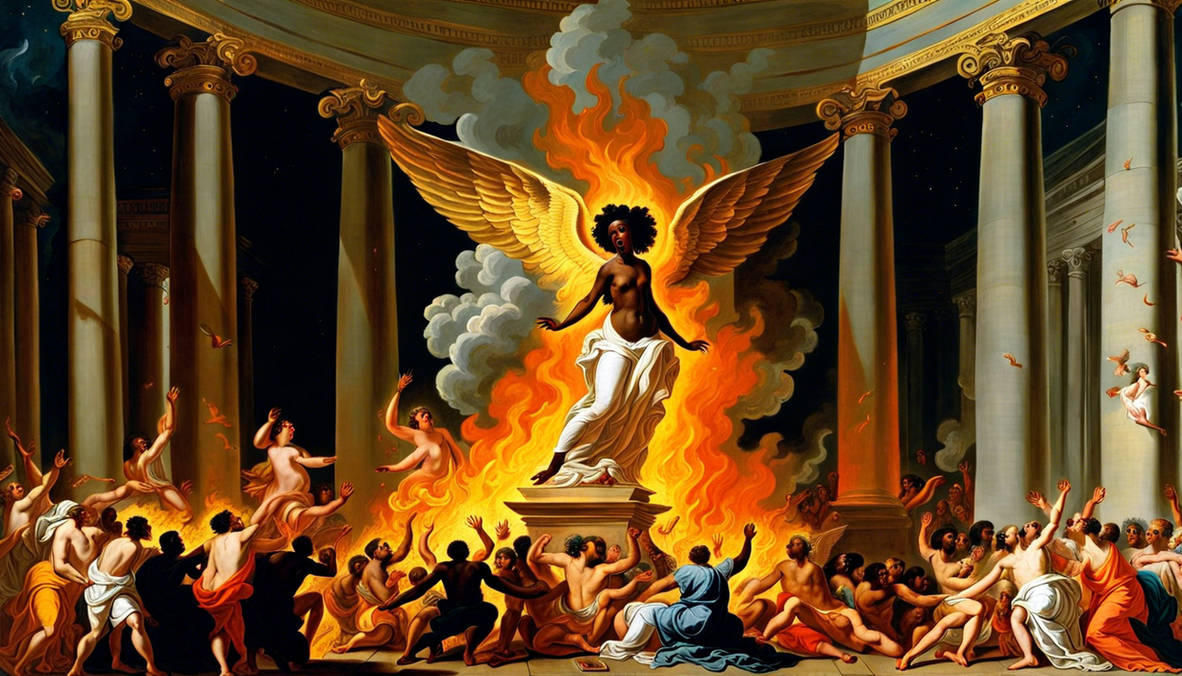
Tanit is the name of a Phoenician goddess who took many forms , as a form of Isis prayed to before , of Juno's wife prayed to after, her temple at Carthage, now around modern Tunis in Tunisia was large and a symbol Carthaginian pride, which at the time of the expansion of christianity in the Roman empire capitoled at Nova Roma/Constantinople, became a symbol of non Christian worship which was attacked multiple times by Christians and then converted and changed by Christians and then totally demolished by Christians who celebrated the demolition as a Christian victory. [ reference for the image => https://www.deviantart.com/hddeviant/art/VIBRATION-58-SELECTIONS-1183674809 ]
^3 - don't speak "^3" refers to disciples disciples disciples , or the students taught by the students taught by the students
jewel meaning ornament, a thing seen as a positive symbol of an act, not precious gem
wee- small
fae- types of fairies
aftdays - days after
Dione- pronounce [die-on]a moon around Saturn, one of its many names, the name means goddess
gulf- deep recession,a large depth
terrorcries- cries made from being terrorized
Ah(h)^INF is not spoken , but expressed mentally
INF infinity
^ - multiply itself by the factor after the symbol
(h)- element to be multiplied
IN AMENDMENTThe Inner Light- a review of my favorite star trek next generation episode
https://www.youtube.com/watch?v=lZpZfJC21lM
Transcript
0:00 Star Trek the Next Generation is a very 0:02 well-written show and there are many 0:04 episodes that one can point to as 0:06 examples of great storytelling but among 0:09 these there is one episode that's often 0:12 cited as the best in the series and that 0:14 episode is the inner light in which Jean 0:17 luk Bard lives an entire life in the 0:19 span of 25 minutes this episode is 0:22 Patrick Stewart's favorite and also my 0:24 personal favorite and I find myself 0:27 revisiting this episode more than any 0:29 other and every time I do I find 0:31 something new to appreciate so in this 0:33 video I'd like to break down why I think 0:35 this episode of all the incredible 0:37 stories in the TNG series stands out for 0:40 so many as its 0:44 finest so the very first thing that must 0:46 be known about the inner light is that 0:49 it was written for broadcast television 0:50 in the early 90s and that means it has a 0:53 very particular format a 1-hour slot of 0:55 Television generally had four or five 0:57 commercial breaks and this naturally 0:59 determined the shows dramatic structure 1:01 most episodes of TNG start with a short 1:03 2 to 4 minute teaser followed by the 1:05 title sequence then five dramatic acts 1:08 with commercial breaks in between total 1:10 run time is generally between 45 and 48 1:12 minutes and each Act generally ends on a 1:15 little Cliffhanger to keep the viewer 1:16 watching through the commercials it was 1:18 a simpler time before the dark ages of 1:20 multiple subscriptions now if you're 1:22 familiar with this format you'll 1:24 remember that the writers often used 1:26 commercial breakes to Signal the passage 1:27 of time in the story and in the case of 1:29 TN 1:30 this was sometimes really creative a 1:32 good example is cause and effect in 1:34 which the Enterprise is caught in a Time 1:35 Loop and keeps getting destroyed only to 1:38 restart after the break great episode so 1:40 the commercial break is actually really 1:42 integral to this format of Storytelling 1:44 and this is definitely the case for the 1:46 Inner Light in which each commercial 1:48 break is also a 5 to 10year time skip 1:51 now I think the best way to analyze any 1:53 story is to try to understand its moral 1:55 argument and for that you generally want 1:57 to look at how its main character 1:59 changes from beginning to end this 2:01 episode is about the transformation of 2:03 Jean luk peard who as we all know is the 2:06 Intrepid and somewhat guarded captain of 2:08 the Enterprise he's a man of great 2:11 stature and responsibility who has very 2:13 few personal relationships Beyond those 2:15 with his crew he seldom shows 2:17 vulnerability and his life is somewhat 2:20 lonely but by the climax of the Inner 2:22 Light he's quite the opposite he's 2:24 surrounded by family and he doesn't seem 2:26 to care about much else now in order to 2:28 cover that much ground in such a short 2:30 run time the writers not only have to 2:32 fast forward time they also have to fast 2:34 forward Picard's character development 2:36 which isn't really something you're 2:37 supposed to do as a writer characters 2:40 ideally develop gradually the whole 2:42 point is to see them grow and change in 2:44 this story we only get a select few 2:46 moments in which to Glimpse the life 2:48 that Picard is living and yet the climax 2:50 of the story is somehow very emotional 2:53 it's one of the most affecting dramatic 2:54 sequences in the entire Series so how 2:57 did they do it this episode was pitched 2:59 to the show producers by freelance 3:01 writer Morgan gendall originally as a 3:03 story in which both Picard and reker 3:06 lived an alternate life on an alien 3:07 world devastated by War the concept went 3:11 through many iterations before they 3:12 eventually settled on a story about a 3:14 civilization sending a probe into space 3:17 as a way of preserving their culture 3:19 early versions of the script included a 3:20 more involved subplot on the ship as the 3:23 crew tries to figure out what's 3:25 happening to their incapacitated Captain 3:27 but it was ultimately decided that the 3:29 episode should Focus almost completely 3:31 on the transformation of Jean Luke's 3:33 character and his relationships on the 3:35 planet Katan and I think part of the 3:37 reason that this episode works is that 3:39 it's very focused and concise not a 3:41 single line of dialogue is wasted not a 3:44 single action or scene is extraneous to 3:47 the plot and the action of the plot 3:49 articulates very clearly the moral of 3:51 the story so I think the writer is 3:53 really understood that this episode is 3:55 primarily a character study another 3:57 reason the story works is that it's 3:59 deeply relatable it deals with universal 4:01 struggles in The Human Condition it's 4:03 essentially the story of Jean Le Picard 4:05 realizing what's important in life he 4:08 begins by having to confront the fact 4:10 that a life he once knew is now gone and 4:12 that the person he thought he was is no 4:14 more that's something anyone can relate 4:16 to not because we've had our brains 4:18 hijacked by a nucleonic beam but because 4:21 life sometimes changes abruptly with no 4:23 going back sometimes the certainty of 4:26 who we thought we were falls apart in 4:28 the face of circumstances is beyond our 4:30 control the First Act of the episode is 4:32 spent with the familiar version of Jean 4:34 Luke the one who never married and who 4:36 doesn't particularly like children and 4:38 he does not accept the story that he is 4:40 a man named Cayman living on the planet 4:42 Katan and suffering from a fever that 4:44 has taken his memory he goes to Great 4:45 Lengths to methodically prove that his 4:48 new life is some kind of holc Illusion 4:50 but eventually he accepts his 4:52 circumstances and this is where we're 4:53 introduced to the episode's iconic flute 4:56 now in a story about change the flute is 4:58 the only constant and it's an important 5:00 story device beard is told that he's 5:02 been learning to play it though he 5:03 doesn't appear to have any skill just 5:05 yet and the First Act ends when Bard 5:08 notices that his wife's pendant looks 5:10 like the probe that sent him there then 5:12 we cut to the Enterprise Bridge 5:13 revealing that virtually no time has 5:15 passed since Bard was struck by the beam 5:17 and go to commercial now that's a work 5:20 of art the 99 cent Daily Double what you 5:23 want is what you get at McDonald's 5:25 today when we come back it's revealed 5:28 that many years have passed since the 5:30 previous act bicard has begun accepting 5:32 his identity as Cayman even if he is 5:34 still a bit preoccupied with finding the 5:36 Enterprise in any case he's committed 5:38 enough to his new life that he promises 5:40 to have a baby with his wife elen and 5:42 this signals to the viewer that peard 5:44 has already really moved on from his 5:46 past and he's kind of ready to fully 5:48 live as Cayman now one way that this 5:50 story stays concise is by implying 5:53 things about Picard's life rather than 5:55 showing them directly and much is 5:57 implied about Picard's character in this 5:59 second act his friendship with Bai 6:02 implies that he's integrated into the 6:04 community the intimacy and tenderness 6:06 between bicard and elen implies that 6:08 they have a strong bond despite his 6:10 apparent memory loss and the fact that 6:12 he can play frera jhaka on the flute now 6:15 means he's begun to embrace his identity 6:17 as Cayman but he's still playing an 6:19 Earth's song and so he's still attached 6:22 to his old life to some degree now 6:24 that's a really important detail that 6:26 we're going to come back to when we come 6:28 back from the break for act three we see 6:30 Cayman and elen celebrating the birth of 6:32 not their first child but their second 6:34 child who they Nam batai after cayman's 6:37 friend who passed away off screen while 6:39 you were watching an ad for Wendy's 6:41 Picard's flu playing has come along 6:42 nicely which helps you to feel the 6:44 passage of time since the previous act 6:47 note that he's no longer playing faka 6:49 this is a new song at this point you 6:51 realize that the story is skipping huge 6:53 periods of time and that Jean L Bard as 6:55 we knew him is really in the distant 6:57 past by this point and that's surprising 7:00 because it means peard isn't trying to 7:02 get back to the Enterprise and solve the 7:04 mystery of why he's on this strange 7:06 planet and yet we're reminded that for 7:08 the crew back aboard the Enterprise only 7:10 minutes have passed in fact the crew 7:12 tries to sever the connection causing 7:14 peard to collapse this is a clever way 7:16 of synchronizing these two timelines for 7:19 the viewer so that we understand just 7:21 how little time has actually passed we 7:24 skip ahead again and see that Bard's 7:26 daughter marbor is now fully grown and 7:28 she's a scientist now until this point 7:30 in the story there have been references 7:32 to some kind of drought happening but 7:34 now it's hinted that the drought is 7:36 actually an existential threat to the 7:38 planet Jean Luke is trying to convince 7:40 his daughter to spend less time worrying 7:43 about soil samples and more time with a 7:45 young man who is interested in her and 7:47 it's here with the realization that this 7:49 civilization might not have much time 7:51 left that the moral of the story begins 7:53 to emerge live now make 7:57 now always the most precious time at 8:01 this point in his life as Cayman Beard's 8:03 motivations have radically changed his 8:06 efforts as a scientist and Explorer have 8:08 yielded no fruit but for the realization 8:10 that time is running out all that 8:13 matters to him now are his relationships 8:15 with his friends and family something he 8:17 never had in his life on board the 8:19 Enterprise act three ends with the 8:21 Revelation that the Katon system was 8:23 destroyed when the sun went Nova a 8:25 thousand years ago this sets up act four 8:28 in which Jean Luke discovered that 8:29 katan's government is already aware that 8:31 the planet is doomed and that some kind 8:33 of plan is underway Picard's son now an 8:36 adult has followed in his Father's 8:38 Footsteps by becoming a musician 8:40 presumably because of his own father's 8:41 flute playing by the way this character 8:43 is played by Patrick Stewart's actual 8:45 son elene passes in a heart-wrenching 8:48 scene beautifully portrayed by Margo 8:49 Rose and Patrick Stewart does an 8:51 incredible job of making you feel this 8:54 loss even though we've had very little 8:56 screen time with these two characters 8:58 actually Patrick St steart has said that 9:00 this episode was the biggest acting 9:02 challenge that TNG ever presented him 9:05 which is really saying something 9:06 considering the sheer breadth of this 9:08 series and it's scenes like this that 9:10 really make you appreciate his 9:12 versatility as an actor and we come back 9:14 from the final commercial break for the 9:15 fifth and Final Act and Bard is very 9:18 elderly he's saddened by the fact that 9:20 his grandson has no future and he's 9:22 completely uninterested in the fact that 9:25 the community is apparently launching 9:26 some kind of Rocket into space something 9:28 that bicard of 40 years ago would surely 9:30 have been interested in the launch is 9:32 the climax of the story and it's where 9:34 the story finally reveals its moral 9:36 lesson first we get this beautiful 9:38 reveal of 9:45 Bai he explains the probe and Picard 9:48 immediately understands the mystery of 9:51 the episode has been solved but that's 9:53 not what this scene is primarily about 9:55 because there's another reveal 10:02 now I think the Brilliance of this scene 10:04 is that when peard realizes that he is 10:06 actually jeanu Picard and this probe 10:09 found him in the future that's not what 10:11 matters to him in the moment because 10:13 that would undermine the moral of this 10:15 story what does matter is elen his wife 10:19 is standing there in front of him and 10:21 that's what matters to bicard and that's 10:23 the moral of the story it's a simple 10:25 lesson that we often hear but don't 10:27 fully absorb until later in in life that 10:30 we tend to take for granted the most 10:31 important things often because we dwell 10:34 too long in the past or because we're 10:36 searching for something we can never 10:37 find all of the little moments in this 10:39 story have led to this beautifully 10:41 dramatized moral conclusion one with 10:44 real depth and 10:46 [Music] 10:49 wisdom now of course the episode cannot 10:51 end there the scene of Jean Luke waking 10:53 up on the bridge is also brilliantly 10:55 acted by Patrick Stewart who basically 10:57 wakes up from a coma and has to process 10:59 the impossibility that he's only been 11:02 unconscious for 25 minutes as always 11:05 Stuart takes this kind of far out 11:07 science fiction premise and somehow 11:09 makes it feel completely real and 11:10 believable I love this little moment 11:12 when he looks back at the bridge and 11:13 smiles which is the moment that we know 11:16 that peard as we know him is going to be 11:17 all right but of course the most famous 11:20 scene in the episode is its incredible 11:22 ending where it's revealed that cayman's 11:24 flute was stashed inside the probe and 11:27 here Patrick Stewart gives us an 11:28 incredible poignant depiction of a man 11:31 who's just been given a second chance at 11:33 life but who has also lost everything 11:36 that matters to him Picard plays Cayman 11:39 song now his only connection to his past 11:42 life just as he did with fraka when he 11:45 was on Katon this isn't just good 11:47 writing it's poetry as the music plays 11:50 we cut to the Enterprise D soaring 11:52 gracefully through the emptiness of 11:54 space peard has finally found the 11:56 Starship he spent a lifetime searching 11:58 for but in returning to who he was he is 12:02 once again alone and once again mourning 12:04 a past that he can never return to wow 12:08 it's pretty amazing to me that such a 12:10 profound bit of Storytelling found its 12:12 way onto Prime Time television in the 12:14 1990s and it's also a great example of 12:17 what Star Trek overall is capable of 12:20 when it approaches storytelling not only 12:22 as a fun adventure in outer space but 12:24 also as a deeper exploration of The 12:26 Human Condition I'd love to hear your 12:28 interpretation of this episode and other 12:31 episodes that you think reach similar 12:33 Heights check out my patreon if you'd 12:34 like to support the channel thanks for 12:36 watching and I'll see you on the next 12:37 one