This talk was delivered by Dr. McIntosh at John Henrik Clarke House on June 7, 2015
Today our topic is Walter Rodney. “What can today’s Black leaders learn from the leadership of Dr. Walter Rodney.” Before I go into the specifics of my answer to that question lets answer another question.
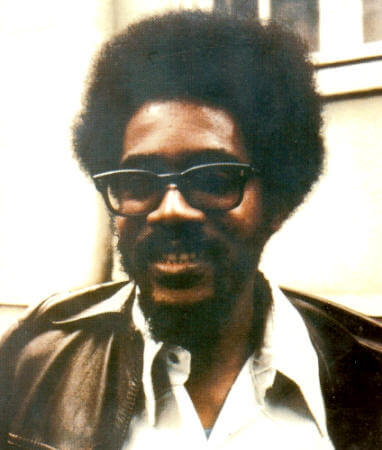 Walter Rodney
Firstly who are today’s leaders and for whom is this lecture given.
Certainly Mr. Jessie Jackson is not in the room, Certainly Mr. Al Sharpton
is not in the room and Certainly Mr. Obama is not in the room. Certainly few
if any people widely known as Black leaders or even known as leaders of
other local organizations are in the room. So this lecture, though about
leadership and about what leaders can learn, is really not for them, is it?
No this lecture is for you and for me. We are the leaders I am
addressing. We have to lead ourselves and our families before we can ever
lead others or even intelligently follow someone else. We have to know what
is possible and what we can expect from ourselves before we can even assess
what we want and expect from someone else. The Study of Effective Black
Leaders helps to provide us with models for what is possible. Here at BEPAA
The Board for the Education of People of African Ancestry, we have decided
to conduct a series of lectures on the issue of leadership starting with our
divine martyred leaders. Martyred leaders are people who were killed on our
behalf. Killed because they struggled for our liberation , our advancement
and our betterment, however they perceived that liberation, advancement or
betterment. Some of these leaders had seemingly entirely different ideas
from each other. However, It is our contention that these martyrs have more
in common that they have in conflict with each other. Martin Luther King and
Malcolm X were viewed as similar enough by the enemies of Black folks to
both be killed. Medgar Evers and Patrice Lumumba though continents apart
were similar enough to be killed by the same forces. We find that when Black
Leaders start out from wherever they start out but if they are sincere, they
end up in the same place, effectively resisting the oppression of Black
folks. Whether they start out saying that the white man is the devil or that
they dream of the time when “all of gods children Black men and white, jews
and gentiles,” etc— Whether they start out talking about Congolese
independence or voter registration, when they get to the point where they
start to shake that entity that destroys Black people collectively—when
they get too close to exercising power —whether they call it independence,
anti imperialism, or socialism— or fighting the accursed devil—When they
get too close to implementing what can be called Black Power—when they
become effective—they become what the enemy views as dangerous. They
either lead our people to victory or become martyrs.
In that same
vein we believe that Walter Rodney’s life provides many lessons that can be
valuable in helping us to learn what we can and should expect from ourselves
, and others, in terms of leadership. A study of Walter Rodney’s life
reveals a person committed to what Ayi Kwei Armah describes in his epic
work, Two Thousand Seasons, as “the destruction of destruction.” And though
Rodney uses different terms from either Ayi Kwei or Neely Fuller, I think
that Rodney ultimately expresses the same thing that Neely fuller said when
Fuller said words to the effect of, “If you don’t understand white supremacy
and how it operates anything you do understand will only serve to confuse
you more. ”
Rodney saw economics and class struggle as being perhaps
the most important factors in understanding the oppression of African People
but he also saw White Supremacy Racism as a related important factor and he
saw both Black Power and Socialist Development as the solution. He saw
Capitalism and Imperialism as being the main purveyor of Black Powerlessness
and he saw Socialism and Black Power as the solution. He explicitly stated
that every victim of this racist, capitalist, imperialist, oppression has a
responsibility to study it find out how it works and to work to destroy it.
The first principle that I believe todays’ leaders — you and I can learn
from Walter Rodney is the principle of using History as a weapon— In a
speech called “African History in the Service of the Black Revolution, ”
Rodney said that
Quote “the first dilemma which one faces in
attempting to utilize African history as one of the weapons in our struggle
is a realization that, in a very real sense, we, as black people, are placed
in [the] invidious position of having to justify our existence by
antecedents, having to prove our humanity by what went before. Now this is
very invidious. Humanity is not a thing one proves. One asserts it” UNQUOTE
He went on to tell how he was essentially past proving to others simply
that we had great so called civilizations as though trying to prove our
worth in European terms. He expresses an understanding of why many of us do
this and makes it clear that he went through this process himself. But he
concludes in that paper with an example of the kind of research in which we
could better engage. He cites the work of Julius Nyerere a leader who tried
to take his country of Tanzania along a socialist line of development.
Rodney says of Nyerere’s approach to historical scholarship QUOTE “the best
example is the work being done in Tanzania today and the type of analysis
being carried out by that remarkable man, Julius Nyerere. Take a document
like “Socialism and Rural Development, ”which is something blacks should all
read. He is attempting to select the elements of culture in Tanzania, the
process of cultural history before the Europeans arrived and as it was
affected by European arrival, and then from that, to try and come to terms
with the modern situation. So you can extrapolate, you can see the process.
It’s not just going back and taking out, harum-scarum. It has to be a
dialectical, you have to see what still exists in the contemporary situation
that comes from the traditional roots. And, in that sense, the analysis of
culture-history is extremely relevant to the present revolution.” DOT DOT
DOT “ White people always keep asking, “After Black Power, what? ”This is
not really for all of us to determine. That’s another epoch. DOT DOT DOT
“When we have achieved what we want to achieve, the history of humanity will
begin. So humanity will work out its history. We are concerned now with the
Blacks. The Blacks have to get something done DOT DOT DOT “
“For me
then, African history, as carried out by the Black brothers and sisters,
will have to be a process of coming to grips with all the aspects of African
history and with trying to determine what are the categories into which we
should fit things, as distinct from saying, let us start and try to
determine whether we can reconstruct African history along the same terms in
which European history has been reconstructed. Because that analysis, where
you utilize only the European criteria is itself the same process of
bastardization; the guy oppresses you and then he selects your terms of
reference [for you]. Even when you’re fighting him you use his terms of
reference. But what I am trying to suggest here is that we have to break out
from those terms of reference.”
Rodney is here talking not simply of
an Afrocentric perspective but an Afrocentric methodology and frame of
reference. These are things that today’s leaders could definitely learn and
benefit from. That Rodney could arrive at this position is something that is
amazing when you consider his roots. Just as John Henrik Clarke was born
into a slave system of share cropping and never supposed to emerge from it
as he did. Rodney was never supposed to escape his colonial roots. He was
supposed to love mother England and be proud of whatever accolades England
bestowed upon him, He was supposed to put on his bowler hat and spats,
MAKING SURE THAT HE ALWAYS SPOKE PROPERLY and HE WAS SUPPOSED TO spend the
rest of his life showing his compatriots how he was almost English and how
they could become almost English too. That’s what the oppressor intended for
Rodney but Rodney chose SELF DETERMINATION AND SELF DEFINITION AND LOYALTY
TO HIS PEOPLE FIRST. RODNEY CHOSE Black power instead. THESE ARE ALL THINGS
OUR LEADERS CAN LEARN FROM Walter Rodney.
Choose your people first,
find out how white supremacy, racism, capitalism, imperialism work, then
work to destroy that destruction. Work to get Black power. Yes it was a
miracle for Walter Rodney born in British Guiana and educated in a colonial
system to ever arrive at that point. From an early age Rodney committed
himself to excellence even within a system of white supremacy.
Walter Rodney performed so excellently within that colonial system that he
was invited to— in fact was given a scholarship to— study in the so called
mother country. Rodney was educated in Queens College in British Guiana. He
was on the debating team and he was an editor of the school newspaper. He
won a scholarship to the University College of the West Indies which for
those of you who don’t know started out as a separate part of The University
of London and eventually became the college that still educates people
mainly from 18 English speaking countries in the Caribbean. There at UWI the
perhaps preeminent colonial school where 3 graduates have gone on to earn
Nobel Prizes, 61 graduates have become Rhodes Scholars and 18 graduates have
become heads of state Rodney distinguished himself academically and then
went to the so called mother country proper—The University of London, The
School of Oriental and African Studies where at age 24 he earned a PHD.
He wrote for his doctoral thesis A History of the Upper Guinea Coast
1545-1800. It is unlikely that the selection of this topic was random. The
selection of this topic is entirely in keeping with Rodney’s determination
to use History as a weapon in real time. As you will recall between the
years 1961 and 1974 Portugal was involved in 3 wars in Africa in the
countries of Mozambique, Angola and Giunea Bissau. This very hot phase of
the war when Africans are effectively fighting back is of course a
continuation of events that began way back with Queen Nzingha and before. So
Rodney was well aware of what issues would have to be dealt with in this
thesis. It is no accident then that THIS PAPER CONTAINS WHAT HAS BEEN
CHARACTERIZED AS A RAZOR SHARP CRITIQUE OF PORTUGUESE IMPERIALISM. Rodney
even as he was earning the academic credentials granted by white supremacy
was using his study of history as a weapon.
Rodney was studying
history not in the abstract but was gaining an in depth knowledge of White
supremacy how it operates and was therefore avoiding the pitfall of
confusion that Neely Fuller warns against So another thing that our leaders
could learn from Rodney- the imperative to study and understand how white
supremacy/capitalism/racism works. Rodney had even as a youngster studied
white supremacy as they say in Medicine, in vitro. There is the story of how
as a youngster he used to pass out flyers for the PPP the party out of which
originated both Chedi Jegan and Forbes Burnham. Who would later essentially
break that party in two with Jegan becoming the leading force in the PPP and
Burnham becoming the leading force in the PNC. But it is said that Rodney
had to learn at an early age not to take his flyers onto the properties with
long drive ways because those driveways were of the wealthier lighter
skinned Blacks who would not support a Peoples Progressive Party. From
childhood, Rodney observed and studied White Supremacy, He used History as a
Weapon and he committed himself to excellence. I think those are three
things that
our leaders could learn from Walter Rodney.
And
if I were pressed to name a few more things we and our leaders could learn,
those things might be his integrity and willingness to sacrifice. Rodney at
24 with a PhD from London had the keys to the kingdom. Yet individually he
walked it as he talked it. He wanted us collectively to do the same thing he
did. He wanted us to choose a path of independence and power rather than
dependence and servitude. He exemplified Claude McKay’s admonition
Quote if we must die, O let us nobly die,
So that our precious blood may
not be shed
In vain; then even the monsters we defy
Shall be
constrained to honor us though dead!
I don’t think I would have to
illustrate Rodney’s commitment to excellence, further than to recite as I
have done his academic career but to illustrate McKay’s point regarding
resistance consider this. In the country where Rodney was assassinated many
believe by the government—(Rodney was given a walkie talkie that turned
out to be a bomb) by Sergeant Gregory Smith and was blown up by it in an
explosion that also injured Rodney’s brother. Smith is widely believed to
have been sent by the government of Forbes Burnham and there are still
people today 35 years later calling for an impartial investigation of that
murder) So let us say he was killed ad argumentum by the government of
Guyana and yet eventually that same government had to award him the nations
highest award, which is to say, Guyana’s highest honour, the Order of
Excellence of Guyana.
Also the same government which is alleged to
have blocked his appointment as a faculty member at the university of Guyana
in 1974 in 1993 had to permit a permanent chair to be named for him at that
same University.
So—then even the monsters we defy
Shall be
constrained to honor us though dead!
Our leaders should learn from
this that seeking degrees and honors from the enemy is not that which
immortalizes us it is resistance to the enemy.
Walter Rodney, after
earning his PhD and thereby receiving what would be a permanent meal ticket
and key to the kingdom for the average colonial graduate went on to Teach
history at Dar Es Salaam from 1967 to 68. The history that Rodney wrote and
talked about was explosive. It contained his critique of imperialism and
Capitalism and more dangerously indicted the the class of sitting Black
leadership in several countries. Although I am jumping ahead let’s look at
this section of his book “How Europe Underdeveloped Africa not published
until around 1972 or 73.” Rodney saw the issue of excellence and perpetual
improvement as something that should not only be maximized in the individual
but in the collective and the world.
He saw the tendency to
perpetual improvement as a human quality and used the term development to
encompass that concept. He saw underdevelopment as a term of comparison and
the natural outcome of capitalist exploitative development. He showed how
the dependent nation in a capitalist relationship would continually go
downhill even as the mother country improved their way of living. He even
showed that the alleged so called civilization the colonizer brought led to
further under development.
Rodney was very scientific in his
research and proof of these assertions. He studies everything from the per
capita allotment for social services in Europe to that same allotment in
different regions of post colonial Africa. He shows that even the so called
improved transportation and railways Europeans brought were all related to
robbing the wealth of Africa. For an example, in those areas critical to
mining or other rape of resources the oppressors would build roads to take
materials to the harbors but the surrounding regions would get no roads or
modern transportation. He showed how African social institutions and
economic life prior to the slave trade were destroyed. Similar to Fanon he
showed how the robbing of Africa of its labor and resources led to
psychological damage and acceptance of dependence and a sense of
inferiority.
Rodney is methodical, comprehensive and relentless as
he pulls the covers off of European Underdevelopment. He explains in the
various chapter,
What is Development? What is Underdevelopment?
How
Africa Developed Before the Coming of the Europeans?
Rodney also defines
Europes Debt to Africa and as Eric Williams had before him shows the links
of Europe’s greatest fortunes and most successful corporations to the
plunder gained in the slave trade.
Rodney debunks the idea that this
was related to any inferiority on the part of Africans but links it to the
combination of the natural uneven development that occurs between nations
and even neighborhoods coupled with an exploitative economic system and
Europe’s use of their control of the seas to dictate the terms the items of
barter until they secured an almost irresistible economic and military
advantage. Rodney points out that “European technical superiority did not
apply to all aspects of production, but the advantage which they possessed
in a few key areas proved decisive. For example, African canoes on the river
Nile and the Senegal coast were of a high standard, but the relevant sphere
of operations was the ocean, where European ships could take command. West
Africans had developed metal casting to a fine artistic perfection in many
parts of Nigeria, but when it came to the meeting with Europe beautiful
bronzes were far less relevant than the crudest cannon. African wooden
utensils were sometimes works of great beauty, but Europe produced pots and
pans that had many practical advantages.”
Rodney is not as apologetic
as some romanticists for African Rulers role in this nor is he a self blamer
and oppressor exonerater such as Henry “Skip the Truth” Gates. Rodney points
out that “The rulers had a certain status and authority, and when bamboozled
by European goods they began to use that position to raid outside their
societies as well as to exploit internally by victimizing some of their own
subjects. In the simplest of societies where there were no kings, it proved
impossible for Europeans to strike up the alliance which was necessary to
carry on a trade in captives on the coast. In those societies with ruling
groups, the association with Europeans was easily established; and
afterwards Europe hardened the existing internal class divisions and created
new ones.”
Ultimately Rodney’s book is the capstone to his principle
of using History as a weapon. It is not written simply to recount the wrongs
done to us and the wickedness of the white man and the complicit rulers.
Rodney offered this work as a guide to changing the heretofore exploitative
relationship.
He saw future development in the world as being guided
by two main forces capitalism and Socialism. He was able to point out that
the governments in former colonies each chose to follow one of those two
lines of development. He pointed out that those that chose a capitalist line
of development chose a disadvantageous path of development that condemned
the masses of their people to poverty, ignorance and poor health. He
illustrated this fact with the indices of underdevelopment such as
production, infant mortality rate etc. He pointed to the ability of
Socialism to force the economy to address the needs of the society rather
than the trinkets and excesses offered by the oppressor to satisfy the
appetites the oppressors consciously develop in those they oppress.
The portion of his critique on the European Powers and their historic
exploitation of the Continents of Africa and Asia and North and South
America was easy to understand and palate for most people who read it. But
Rodney’s critique of those leaders among the formerly colonized who chose a
capitalist line of development was impossible for those leaders and their
supporters to tolerate.
Worsening matters from the standpoint of the
Oppressor was Rodney’s determination to walk it as he talked it. He not only
spoke of revolution and history in a vacuum he saw himself as a part of
history and revolution. In 1968 while Rodney was in Montreal attending a
Black Writer’s conference The government of Jamaica the land where he had
distinguished himself as a scholar in 1968 declared him persona non grata
meaning that he could not return to Jamaica. This sparked what was called
the Rodney Riots in Jamaica October of 1968.
The riots began when
the students from UCWI began protests which shut down the campus then
marched in the streets gathering momentum as they went. Eventually the
protests grew to the point where people were killed and injured and millions
of dollars of property were damaged. Do you see the lesson in that? Do you
see it. Walter Rodney had done nothing more than teach people history and an
upheaval resulted.— HISTORY AS A WEAPON.
The government used
Rodney’s trips to the Soviet Union and to Cuba as a pretext but everyone
knew that it was Rodney’s practice of taking transformative information to
the poor Jamaican Working class that was the real issue. Rodney was
essentially forced to return to Dar Es Salaam to again teach from 1969 to
1974.
When Rodney tried to work as a faculty member in his home of
Guyana he was blocked by the government. CLR James suggests that this was
one of the dumbest things the government did they took him out of the realm
of an academic and brought him into the realm of leader of front line
troops. Rodney ended up forming an opposition party called the Working
Peoples Party and was eventually arrested for alleged Arson of some
government buildings. Although he was released on that charge, he was
ultimately assassinated and the sort of division that seems to always be
created among leaders of African Ancestry was created.
This division
makes for great confusion and great enmity. That there was much confusion is
illustrated by the fact that many progressive people in the US migrated to
Guyana under what they saw as the progressiveness of Forbes Burnham and the
promise that seemed to be there when Burnham strengthened ties to the Soviet
Union and Cuba in the 60’s and early 70’s. Political Prisoner Herman
Ferguson found refuge there. Other people like Una Mulzac moved to Guyana to
help Chedi Jegan only to have a terrible experience and narrowly escape
Rodney’s fate. (Her book store in Guyana was bombed killing one of her co
workers.)
For what ever reasons Forbes Burnham, Chedi Jegan and
Walter Rodney who all worked for the PPP at some point in history ended up
divided by reasons that each camp will define differently. And each camp
will do so with the same passion and intensity that we encounter when people
try to discuss why Malcolm X was assassinated or why US and the Panthers
fought in the 60’s. In the end what is known is that Walter Rodney left it
all in the field.
In a paper by CLR James some of the cause of his
death is attributed to his not having been protected from certain aspects of
struggle by his followers and for not understanding insurrection and the
seizing of power. Rodney, died however, because he had shaken the pillars of
power. He died because he was teaching poor people what he had learned and
how to do the same thing. He died because of the lack of enough leadership
from other’s to share the load he bore. He died because of the lack of
leadership working together to iron out contradictions instigated by a
common enemy. In the end, If Walter Rodney had a fault it was his unwavering
courage and his inability to divide himself into twenty leaders just like
himself.