 Bookshop
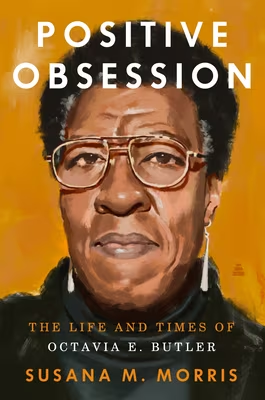
Science fiction writer Octavia E. Butler was truly an original in American letters. Her reputation as a highly creative scribe took time to construct because she didn’t fit the customary commercial type. In the recently published Positive Obsession: The Life and Times of Octavia E. Butler, her biographer Susana M. Morris describes the imaginative maverick’s struggles and challenges as she would become a visionary and pioneering author, accomplishing such standouts as Patternmaster (1976), Survivor (1978), Kindred (1979), Wild Seed (1980), Bloodchild (1984), Adulthood Rites (1988), Parable of the Sower (1993), and Parable of the Talents (1998). Butler, who described some of her works as “cautionary tales,” was the first Black woman to constantly put her stellar words on the bookshelves, and Morris avoids the usual chords of heroine worship, moving to put her considerable powers of analysis on the writer in this illuminating biography.
In Morris’s preview of what the book tells, she quotes revealing commentary from one of Butler’s classics, Parable of the Sower:
Prodigy is, at its essence, adaptability and persistent, positive obsession. Without persistence, what remains is an enthusiasm of the moment. Without adaptability, what remains may be channeled into destructive fanaticism. Without positive obsession, there is nothing at all.”
Minus determination and persistence, there was no Octavia E. Butler story. Born in 1947, Butler was ushered into this world in humble beginnings, to a domestic worker and a boot black. During her final year at Pasadena City College, she takes her first Black literature class, a heady exposure of the African American soul on the page and image, the various passions stacked against the drug store science fiction magazines that she’d been buying since fourteen. She became acquainted with the explorers of the genre in that “Golden Age” era: Robert Heinlein, John Brunner, Theodore Sturgeon, Frank Herbert, Marion Zimmer Bradley, and Ursula Le Guin. All these influences were absorbed into the aggressively creative imagination of Butler’s singular style.
In 1969, Butler met one of the genre’s outlaws, Harlan Ellison, who wrote outrageous novels and screenplays, at a screenwriting workshop, and later became her advocate. That next summer, her time at Clarion Science Fiction Writers’ Workshop strengthened her resolve. The early 1970s gave her a most productive apprenticeship in publishing, getting a manuscript of Patternmaster to Doubleday, a mainstream company. Following the 1976 publication of her debut work, she dazzled her readers with a future where telepathic skills are commonplace in that book, but her research on chattel slavery and time travel astonished them with her most notable novel, Kindred.
Butler was a private person, yet here Morris recounts many of the thoughts Butler had as she talked about the book’s origin.
“Kindred grew out of something I heard when I was in college, during the mid-1960s. I was a member of a black student union, along with this guy who had been interested in black history before it became fashionable. …His attitude about slavery was very much like the attitude I had when I was thirteen—that is, he felt that the older generation should have rebelled.”
Later, as she was doing research for the book, Butler noted:
“One of the things I realized when I was reading the slave narratives—I think I had gotten to one by a man who was explaining how he had been sold to a doctor who used him for medical experiments—was that I was not going to be able to come anywhere near as it was. I was going to have to do a somewhat cleaned-up version of slavery, or no one would be willing to read it.”
Morris, an award-winning associate professor of literature, media, and communication at the Georgia Institute of Technology, does a service to her subject by showing her financial challenges despite her growing success, the mental strain of racism and poverty, the heart-pain of isolation, and the weight of loneliness on daily life. Still, Butler crashed the ceiling by rearranging the racist and commercial boundaries of speculative fiction. She published stories, essays, and the acclaimed Xenogenesis trilogy. With her colleagues, she traveled to the Soviet Union, Finland, and Peru marveling at the sights. She also kept up with the politics of the day.
In 1995, Butler earned the esteemed MacArthur Foundation “Genius Grant” as the first writer in the speculative fiction genre for her body of work. The previous year saw her prophetic Parable of the Sower named by the New York Times as a Notable Book of the Year. She had been granted with nominations for the Locus, Nebula, and Sturgeon Awards. When her mother died, she hurled herself into writing Parable of the Talents, which was awarded with a Nebula for Best Novel. In 2005, she penned her final work, Fledgling. That next year, Butler died after a fall outside her Seattle home.
“I didn’t talk much about my doubts,” Butler wrote in 1989.
“I wasn’t fishing for hasty reassurances. But I did a lot of thinking—the same things over and over. Who was I anyway? Why should I pay attention to what I had to say? Did I have anything to say?”
Well, the Morris biography of the writer opens the unique intellectual and creative mind of a richly imaginative genius. Throughout its contents, its readers are influenced by her exceptional achievements to sit up and take notice. Octavia Estelle Butler was for real!