 Bookshop
Recently, I received a letter from lit legend Gayl Jones, saying that she wasn’t writing anymore. Discovered by iconic editor and author Toni Morrison, Jones’s legacy burned brightly from her debut novel, Corregidora (1975), followed by Eva’s Man (1976), and the short-story collection White Rat (1977). She then stepped out of the spotlight, joined the faculty of University of Michigan, became involved with an emotionally frustrated man, which led to her resignation in 1983 after her husband’s dust-up with Pride rally marchers. Life took a further twist when her mother died in 1987, followed by her husband allegedly sending threats to the University of Kentucky and police surrounded their home, causing him to kill himself. Thereafter, Jones vanished from public view, trying to recover after this truly harrowing experience.
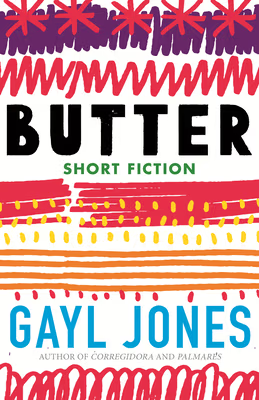
Jones’s many devout fans, however, have much to thank Beacon Press for, since they have continued to steadily publish series of her imaginative, skillful, and provocative offerings including The Healing (1998), Mosquito (1999), Palmares (2021), and The Birdcatcher (2022). Described as one of the finest literary writers of the last century, she was acclaimed recently as a finalist for both the Pulitzer Prize and the National Book Award. Jones’s most recent offering is a stunning collection of short fiction titled Butter: Novellas, Stories, and Fragments. This fascinating publication only assures her supremely acquired reputation as one of the talented storytellers. Butter, Jones’ second story collection, alters the critical views of her work as a practitioner of a muscular style not common to her female contemporaries. Continuing as an anti-traditionist with no major technical flaws, she often changes the moods and nuances in these tales, sparking a million new ideas with every sentence. Witness the mental mechanics of Odille, along with her musician and composer pal, Dante in the title story, “Butter.” Through her ongoing series of images, she is descriptive in picturing events and objects, tackling the art of getting the right exposure in photography, underwater camera work, Frederico Fellini and Sophia Loren and Italian movies, the poetry of Robert Creeley and Imamu Amiri Baraka, Mozart, and Vivaldi, and the Venus flytrap.
Very few authors embrace the alchemy of magic realism such as the Latin American word wizards like Marquez, Cortazar, Puig, or Amado, but Jones does this skillfully in her dream with playful African elephants at the end of “Butter.” On the other hand, she refuses to forego the human factor here, emphasizing the need to belong, with all the emotional elements such as sorrow, pathos, sadness, reverie, boredom, melancholy, and joy.
In the novella “Sophia,” Jones takes readers into different worlds with superb narration and rich detail, doing a deep dive into Mexican art with painters such as Siqueiros, Rivera, and Tamayo; the sometimes-no-win principles of rural politics; and the contrasting visual styles of posters of Zapata and Villa. There is a strong message of social awareness in the taut competition between the debaters and activists and the collective power of “angry men and women.” Often, Jones surprises her fans with a factoid like the Mexican ancestors from the Confederates settling in the country after the Civil War, blending into old Mexican clans.
As for the fragments and short stories, the writer makes voyeurs of all, leaving everything to her most observant gaze. The pen spotlights a man who craves notice or an anxious woman named after Butterfly McQueen in “Screen Test”; a college freshman meeting the mistress of a girlfriend’s older brother who was a former spy living in Paris during the Algerian War in “A Spy Story”; and a poor worker in Tijuana whose boss sleeps with all the pretty girls in “Worker.” One story, “The Female Angel,” is a well-traveled celestial being allegedly seen by master artist Romare Bearden around 1950. Pure Jones magic.
There is a point in depicting her range in this varied volume of fiction as Jones explores the limits of narrative technique. She uses a wide tapestry of many well-tuned voices in Butter venturing into wholly new modes of artistic expression. For Jones’s loyal fans, the writer means this collection to not only entertain but astonish and shock.