Benilde Little on her Novels and 1st Nonfiction Book, Welcome to My Breakdown
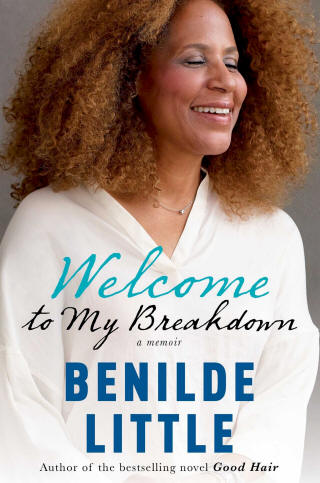
You are known for your novels, Good Hair, The Itch,
Who Does She Think She Is?,
Acting Out, why nonfiction, why now?
It wasn’t a conscious,
creative choice to write a non-fiction book. It was the place I was emotionally
in, where this was all I could write. The feeling of hopelessness, grief and
sadness was so all consuming that I had to get it out of me. I suppose I
could’ve approached those feelings in a fictional form, but that never even
occurred to me; wasn’t a thought. It was not the write format.
Toni Morrison has
said to write the book you want to read. I believe that, but I also know that
this was a book I had to write and I did write it for me.
Welcome
to My Breakdown, the title of your new book suggests a light tone, but the book
is anything but. You write that when your mother died you weren’t sure how you
would survive. Was it difficult for you to write about your depression?
Sometimes, but not as much as one might imagine; I wrote this book in
pieces, so sometimes when I was writing about it, I wasn’t consistently living
with it. When I’d research other writers talking about their depression, William
Styron and David Forster Wallace, in particular, but also
Terrie Williams, in
her book Black Pain
(in which she writes about her own depression and others’),
I felt less alone. Feeling less alone helped me to feel somewhat better. What
was hard was re-reading the descriptions of that time. There were times when I’d
scan it and other times when I’d cry.
Do you think that this book might encourage candid conversations in
all communities, but particularly the African American community about
depression?
That is my sincere hope. I think it will. It’s been
said that the book is honest and bare and I think that will give some people
permission to take a deep look at one’s self in an honest, and hopefully
compassionate, way.
Clara Little is the beating heart of this
book. What a remarkable woman your mother was, a loving, devoted mom, a wife, a
political activist, community organizer, a feminist before the word had
currency. What was it like to be the center of that much love and affection?
You don’t know what you don’t know. I thought all mothers were like her. It
wasn’t until I was in adolescence when I began spending lots of time at the
homes of friends where I got to see other moms, who were very different than
mine. I realized and appreciated her as an adult and especially when I became a
mother and I could finally realize what sacrifices she made and what a
difference in my life all that love and affection made. It’s why I could grow up
in Newark and have the life I have now. Her expectation of my brothers and me
was that we become productive, college educated citizens of the world. She’s why
we didn’t become teenage parents or get addicted to drugs or crime. And we
weren’t put in a bubble, either.
The
downside of all that intense love and affection is that I have a very high bar
for what I expect love to feel like. It’s another reason my grief was so
great—knowing that no one will ever love me like she did. It’s a somewhat
hybrid blessing.
Clearly you and your husband are more affluent than
you were growing up, you live in a wealthy suburb, and enjoy many material
possessions that were beyond your parents’ reach. There are hints here that you
are an old school, hands on mother like your mother was. Do you consider
yourself the same kind of mother as your mother? What’s the same, what’s
different? What’s your most important job as a mother in your view?
To me
the most important thing a mother can give her child is a solid sense of self.
I’m not sure it’s possible to do this completely but if you can instill in your
kids that they are good just the way they are, then they can do anything. They
can be fulfilled, they can be secure and can find their purpose. I don’t think
our parents were thinking much, if at all, about our psychological health. I
think my mother was ahead of her time and she was very intuitive, but I know she
wasn’t consciously thinking about it. She didn’t belittle us; she would never
slap us in the face because she believed that was demeaning (although she did
get that strap and put it on the butt). I’m similar in how I’ve raised my kids
in terms of being fiercely in their corner, advocating for them, loving them
fiercely, but no spanking. I believe that that diminishes them and it’s not
effective. I don’t want to rule from a place of fear. I think if they respect
you, they want to please you. This is not to say that they won’t mess up and
that they won’t do things that hurt and disappoint you, but ultimately
disappointing a good parent is not something a child will want to do. When I got
older, college age probably, it was hell to me to disappoint my mother. I see a
lot of that in my daughter. It’s there with my son, but buried, I think because
he’s a teenager. I believe in punishment for bad behavior. Like my mother, I
hate lying and go nuts when my kids have.
Readers will welcome your
candor about dating, marriage, family, and children. You are in a long marriage
with a child in college and another in middle school. Can you tell us succinctly
how the dream of having it all, like your character Alice in
Good Hair
reconciles with the reality of family, marriage, and children?
Well, what
I know for sure is that there is no such thing. There have been tradeoffs. I
began writing fiction shortly after we got married in anticipation of having
children and wanting to be home with them. I began a career I could have and
still be home with my kids. I quit my job at
Essence because, for me, it was too
demanding to do and be the kind of mother I wanted to be. I don’t know if I’d
make the same decision today, but that’s what I was thinking at the time.
There’s no easy, right answer. You give up your job, you give up part of an
income, which impacts your lifestyle, which can impact your relationship. I
don’t know if one ever truly reconciles. You might be able to “have it all,” but
not at the same time.
We lose our parent, that’s an inescapable truth.
Is there anything about the grieving process that you can share with others to
help them through grief?
Give yourself time. There’s no one-way to grieve
and there’s no time limit. There are those stages: shock, denial, anger,
bargaining, guilt, sadness, acceptance. Those things can show up in different
orders or you may not experience each one. For me, I felt like I didn’t have a
choice. It was a wave that simply knocked me down and I was in an undertow. The
best was to recover in an undertow is to give in to it. I gave over to it. Now,
I didn’t have a job in an office where a boss was expecting me to perform
everyday. For people who have to get back to work, I would still advise them to
give the grieving process as much time as you need. Do your work and go home and
give yourself permission to feel like crap, to cry, to rail, all of it.
In the end, would you say that there was anything beneficial or redeeming
about your depression?
It made me more compassionate, less arrogant, but
also less tolerant of people who sit on the sidelines of their feelings. It
helped me get clear about who I wanted in my life. I got in touch with my need
for gentleness, gentle people who are also willing to be vulnerable and real.
I’m no longer close to people who are disconnected from their feelings, because
they can’t truly be aware of others.
What’s the takeaway? What do you
want people to get, to do?
To take off the mask. I look forward to having
honest conversations about some of the topics in the book, grief,
motherhood—staying home/having a career, depression, mid-life, perfection
pressure. So much of what we do in this culture is to soothe our wounds: we buy
too much, eat too much, and drink too much. Don’t get me wrong, doing the work,
looking at one’s self and examining all those warts is not easy. But I believe,
in the long run, it’s the only option.
The epigram I used in Good Hair says this beautifully:
“If you bring forth what is within you, what you bring forth will save you. If you do not bring forth what is within you, what you bring forth will destroy you.”—Jesus. The Gospel of Thomas
Reader Comments (0)
Log In to Join the Conversation
Commenting is reserved for registered AALBC members to maintain high-quality discussions.
No comments yet. Be the first to share your thoughts!
Advertisement