Clarence Page - The “Culture Worrier” Interview

Clarence Page is a nationally-syndicated columnist and member of the Chicago
Tribune editorial board. Besides those duties, the Pulitzer Prize-winner makes
frequent TV appearances, including on The McLaughlin Group as a regular member
of the show’s panel of political pundits.
Clarence makes his home in the
Washington, DC area with his wife, Lisa, and their son, Grady. Here, he talks
about his life, career and his best-selling collection of essay,
Culture Worrier: Selected Columns 1984–2014: Reflections on Race, Politics and Social Change.
Kam Williams: Hi Clarence, how’re you doing?
Clarence Page:
I’m
good. How are you today, Kam?
KW: Great! First, I wanted to ask, how
much of a connection do you still have to Chicago? You write for the
Tribune, but live in DC.
CP: That’s right. I work out of our
Washington bureau. My column is syndicated nationally, anyway. I have more
of a Washington perspective than the other Tribune columnists, but I still
love the place and try to get back as often as I can. And I occasionally do
a locally-oriented blog item which is only printed in the Tribune.
KW: I think of you as the black Mike Royko. How would describe your style?
CP: I think every Chicago columnist considers himself to be a Mike
Royko. [Chuckles] His office was next-door to mine at the Tribune Tower for
a number of years. I always admired his strong voice. a very ordinary
Chicagoan sitting at the bar after work going back-and-forth with his
buddies about politics and this or that from a working-class point-of-view.
I really appreciated his ability to do that so flawlessly, and in such a
strong voice. So, I always tried to cultivate a voice assessing what was
good for the average members of the public, and sometimes I succeeded.
[Chuckles]
KW: You always do a great job. Tell me a little about why
you decided to publish a collection of essays?
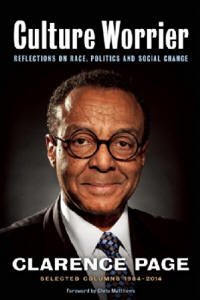 CP: It occurred to me
that after doing this for 30 years, from the Reagan Era to the Age of Obama,
that if there was ever an appropriate time for me to publish a collection of
columns, this would be it. So, I went back and reread my pieces, and I began
to notice the strong trend toward social commentary interwoven with politics
played in most of them, and the phrase "Culture Worrier" just jumped out at
me.
CP: It occurred to me
that after doing this for 30 years, from the Reagan Era to the Age of Obama,
that if there was ever an appropriate time for me to publish a collection of
columns, this would be it. So, I went back and reread my pieces, and I began
to notice the strong trend toward social commentary interwoven with politics
played in most of them, and the phrase "Culture Worrier" just jumped out at
me.
KW: How do you enjoy appearing on the McLaughlin Group with
John, Eleanor Clift, Mort Zuckerman and Pat Buchanan?
CP: I’ve been
doing the show since about 1988. McLaughlin’s been a remarkable talent scout
over the years when you think about how people like Chris Matthews, Lawrence
O’Donnell and Jay Carney used to be regulars on the show.
KW: What was the most interesting and the most challenging aspects of
being an army journalist back in 1969?
CP: Oh, that’s an interesting
question! I will say that the difference was that when you’re an Army
journalist, as opposed to a civilian correspondent covering the military,
you’re very often either a public relations agent or expected to perform
that role, with a few exceptions, such as reporters for Stars and Stripes. I
would say that one of the most unexpected benefits of that job was being
taught to never try to cover anything up, but rather to get any bad
information out right away, so that there would be nothing more to come out
later. This was a wonderful lesson to be taught because often the effort to
cover up a story becomes a bigger story than the original one.
KW:
You suffered from ADD, but it obviously didn’t prevent you from having a
very successful career as a journalist. How did you overcome this difficulty
or turn it into a strength?
CP: I didn’t know I had ADD, because it
hadn’t been invented back then. For what it’s worth, like a lot of others
with ADD, I’ve been able to succeed simply by trying harder.
KW:
When I watched Life Itself, the documentary about Roger Ebert, I learned
that winning a Pulitzer Prize was a very big deal to him. What did winning a
Pulitzer mean to you?
CP: One thing about winning a Pulitzer, it
means you know what the first three words of your obituary will be: Pulitzer
Prize-winner. [Chuckles] After winning the Pulitzer, I couldn’t help but
notice how people suddenly looked at me with a newfound respect, and would
say, "He’s an expert." On the negative side, I developed a terrible case of
writer’s block for awhile, because I felt like readers would expect every
one of my columns to be prize worthy. I spoke to a number of other Pulitzer
winners who had the same problem, a creative block that had them hesitating.
How do you get past the writer’s block? Nothing concentrates the mind like a
firm deadline, and a little voice in the back of my mind reminding me that,
"If you don’t write, you don’t eat." Listen, we all want to be respected and
appreciated, but when you get a big honor like that, people start to look
for your work in a new way with higher expectations. Today, the best thing
about having won is when I get a nasty comment from some internet troll I
can remind myself of the Pulitzer and say, "Well, somebody appreciates me."
KW: Dave Roth says: As far as I can tell, despite many people’s well
intentioned efforts over the last 50 years, America still appears to be a
racially-divided and culturally-segregated country, as evidenced by, among
many other examples, Ferguson, Missouri, any examination of failing public
schools and/or prison populations, and the current gerrymandering case being
heard by the Supreme Court. What, in your view, is substantially culturally
different in the U.S. today versus say March 3, 1991, Rodney King Day? And
what do you believe is the single greatest piece of evidence that progress
is being made toward a society that provides equality of opportunity and
treatment under the law, regardless of race, ethnicity or gender?
CP:
Good question. First of all, I would say that our cultural divides are less
racial and more tribal. We’re trying to reduce racial barriers to
opportunity while at the same time not creating artificial quotas in regards
to race. Today’s tribal politics is more attitudes and values-based than
back in the olden days when it was something we strictly associated with
ethnicity.
KW: What do you see as the
most critical domestic concern that needs to be addressed by our national
government?
CP: I would say environmental protection is our most
important long-range issue. In the shorter term, as well as the longer term,
I’ve always said our biggest challenge is in education, which has become
even more challenging because of income inequality and wage stagnation. We
haven’t confronted the fact that people who get their income from capital
investments have benefited while ordinary workers who rely on salary have
not. So, the income gap is getting worse. But Washington is in gridlock,
politically, and I’m pessimistic about our making any major improvements
over the next couple years.
KW: When you
think about your legacy how would you like to be remembered?
CP:
What a wonderful question! When I posed that question to retiring Supreme
Court Justice Thurgood Marshall, he looked up as if he were surprised, but
he quickly responded, "That he did the best he could with what he had." It
was remarkably humble, but to the point. That’s how I’d like to be
remembered, too.
KW: Is there any question no one ever asks you,
that you wish someone would?
CP: [LOL] That’s good one, too! What
would I have done, if I had not become a political writer? I wanted to
become an entertainment writer. I’ve always been fascinated by showbiz as
much as I was by politics.
KW: What is your favorite dish to cook?
CP: Pasta and salmon.
KW: The
Troy Johnson [this websites’s
founder] question:
What was the last book you read?
CP:
Americanah by Chimamanda Ngozi
Adichie. She’s dynamite!
KW: When you look in the mirror, what do you see?
CP: I see a guy
getting older. [Laughs] But I always try to keep my mind open or I’d never
have figured out Twitter and Instagram.
KW: What is your earliest childhood memory?
CP: I remember being told by
my parents when I was 4 that I couldn’t go to an amusement park advertised
on TV because colored kids weren’t allowed there. That was a bit of a shock
and really stayed with me over the years. That was how I first learned about
racial segregation. Fortunately, I took it as a challenge, early on, and it
motivated me. You never know how a child might respond to discrimination. It
goes both ways. Some kids become embittered.
KW: Thanks again for
the time, Clarence, I really enjoyed our chat.
CP: Same here.
Thanks, Kam
Reader Comments (0)
Log In to Join the Conversation
Commenting is reserved for registered AALBC members to maintain high-quality discussions.
No comments yet. Be the first to share your thoughts!
Advertisement