
Freakonomics
Controversial Economics Best Seller Adapted to Screen
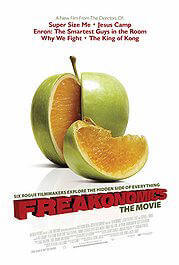 Freakonomics
[2010]
Freakonomics
[2010]
Rated PG-13 for violence, sexuality, nudity, drug use and brief profanity.
In English and Japanese with subtitles.
Running time: 93 Minutes
Distributor: Magnolia Pictures
Film Review by Kam Williams
Very Good (3 stars)
Freakonomics was a best-selling primer on Economics written by University of
Chicago professor Steven Levitt in collaboration with journalist Stephen
Dubner. Together, the talented twosome endeavored to make an inscrutable
subject accessible for the average individual by breaking ghetto
demographics and financial transactions down into layman’s terms even a
street hustler could comprehend.
For instance, they exploded the myth of selling drugs as a viable means of
making it out of the ghetto by showing that the average dealer’s income is
less than minimum wage. A more controversial conclusion arrived at by the
authors and propagated by controversial pundits like conservative Bill
Bennett was the notion that the U.S. crime rate could be significantly
reduced by sterilizing all African-American females.
Now, a film based on this incendiary tome has been brought to the screen by
a half-dozen different directors, including Academy Award-winner Alex Gibney
(for Taxi to the Dark Side), Oscar-nominees Morgan Spurlock (for Super Size
Me), Rachel Grady (for Jesus Camp) and Heidi Ewing (also for Jesus Camp),
along with Seth Gordon and Eugene Jarecki. They divvied up the chapters and
structured the picture as a discrete series of vignettes recreating the
assorted content.
 Freakonomics: A Rogue Economist Explores the Hidden Side of Everything Click to order via Amazon by Steven D. Levitt & Stephen J. Dubner
|
Among the topics addressed are the aforementioned correlation between black criminality and the abortion rate, as well as such intriguing questions as whether 9th graders can be bribed to get good grades, whether Japanese Sumo wrestling is fixed, whether government incentives work, and how Bernie Madoff, pedophile priests and other disgraced "pillars of the community" managed to mask their crimes for so long.
An iconoclastic expose’ featuring fresh cultural slants apt to leave the average armchair economist reevaluating a lot of conventional wisdom they’vetaken for granted.